
Supreme Court Highlights
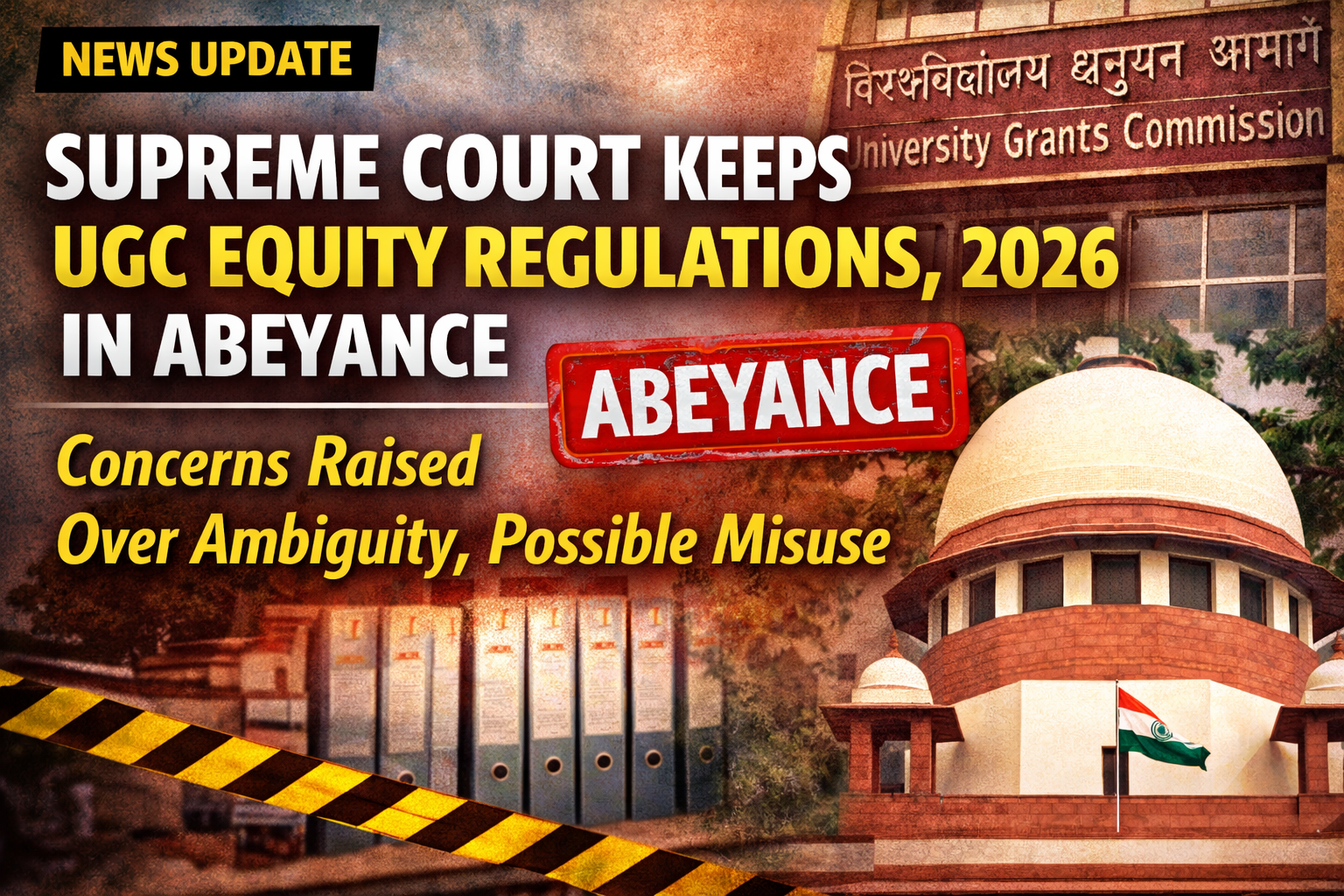
Supreme Court Keeps UGC Equity Regulations, 2026 in Abeyance; Raises Concerns Over Ambiguity and Possible Misuse
Supreme Court Keeps UGC Equity Regulations, 2026 in Abeyance; Raises Concerns Over Ambiguity and Possible Misuse

New Delhi | February 1, 2026
The Supreme Court on Tuesday issued notice in a batch of writ petitions challenging the University Grants Commission (Promotion of Equity in Higher Education Institutions) Regulations, 2026, and ordered that the impugned regulations be kept in abeyance until further orders.
A Bench of the Supreme Court, after hearing the petitioners, the Union of India, and intervenors, observed prima facie ambiguities in certain provisions of the 2026 Regulations and noted that the possibility of their misuse cannot be ruled out.
Solicitor General Accepts Notice
On the Court’s query, Solicitor General of India Tushar Mehta accepted notice on behalf of Respondent Nos. 1 and 2. The Court also heard Senior Advocate Ms. Indira Jaisingh, appearing in the matter.
The petitions primarily challenge the definition of “caste-based discrimination” under Clause 3(c) of the 2026 Regulations.
Challenge to Definition of Caste-Based Discrimination
The petitioners contended that Clause 3(c) is restrictive and exclusionary, rendering individuals belonging to non-reserved or general categories remediless, even if they are subjected to caste-based discrimination or institutional bias within higher education institutions.
It was argued that the Regulations proceed on an unfounded presumption that caste-based discrimination is necessarily unidirectional and cannot operate against persons from non-reserved categories.
Key Constitutional Questions Framed
The Supreme Court framed several substantial questions of law requiring detailed examination, including:
-
Whether Clause 3(c) bears a reasonable nexus with the object of the Regulations, especially when no separate procedural mechanism has been prescribed for addressing caste-based discrimination, unlike the broader definition of “discrimination” under Clause 3(e).
-
Whether the operationalisation of caste-based discrimination under the Regulations affects the constitutional and statutory sub-classification of Most Backward Castes within SC, ST, and OBC categories, and whether the framework provides adequate safeguards for Extremely Backward Castes facing structural disadvantage.
-
Whether the inclusion of the term “segregation” under Clause 7(d)—relating to allocation of hostels, classrooms, mentorship groups or similar arrangements—could result in a “separate but equal” classification, infringing Articles 14, 15, and the constitutional value of fraternity.
-
Whether the omission of “ragging” as a specific form of discrimination, despite its presence in the 2012 Regulations, amounts to a regressive legislative omission, leading to unequal access to justice and violation of Articles 14 and 21.
2019 Petition to Be Heard Together
The Court noted that the issues raised in Writ Petition (Civil) No. 1149 of 2019 which was filed by the mother of Dr. Payal Tadavi and Rohit Vemula, also bear upon the constitutional validity of the 2026 Regulations. Accordingly, all matters were directed to be heard together and listed before a three-Judge Bench.
2012 Regulations to Continue
Invoking its powers under Article 142 of the Constitution, the Supreme Court directed that the UGC (Promotion of Equity in Higher Education Institutions) Regulations, 2012 shall continue to operate and remain in force until further orders.
The matter has been listed again on 19 March 2026.



Constitution
Supreme Court Reserves Judgement on Review Petitions Clubbed with Bhumika Trust’s Writ Petition Challenging the Mandatory Three-Year Practice Rule for Entry-Level Judicial Officers
A bench of Supreme Court comprising Chief Justice of India Surya Kant, Justice August George Masih and Justice K. Vinod Chandran has reserved judgment after hearing a batch of review petitions clubbed with the writ petition filed by Bhumika Trust, which seeks relaxation of the mandatory three-year practice requirement for persons with disabilities.
The writ Petition filed on 14-11-2025 by Bhumika Trust, prayed for following reliefs as mentioned hereinbelow-
“a. Issue an appropriate writ order or direction in nature of Mandamus or any other appropriate writ, thereby declaring order, and declaring the application of the mandatory three-year practice requirement for appointment to the post of Civil Judge (Junior Division), as upheld in the judgment dated 20.05.2025 in All India Judges Association v. Union of India, All India Judges Association & Ors. v. Union of India & Ors., (2025) INSC 735, W.P. (C) No. 1022 of 1989 to be unconstitutional and violative of Articles 14, 16, and 21 of the Constitution of India, insofar as it applies to persons with benchmark disabilities.
b. Issue an appropriate writ order or direction in nature of Mandamus or any other appropriate writ , thereby direct the respondents to frame a comprehensive policy on reasonable accommodation for persons with benchmark disabilities in judicial service recruitment, in compliance with Sections 3, 20, 32, 33, and 34 of the Rights of Persons with Disabilities Act, 2016, including but not limited to:
i. Provide exemption from or alternate requirements in place of the mandatory three-year practice rule to avoid indirect discrimination against persons with disabilities, ensuring fair access to judicial recruitment.
ii. Conduct all judicial service examinations and interviews in accessible formats, including screen reader compatibility for visually impaired candidates, provision of sign language interpreters for the hearing impaired, scribes for those with writing difficulties, and any other necessary accommodations to enable full participation.
iii. Judicial academies must develop and implement training materials and methods tailored to the specific accessibility needs of persons with benchmark disabilities, such as accessible digital content and inclusive teaching practices.
iv. Ensure provision of necessary assistive technologies (e.g., screen readers, hearing aids), accessible physical infrastructure (ramps, elevators, accessible toilets), and reasonable support services during judicial training and throughout the tenure of service.
v. Provide continuous reasonable support, such as interpreters, scribes, and personal assistance during both training and judicial service to enable effective and dignified participation These measures are essential to eliminate systemic exclusion and to uphold the constitutional rights to equality, non-discrimination, and dignity under Articles 14, 16, and 21 of the Constitution of India, ensuring the judicial service recruitment process is inclusive, accessible, and equitable for persons with benchmark disabilities.
c. Issue an appropriate writ order or direction in nature of Mandamus or any other appropriate writ, thereby direct the appropriate respondents to identify job positions vacant and all backlogs in various departments in Indian judiciary that can be suitably held by persons with benchmark disabilities for the purpose of filling reserved vacancies as mandated under Section 33 of the Rights of Persons with Disabilities Act, 2016. This includes constituting an expert committee, which must include representation from persons with benchmark disabilities, to assist in identifying these suitable posts. Further, the Government should undertake a periodic review of the identified posts at intervals not exceeding three years to ensure that these positions remain appropriate, accessible, and equitable for persons with disabilities, thereby promoting inclusive and fair employment opportunities in public services.
d. Issue an appropriate writ order or direction in nature of Mandamus or any other appropriate writ, thereby declare that the failure to provide reasonable accommodation in judicial appointments amounts to systemic exclusion of persons with disabilities and violates their constitutionally protected rights to equality, non-discrimination, and dignity under Articles 14, 16, and 21 of the Constitution of India.”
The review petitions challenged the Supreme Court’s judgment dated 20-05-2025, whereby the Court mandated a minimum of three years’ legal practice as pre-requisite eligibility condition for candidates seeking direct recruitment to the post of Civil Judge (Junior Division) after obtaining a law degree.
Among the review petitions, one was filed on 16-06-2025 by Chandrasen Yadav, through Advocate-on-Record Kunal Yadav. In addition to seeking a review of the judgment dated 20 May 2025, the petitioner also proposed an alternative remedy in the form of a “cooling-off period.” It was contended that such a transitional arrangement would mitigate the immediate hardship caused by the newly introduced eligibility criterion.
The bench of Hon’ble Supreme Court comprising Chief Justice of India Surya Kant, Justice August George Masih and Justice K. Vinod Chandran in above Review Petition having diary number 33086 of 2025 [Review Petition number 420/2026] with another Review petition Diary number 30163 of 2025 [Review Petition number 421/2026] after perusing the record available in these review petitions allowed the Application for permission to file Review Petitions and listed the review petitions in the open court and allowed oral hearing.
On 28-07-2026 the Bench heard extensive submissions from various counsels, intervenors, and the Amicus Curiae before reserving the judgment.
Before Starting the deliberations on the issue counsel of Maharashtra Public Service Commission put up the point that they have already notified 286 posts for the civil judge junior division and they are facing hardship in starting the selection process because of the interim order which had stalled the selection process nationwide.
Mr. Jayant Singh Raghav appearing in person on behalf of Bhumika trust, Writ Petition contended that he has compiled some suggestions in the form of written submissions and presented before the court.
The review petitioner Chandrasen Yadav was represented by Sr. Advocate Pinky Anand in the Review Petition number 420/2026. During Arguments she not only highlighted the grounds why the judgement dated 20-05-2025 must be reviewed but also suggested few recommendations
Grounds taken by Sr. Advocate Pinky Anand on behalf of review petitioner Chandrasen yadav is mentioned hereinbelow –
- Absence of Empirical Data: No empirical or statistical evidence has been provided to justify the claim that fresh law graduates perform inadequately as judges, making the basis of the restriction speculative and arbitrary.
- Financial and Institutional Barriers: The judgment fails to account for the lack of financial and institutional support available to first-generation lawyers and students from economically weaker sections, who cannot afford to spend three unpaid years in litigation practice before becoming eligible.
- Lack of Structured Mentorship: No mechanism has been proposed for how fresh law graduates will secure practical training or mentorship during the mandated three-year practice period.
- Impugned judgment does not provide a transition clause and affects students retrospectively even those who were previously eligible.
- Disproportionate Impact on Women candidates and Marginalized Groups: The rule disproportionately affects Women candidates and students from socially and educationally disadvantaged backgrounds, including SC, ST, OBC, and EWS categories and, many of whom aspire to judiciary as a means of social mobility and justice.
- Disregard for Institutional Training: The judgment fails to appreciate the structured and institutional training imparted during LL.B. courses and the mandatory training provided post-selection by State Judicial Academies.
- Neglect of Shetty Commission Report: The decision erroneously ignores the findings and recommendations of the Shetty Commission, particularly paragraphs 8.31, 8.34, and 8.35, which emphasize the sufficiency of post-selection training over prior practice.
- Violation of Fundamental Rights: The judgment infringes upon the fundamental rights guaranteed under Articles 14 (equality before the law), 16 (equal opportunity in public employment), and 19(1)(g) (freedom to practice any profession), especially for law graduates who had fulfilled the eligibility criteria prevailing at the time of their education.
- Suggestions provided by Sr. Advocate Pinky Anand on behalf of review petitioner Chandrasen yadav is mentioned hereinbelow –
- Replace the mandatory pre-recruitment three-year practice requirement with structured post-selection training.
Instead of insisting on three years of Bar practice before recruitment, selected candidates should receive supervised practical training during their induction period.
- Introduce a judicial apprenticeship model.
Newly selected Civil Judges should be attached to District Judges as apprentices, law clerks, or judges-in-training to gain practical exposure to judicial administration, legal reasoning, ethics, and courtroom management.
- Provide structured exposure in advocates’ chambers.
During training, judicial recruits may be attached to designated Senior Advocates, Government Pleaders, Advocate Generals, Standing Counsel, or Legal Aid Defence Counsel under NALSA’s LADC Scheme to obtain meaningful litigation experience.
- Adopt international best practices.
Consider a model similar to Germany, where judicial aspirants undergo a structured preparatory training programme across courts, prosecution offices, administrative authorities, and law offices instead of relying solely on independent Bar practice.
- Create a uniform national induction curriculum.
Standardize judicial training across all State Judicial Academies through the National Judicial Academy or a permanent committee headed by the Chief Justice of India to ensure consistent quality and practical orientation.
- Strengthen practical legal education during law school.
Introduce optional structured six-month practice modules and specialized judicial-track courses within LL.B. programmes to equip aspiring judges with practical skills before recruitment.
- Promote continuous judicial education.
Encourage lifelong professional development through scholarships for higher legal studies, exchange programmes, deputations, and periodic training linked to career advancement and elevation.
- Grant a transitional (“cooling-off”) period.
Instead of immediate implementation of the three-year practice requirement, provide a transitional window for candidates who had legitimately prepared under the previous eligibility criteria so that they are not rendered ineligible overnight.
Senior Advocate Colin Gonsalves, appearing for review petitioner Jaideep Subudhi, urged the Supreme Court to adopt experiential learning models in place of a rigid pre-recruitment litigation requirement. He advocated for structured legal aid work, judicial clerkships, internships, and continuous judicial training as more effective alternatives to the mandatory three-year Bar practice requirement.
Drawing the Court’s attention to the views of National Law Universities (NLUs) and other premier law institutions, Gonsalves submitted that they had overwhelmingly opposed the three-year litigation mandate. He argued that such a requirement would discourage meritorious law graduates from joining the judicial service, pointing out that only around 20% of graduates from the National Law School of India University (NLSIU) pursue active litigation. He further submitted that the requirement could aggravate the existing shortage of judicial officers by making entry into the subordinate judiciary less attractive.
Questioning the procedural correctness of the judgment dated 20 May 2025, Gonsalves argued that a three-Judge Bench could not have effectively overruled an earlier decision of a coordinate three-Judge Bench without referring the issue to a larger Bench.
Addressing the Court, he submitted:
“The suggestion made here is experiential learning… judges who are taken from day one through legal aid, clerkship, and internship-based models, continuous evaluation, accountable mechanisms, and holistic, evolving judicial training. The NLUs and leading law colleges have emphatically opposed the three-year rule… Only 20% of NLSIU graduates are entering law practice.”
Special provisions were also proposed for persons with disabilities, including limiting the mandatory practice requirement to one year—preferably after selection—and recognising judicial clerkships and research assignments as equivalent forms of practical legal experience until accessible judicial infrastructure is fully developed.
Appearing as Amicus Curiae, Senior Advocate Siddharth Bhatnagar also favoured a staggered implementation if the Court ultimately retained the three-year eligibility criterion. He suggested permitting fresh law graduates to participate in the 2026 judicial service examinations while progressively increasing the practice requirement—from zero years in 2026, one year in 2027, two years in 2028, and three years from 2029 onwards.
Referring to applications seeking relaxation of the upper age limit due to delayed recruitment cycles, Chief Justice Surya Kant observed that age-related relief may require consideration before the Court reserved judgment. Bhatnagar further suggested that concessions such as lower qualifying marks could be considered for women and persons with disabilities and recommended that judicial clerkships be recognised towards the prescribed legal practice requirement.
Case Title:
Writ Petition –
All India Judges Association v. Union of India (W.P. (C) No. 1110/2025)
&
Review Petition –
Chandrasen Yadav Vs. Union Of India & Ors. [ RP(C) 420/2026]
Falguni Mittal Vs. Union of India & Ors. Jaideep Subudhi Vs.Union Of India & Ors etc.
Corporate Desk
Supreme Court Flags Alleged Sham Rs. 85 Crore Claim in AVJ Developers Insolvency Case, Seeks Nationwide Data on NCLT Delays

Lentis Legalis | 16 April 2026
Reviewed by Adv. Chandrasen Yadav
New Delhi, April 29: In a significant hearing concerning the insolvency resolution of AVJ Developers (India) Private Limited, the Supreme Court of India on 16-04-2026 raised serious concerns over an alleged Rs. 85 crore financial claim described before it as “sham and bogus,” while also taking note of increasing delays in approval of resolution plans by insolvency tribunals across the country.
The matter came up in two connected appeals one filed by the AVJ Heightss Apartment Owners Association and another by a suspended director of the corporate debtor. Both appeals challenge a common judgment of the National Company Law Appellate Tribunal (NCLAT), which had upheld the admission of the claim of India Infoline Finance Limited (IIFL).
Disputed Rs. 85 Crore Claim Under Scrutiny
The Bench noted that the Resolution Professional had earlier rejected IIFL’s claim on January 24, 2020, citing inability to verify the claim from the company’s records. However, the National Company Law Tribunal (NCLT) later allowed the claim, and the NCLAT affirmed that decision.
During the hearing, counsel for the appellants argued that the entire claim was fraudulent. The Court was also informed of an arbitral award dated July 3, 2024, containing serious findings concerning the alleged loan transaction of Rs. 85 crores.
According to portions of the award referred to in court, the claimed loan amount was allegedly routed through multiple accounts instead of the sanctioned account, while certain documents relied upon to support the transaction were said to be tainted or inconsistent.
The arbitral tribunal reportedly questioned whether documents were backdated and whether signatures were genuine. It also made observations suggesting attempts to evergreen earlier loan accounts and avoid regulatory classification norms.
Court Concerned Over Delay in Resolution Plan Approval
Apart from the disputed financial claim, the Supreme Court expressed strong concern that the Committee of Creditors (CoC) had approved a resolution plan on July 4, 2024, and an application for approval was filed before the NCLT on July 12, 2024, yet no final adjudication has taken place even after a prolonged period.
Calling the situation “very unfortunate,” the Court observed that many such approval applications are reportedly pending before the NCLT Principal Bench, New Delhi, and other benches for years.
Directions to NCLT and IBBI
The Court directed the Registrar of the NCLT Principal Bench, New Delhi, to furnish details on:
- Number of pending resolution plan approval applications
- Duration of pendency
- Reasons for non-disposal
The Insolvency and Bankruptcy Board of India (IBBI) was also impleaded as a party respondent and directed to place necessary figures and statistics across the country, within two weeks.
Senior Advocates Appointed as Amicus
The Court requested Gopal Jain and Navin Pahwa, senior advocates, to assist the Court as amici curiae.
Case Title: AVJ HEIGHTSS APARTMENT OWNERS ASSOCIATION VS. IIFL FINANCE LIMITED & OTHERS
Read Full Judgement – Click Heare
Author
Adv. Chandrasen Yadav
B.Sc., LL.B. & LL.M.
Landmark judgements
Bonafide Need Must Be Judged on the date when the suit for eviction was filed: Supreme Court Sets Aside High Court Order in Eviction Case.
Lentis Legalis | 19 April 2026
Reviewed by Adv. Chandrasen Yadav
By allowing a civil appeal, The Hon’ble Supreme Court in a rent disputes and eviction matter reiterated the legal principle quoting Maganlal son of Kishanlal Godha Vs. Nanasaheb son of Udhaorao Gadewar, that while dealing with a landlord-tenant dispute, it was held that the adjudication of bonafide need should be done as on the date when the suit for eviction was filed, unless some subsequent event materially changes the ground of relief. It was further held that subsequent events may be considered to have overshadowed the genuineness of the landlord’s requirement only if they are of such nature and dimension as to make it lose its significance altogether.
Facts of the case: On 5th December, 1994, suit for eviction came to be filed under Section 28 of the Bombay Rents, Hotel and Lodging House Rates Control Act, 1947 by the legal heirs of Mr. Martins. The eviction of the sub-tenant was sought on the ground of bonafide need of the family of the principal tenant. It was specifically pleaded that the plaintiffs required the suit premises for their bonafide need so as to occupy the same.
Before the Trial Court, the parties led evidence. By judgment dated 18th July 2001, the learned Judge of the Trial Court recorded a finding that the plaintiffs had proved their bonafide need in respect of Room No.59 that was occupied by the defendants as the said premises was required for privacy of the widow of Mr. Martins, who was an old lady having 87 years of age and there were six daughters who used to visit her place. It was further held that greater hardship would be caused to the plaintiffs if the decree for eviction was not passed. The suit was, accordingly, decreed.
The defendants being aggrieved by the decree of eviction challenged the same by filing an appeal. The Appellate Court reversed the said decree on the reasoning that the plaintiff No.1, who was the widow of Mr. Martins had expired and, therefore, the bonafide need of the plaintiffs did not survive. Accordingly, the decree for eviction was set aside and the suit for eviction was dismissed.
The original plaintiffs being aggrieved by the reversal of the decree for eviction approached the High Court under Article 227 of the Constitution of India and challenged the aforesaid judgment. During pendency of the petition, the original defendants placed on record an affidavit in reply dated 12th April 2023, wherein it was stated that Room No.63 that was in occupation of the original plaintiffs was not being utilised by them and that the said room was occupied by some other persons. When the petition was taken up for hearing, it was noticed that the original plaintiffs had not filed any rejoinder to the defendants’ affidavit. The High Court, thus, held that the plaintiffs had let out Room No.63 despite the same being available to them which indicated that they did not bonafide require the suit premises. Accordingly, the petition was dismissed. Being aggrieved, one of the original plaintiffs has filed the present appeal before the Hon’ble Supreme Court.
Observations and Findings: Hon’ble Supreme Court after hearing the learned counsel for the parties and perusing the documentary material on record, opined that the writ petition did not warrant dismissal solely on the ground that the original plaintiffs failed to file any rejoinder to the defendants’ affidavit in reply dated 12th April 2023 and concluded on the point that all relevant material that was brought on record by both the parties ought to have been examined while deciding the writ petition. The affidavit in reply dated 12th April 2023 could have been considered as additional material in opposing the claim for eviction on the ground of bonafide need. Dismissal of the writ petition solely on the ground of NON-TRAVERSE has, in our view, vitiated the impugned judgment.
Supreme Court further observed that the High Court failed to consider whether the subsequent event as urged by the defendants had material bearing on the right claimed by the plaintiffs. It has to be borne in mind that the Trial Court had passed a decree for eviction on the basis of the evidence on record which was reversed by the Appellate Court. It was, therefore, necessary for the High Court to have taken into consideration the entire material available on record including the affidavit dated 12th April 2023. Thus, by failing to do so, the High Court failed to exercise jurisdiction vested in it while deciding the challenge to the reversal of the decree for eviction.
Accordingly, the order dated 4th February 2025 passed in Writ Petition No.1458 of 2003 was set aside. The proceedings in R.A.E. Suit No.70 of 1995 are remanded to the Small Causes Court, Mumbai for being decided afresh in accordance with law. The parties were given liberty to amend their pleadings and thereafter lead further evidence in accordance with law.
HON’BLE MR. JUSTICE J.K. MAHESHWARI and HON’BLE MR. JUSTICE ATUL S. CHANDURKAR
Read Full Judgement: Click Here
Author
Adv. Chandrasen Yadav
B.Sc., LL.B. & LL.M.

Supreme Court Reserves Judgement on Review Petitions Clubbed with Bhumika Trust’s Writ Petition Challenging the Mandatory Three-Year Practice Rule for Entry-Level Judicial Officers

Uttar Pradesh Information Commission Imposes Maximum Statutory Penalty Rs. 25,000/- and warned for further departmental action on Gram Panchayat Officer of Ayodhya district for not providing information under RTI Act 2005.

Right to Information Act, 2005: A Comprehensive Legal Insight into the Citizen’s Right to Information
Section 107 of the Bharatiya Nyaya Sanhita, 2023: Abetment of suicide of child or person of unsound mind.

Supreme Court to Hear Review Petition on 10 February 2026 Challenging Mandatory Three-Year Practice Requirement for Entry-Level Judicial Services

Major Relief for Law Students as Supreme Court Opens Review on Mandatory 3-Year Practice Rule

-
Bharatiya Nyaya Sanhita (BNS)7 months ago
Section 107 of the Bharatiya Nyaya Sanhita, 2023: Abetment of suicide of child or person of unsound mind.
-
 Supreme Court Highlights9 months ago
Supreme Court to Hear Review Petition on 10 February 2026 Challenging Mandatory Three-Year Practice Requirement for Entry-Level Judicial Services
-
 Landmark judgements8 months ago
Major Relief for Law Students as Supreme Court Opens Review on Mandatory 3-Year Practice Rule
-
Bharatiya Nyaya Sanhita (BNS)7 months ago
Section 125 of the Bharatiya Nyaya Sanhita, 2023: Act endangering life or personal safety of others.
-
Bharatiya Nyaya Sanhita (BNS)7 months ago
Section 111 of the Bharatiya Nyaya Sanhita, 2023: Organised crime.
-
Bharatiya Nyaya Sanhita (BNS)7 months ago
Section 109 of the Bharatiya Nyaya Sanhita, 2023: Attempt to murder.
-
Bharatiya Nyaya Sanhita (BNS)7 months ago
Section 120 of the Bharatiya Nyaya Sanhita, 2023: Voluntarily causing hurt or grievous hurt to extort confession, or to compel restoration of property.
-
Bharatiya Nyaya Sanhita (BNS)7 months ago
Section 34 of the Bharatiya Nyaya Sanhita, 2023: Things done in private defence.