
Landmark judgements
Bonafide Need Must Be Judged on the date when the suit for eviction was filed: Supreme Court Sets Aside High Court Order in Eviction Case.


Lentis Legalis | 19 April 2026
Reviewed by Adv. Chandrasen Yadav
By allowing a civil appeal, The Hon’ble Supreme Court in a rent disputes and eviction matter reiterated the legal principle quoting Maganlal son of Kishanlal Godha Vs. Nanasaheb son of Udhaorao Gadewar, that while dealing with a landlord-tenant dispute, it was held that the adjudication of bonafide need should be done as on the date when the suit for eviction was filed, unless some subsequent event materially changes the ground of relief. It was further held that subsequent events may be considered to have overshadowed the genuineness of the landlord’s requirement only if they are of such nature and dimension as to make it lose its significance altogether.
Facts of the case: On 5th December, 1994, suit for eviction came to be filed under Section 28 of the Bombay Rents, Hotel and Lodging House Rates Control Act, 1947 by the legal heirs of Mr. Martins. The eviction of the sub-tenant was sought on the ground of bonafide need of the family of the principal tenant. It was specifically pleaded that the plaintiffs required the suit premises for their bonafide need so as to occupy the same.
Before the Trial Court, the parties led evidence. By judgment dated 18th July 2001, the learned Judge of the Trial Court recorded a finding that the plaintiffs had proved their bonafide need in respect of Room No.59 that was occupied by the defendants as the said premises was required for privacy of the widow of Mr. Martins, who was an old lady having 87 years of age and there were six daughters who used to visit her place. It was further held that greater hardship would be caused to the plaintiffs if the decree for eviction was not passed. The suit was, accordingly, decreed.
The defendants being aggrieved by the decree of eviction challenged the same by filing an appeal. The Appellate Court reversed the said decree on the reasoning that the plaintiff No.1, who was the widow of Mr. Martins had expired and, therefore, the bonafide need of the plaintiffs did not survive. Accordingly, the decree for eviction was set aside and the suit for eviction was dismissed.
The original plaintiffs being aggrieved by the reversal of the decree for eviction approached the High Court under Article 227 of the Constitution of India and challenged the aforesaid judgment. During pendency of the petition, the original defendants placed on record an affidavit in reply dated 12th April 2023, wherein it was stated that Room No.63 that was in occupation of the original plaintiffs was not being utilised by them and that the said room was occupied by some other persons. When the petition was taken up for hearing, it was noticed that the original plaintiffs had not filed any rejoinder to the defendants’ affidavit. The High Court, thus, held that the plaintiffs had let out Room No.63 despite the same being available to them which indicated that they did not bonafide require the suit premises. Accordingly, the petition was dismissed. Being aggrieved, one of the original plaintiffs has filed the present appeal before the Hon’ble Supreme Court.
Observations and Findings: Hon’ble Supreme Court after hearing the learned counsel for the parties and perusing the documentary material on record, opined that the writ petition did not warrant dismissal solely on the ground that the original plaintiffs failed to file any rejoinder to the defendants’ affidavit in reply dated 12th April 2023 and concluded on the point that all relevant material that was brought on record by both the parties ought to have been examined while deciding the writ petition. The affidavit in reply dated 12th April 2023 could have been considered as additional material in opposing the claim for eviction on the ground of bonafide need. Dismissal of the writ petition solely on the ground of NON-TRAVERSE has, in our view, vitiated the impugned judgment.
Supreme Court further observed that the High Court failed to consider whether the subsequent event as urged by the defendants had material bearing on the right claimed by the plaintiffs. It has to be borne in mind that the Trial Court had passed a decree for eviction on the basis of the evidence on record which was reversed by the Appellate Court. It was, therefore, necessary for the High Court to have taken into consideration the entire material available on record including the affidavit dated 12th April 2023. Thus, by failing to do so, the High Court failed to exercise jurisdiction vested in it while deciding the challenge to the reversal of the decree for eviction.
Accordingly, the order dated 4th February 2025 passed in Writ Petition No.1458 of 2003 was set aside. The proceedings in R.A.E. Suit No.70 of 1995 are remanded to the Small Causes Court, Mumbai for being decided afresh in accordance with law. The parties were given liberty to amend their pleadings and thereafter lead further evidence in accordance with law.
HON’BLE MR. JUSTICE J.K. MAHESHWARI and HON’BLE MR. JUSTICE ATUL S. CHANDURKAR
Read Full Judgement: Click Here
Author
Adv. Chandrasen Yadav
B.Sc., LL.B. & LL.M.






Lentis Legalis | 08 April 2026
Reviewed by Adv. Chandrasen Yadav
On 13 March 2026, the Transgender Persons (Protection of Rights) Amendment Bill, 2026 was introduced in the Lok Sabha, proposing significant changes to the Transgender Persons (Protection of Rights) Act, 2019. The Statement of Objects and Reasons accompanying the Bill underscores a distinct legislative policy: to recognise and protect a specific class of transgender (TG) persons who suffer from acute social exclusion.
The Bill asserts that the original legislative intent was, and continues to be, the protection of individuals who face severe social discrimination owing to biological factors beyond their control and without any element of choice. It emphasises that the Act was designed to safeguard a narrowly defined class of persons—those historically and socially recognised as transgender—who endure extreme and systemic marginalisation. According to the proposed amendment, the statute was never intended to extend protection to all categories of gender identities, including self-perceived identities or gender fluid expressions.
A central concern highlighted by the Bill is the alleged vagueness in the existing definition of “transgender person.” It contends that such ambiguity hampers the identification of genuinely oppressed individuals and renders the implementation of various provisions—across penal, civil, and personal laws—ineffective and unworkable. Consequently, the Amendment Bill seeks to introduce a more precise and restrictive definition to ensure that the benefits of the Act reach its intended beneficiaries through clearer identification mechanisms.
The foundation of transgender jurisprudence in India can be traced to the landmark decision in National Legal Services Authority v. Union of India (2014), popularly known as the NALSA case. In this seminal judgment, the Supreme Court recognised transgender persons as a “third gender” and affirmed their entitlement to fundamental rights under the Constitution. The Court unequivocally held that gender identity lies at the core of an individual’s personal autonomy and must be determined by self-identification rather than biological or medical criteria. It observed:
“Gender identity is integral to the dignity of an individual and is based on self-identification, not on surgical or medical procedures. No person can be discriminated against on the ground of gender identity.”
Justice K.S. Radhakrishnan, drawing upon a catena of judicial precedents and international human rights instruments, elaborated that gender identity is among the most fundamental aspects of life. It reflects a person’s deeply felt internal and individual experience of gender, which may or may not correspond with the sex assigned at birth. This understanding firmly situates gender identity within the domain of personal liberty and dignity.
The jurisprudential evolution continued with Navtej Singh Johar v. Union of India (2018), where the Supreme Court decriminalised consensual same-sex relations by reading down Section 377 of the Indian Penal Code. The Court, in doing so, foregrounded the primacy of constitutional morality over societal or majoritarian morality. It also recognised rights relating to sexual orientation, autonomy, and choice of partner as intrinsic to Article 21.
Further strengthening this framework, the nine-judge bench decision in K.S. Puttaswamy v. Union of India (2017) affirmed that the right to privacy encompasses sexual orientation and gender identity as essential attributes of individual dignity and liberty, immune from majoritarian disapproval.
More recently, in Supriyo v. Union of India (the “Marriage Equality Case”), the Supreme Court acknowledged that transgender persons in heterosexual relationships possess the right to marry under existing legal frameworks, thereby reinforcing their legal recognition and dignity.
In light of this established jurisprudence, the 2026 Amendment Bill appears, prima facie, to depart from the constitutional principles articulated by the Supreme Court. While judicial precedents have consistently upheld self-perceived gender identity as central to personal autonomy, the proposed amendments introduce a certification regime requiring recognition by a district magistrate based on the recommendation of a designated medical board headed by a chief medical officer.
This shift from self-identification to medical verification raises critical constitutional questions. It potentially reintroduces elements of external validation and bureaucratic control over identity, which the Supreme Court had expressly sought to eliminate. Whether such a framework can withstand constitutional scrutiny—particularly in light of the principles of dignity, autonomy, and privacy—remains an open and significant question.
Read the full judgment of NALSA case. – Click Here
Read the Full Judgement of Navtej Singh Johar vs. Union of India. – Click Here
Read the Full Judgement of Justice K.S. Puttaswamy vs. Union of India. – Click Here
Author
Adv. Chandrasen Yadav
B.Sc., LL.B. & LL.M.
Crime And Justice
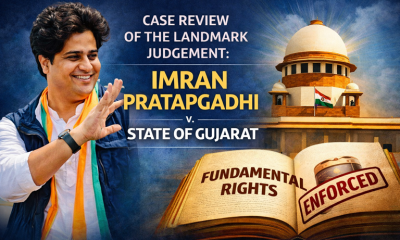
Case Review of the Landmark Judgement : Imran Pratapgadhi v. State of Gujarat 2025 INSC 410


Lentis Legalis| 04.03.2026
Chandrasen Yadav
The appellant in the present matter, Imran Pratapgadhi who was a Member of the Rajya Sabha. The 2nd respondent Kishan Bhai Dipak Bhai Nanda was the first informant at whose instance a First Information Report (for short, ‘FIR’) was registered with Jamnagar Police Station for the offences punishable under Sections 196, 197(1), 302, 299, 57 and 3(5) of the Bharatiya Nyaya Sanhita, 2023 (for short, ‘the BNS’).
| Offence | Section No. of BNS |
| Promoting enmity between different groups on ground of religion, race, place of birth, residence, language, etc , and doing acts prejudicial to maintenance of harmony. | 196 |
| Imputations, assertions prejudicial to national integration | 197(1) |
| Uttering words, etc., with deliberate intent to wound religious feelings of any person. | 302 |
| Deliberate and malicious acts, intended to outrage religious feelings of any class by insulting its religion or religious beliefs. | 299 |
| Abetting commission of offence by the public or by more than ten persons. | 57 |
| Rule of evidence for Constructive liability in case of act done in furtherance of any Common intention | 3(5) |
In the complaint of the 2nd respondent, he stated that on 29th December 2024, on the occasion of the birthday of one Altaf Ghafarbhai Khafi, a member of the Municipal Corporation of Jamnagar, a mass wedding program was held at Sanjari Education and Charitable Trust. The said Municipal Councillor invited the present appellant to the function. A video of the event was made. The appellant posted the video on the social media platform ‘X’ from his verified account. The video has the recitation of a poem reproduced hereinbelow-
“ए खून (blood) के प्यासो (thirsty) बात सुनो ग ़र हक्क़ (truth) की लडाई जुल्म (excesses/injustice) सही
हम जुल्म (excesses/injustice) से इश्क़ (love) ननभा देंगे गर शम- ए- नगररया (melting of a candle which resembles tears) आनतश (flame) है
हर राह वो शम्मा (light) जला देंगे गर लाश हमारे अपनोोंकी खतरा है तुम्हारी मसनद (throne) का
उस रब (god) की ़सम हस्ते हस्ते नकतनी लाशे दफ़ना देंगे ए खूनके प्यासोों बात सुनो”
The allegation in the complaint is that the spoken words of the poem incite people of one community against another, and it hurts a community’s religious and social sentiments. It is alleged that the song had lyrics that incited people of other communities to fight for the community’s rights. It is alleged that the video posted by the appellant created enmity between two communities at the national level and hatred towards each other. It was further alleged that it had a detrimental effect on national unity.
The appellant before coming to the Supreme Court had filed a petition under Section 528 of the Bharatiya Nagarik Suraksha Sanhita (for short, ‘the BNSS’) read with Article 226 of the Constitution of India, praying for quashing the said FIR in the High Court. While issuing notice on the said petition, the learned Judge had directed the appellant to file an affidavit disclosing the poem’s source. Accordingly, an affidavit was filed by the appellant but could not disclose the specific origin of the source.
The learned Single Judge of the High Court by impugned judgment and order, rejected the petition by holding that as the investigation is at a very nascent stage, interference cannot be made in view of the judgement of the Hon’ble Supreme Court in the case of Neeharika Infrastructure Pvt. Ltd. v State of Maharashtra 2021 SCC Online SC 315.
Appellant in support of the appeal had taken following grounds-
- That none of the ingredients of the offences alleged against the appellant are made out on the plain reading of the complaint and the poem.
- It cannot be said that the poem caused social disharmony amongst the people.
- the poem does not promote disharmony or feelings of enmity, hatred or ill-will between the various religious, racial, language or regional groups and castes or communities.
- The plain reading of the poem indicated that it was all about sacrificing oneself to fight for rights and truth.
- That registration of the FIR based on the said poem violates the appellant’s fundamental right guaranteed under Article 19(1)(a) of the Constitution.
Supreme Court highlighting the role of dissent mentioned that Free expression of thoughts and views by individuals or groups of individuals is an integral part of a healthy, civilised society. Without freedom of expression of thoughts and views, it is impossible to lead a dignified life guaranteed by Article 21 of the Constitution. In a healthy democracy, the views, opinions or thoughts expressed by an individual or group of individuals must be countered by expressing another point of view. Even if a large number of persons dislike the views expressed by another, the right of the person to express the views must be respected and protected.
Supreme Court in the Judgement mounted a standard that The Courts are duty-bound to uphold and enforce fundamental rights guaranteed under the Constitution of India. Sometimes, we, the Judges, may not like spoken or written words. But, still, it is our duty to uphold the fundamental right under Article 19 (1)(a). We Judges are also under an obligation to uphold the Constitution and respect its ideals. If the police or executive fail to honour and protect the fundamental rights guaranteed under Article 19 (1)(a) of the Constitution, it is the duty of the Courts to step in and protect the fundamental rights. There is no other institution which can uphold the fundamental rights of the citizens.
Supreme court not only set aside the impugned order of the High Court but also quashed the FIR which was registered against the Imran Pratapgaradhi.
Read full Judgement:
https://api.sci.gov.in/supremecourt/2025/3511/3511_2025_4_1501_60508_Judgement_28-Mar-2025.pdf
Landmark judgements
Execution Is Not a Mere Formality: Supreme Court on Rights of Post-Award Purchasers and Finality of Arbitral Decrees

Lentis Legalis|04.03.2026
Chandrasen Yadav
The Cotton Corporation of India Limited, the first respondent, had entered into a sale agreement dated 22.01.1998 with M/s Lakshmi Ganesh Textiles Limited, the second respondent, for the supply of cotton bales. Upon failure of the purchaser to pay the sale consideration, the first respondent initiated arbitral proceedings being AP No. 9 of 1999 for recovery of the outstanding amount.
The learned arbitrator passed an award dated 11.06.2001 in favour of the first respondent for a sum of Rs. 26,00,572.90 along with interest at the rate of 18% per annum and costs. The second respondent challenged the said award by filing AOP No. 10 of 2006 under Section 34 of the Arbitration and Conciliation Act, 1996 before the Principal District Judge, Coimbatore. The Section 34 petition came to be dismissed on 21.01.2013, and as no appeal was preferred thereafter, the arbitral award attained finality.
In the meantime, the second respondent, who was a borrower of ICICI Bank, defaulted in repayment of its dues, as a result of which the bank initiated proceedings under the SARFAESI Act on 11.11.2013 and attached the properties of the borrower. Pursuant to a tripartite agreement dated 29.12.2014 entered into between ICICI Bank, the second respondent, and the appellant, a sale deed dated 23.04.2015 was executed in favour of the appellant in respect of the EP Schedule Property.
Subsequently, in the year 2019, the first respondent initiated execution proceedings to enforce the arbitral award, which were later transferred to the court of the Principal District Judge, Tirupur. During the pendency of the execution proceedings, the executing court, by order dated 19.08.2021, directed conditional attachment of the EP Schedule Property. Aggrieved thereby, the appellant, claiming to be a third-party purchaser, filed EA No. 141 of 2021 under Order XXI Rule 58 of the Code of Civil Procedure seeking removal of attachment on the ground that he was a bona fide purchaser for value without notice of the arbitral liability.
The Supreme Court noted that the appellant was a purchaser subsequent to the passing of the arbitral award for recovery of money and that the execution proceedings were pending when the sale deed was executed in his favour. It was further observed that the appellant had failed to discharge the burden of proving that the purchase was made without notice of the existing claim. The Court also took note of the fact that the arbitral award continued to remain unrealised.
In view of these circumstances and by applying the ratio laid down in Danesh (supra), the Court held that the claim petition filed by the appellant had been rightly dismissed by the courts below. Consequently, the Civil Appeal was dismissed, and the executing court was directed to dispose of the execution proceedings within a period of two months.
The Court reiterated the long-standing principle, traceable even to the Privy Council, that the real difficulties of a litigant often begin only after obtaining a decree. While suits may conclude within a few years, execution proceedings frequently take much longer. Recognising this mischief, Order XXI of the CPC was substantially amended in 1976 to operate as a self-contained code, barring separate suits and prescribing strict timelines for objections.
The Court cautioned that accepting the appellant’s argument would permit pendente lite purchasers or third parties to bypass the statutory safeguards, thereby frustrating execution proceedings. Such an approach would encourage judgment-debtors to defeat decrees by transferring properties or setting up proxy objectors, resulting in endless collateral litigation and rendering decrees ineffective.
Relying upon Jini Dhanrajgir v. Shibu Mathew, the Court emphasised that success in litigation is meaningless unless the successful party actually obtains the relief granted. The legal system, it was observed, must ensure not merely disposal of cases, but actual enforcement of rights, so that justice is not only seen to be done but is truly achieved.
Judgement:
R. Savithri Naidu v. M/s The Cotton Corporation of India Ltd. and Another, 2026 INSC 150

Supreme Court Reserves Judgement on Review Petitions Clubbed with Bhumika Trust’s Writ Petition Challenging the Mandatory Three-Year Practice Rule for Entry-Level Judicial Officers

Uttar Pradesh Information Commission Imposes Maximum Statutory Penalty Rs. 25,000/- and warned for further departmental action on Gram Panchayat Officer of Ayodhya district for not providing information under RTI Act 2005.

Right to Information Act, 2005: A Comprehensive Legal Insight into the Citizen’s Right to Information
Section 107 of the Bharatiya Nyaya Sanhita, 2023: Abetment of suicide of child or person of unsound mind.

Supreme Court to Hear Review Petition on 10 February 2026 Challenging Mandatory Three-Year Practice Requirement for Entry-Level Judicial Services

Major Relief for Law Students as Supreme Court Opens Review on Mandatory 3-Year Practice Rule

-
Bharatiya Nyaya Sanhita (BNS)7 months ago
Section 107 of the Bharatiya Nyaya Sanhita, 2023: Abetment of suicide of child or person of unsound mind.
-
 Supreme Court Highlights9 months ago
Supreme Court to Hear Review Petition on 10 February 2026 Challenging Mandatory Three-Year Practice Requirement for Entry-Level Judicial Services
-
 Landmark judgements8 months ago
Major Relief for Law Students as Supreme Court Opens Review on Mandatory 3-Year Practice Rule
-
Bharatiya Nyaya Sanhita (BNS)7 months ago
Section 125 of the Bharatiya Nyaya Sanhita, 2023: Act endangering life or personal safety of others.
-
Bharatiya Nyaya Sanhita (BNS)7 months ago
Section 111 of the Bharatiya Nyaya Sanhita, 2023: Organised crime.
-
Bharatiya Nyaya Sanhita (BNS)7 months ago
Section 109 of the Bharatiya Nyaya Sanhita, 2023: Attempt to murder.
-
Bharatiya Nyaya Sanhita (BNS)7 months ago
Section 120 of the Bharatiya Nyaya Sanhita, 2023: Voluntarily causing hurt or grievous hurt to extort confession, or to compel restoration of property.
-
Bharatiya Nyaya Sanhita (BNS)7 months ago
Section 34 of the Bharatiya Nyaya Sanhita, 2023: Things done in private defence.