
High Court Updates
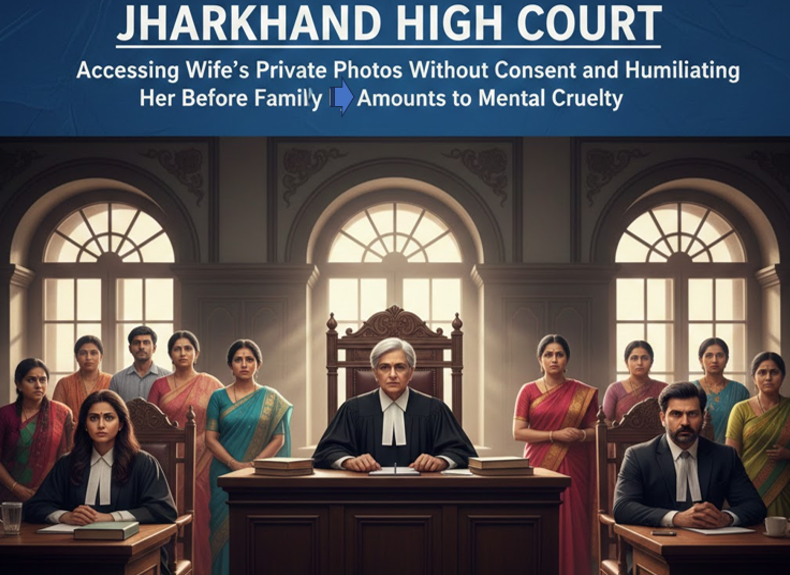
Accessing Wife’s Private Photos Without Consent and Humiliating Her Before Family Amounts to Mental Cruelty

Ranchi | January 10, 2026
Lentis Legalis
The Jharkhand High Court has ruled that viewing a wife’s private photos without her consent and showing them to family members, causing humiliation, constitutes mental cruelty under matrimonial law and is a valid ground for divorce.
A division bench of Justices Sujit Narayan Prasad and Arun Kumar Rai allowed the wife’s appeal, overturning the Family Court’s order that had previously refused to grant a decree of divorce. The High Court observed that the trial court failed to appreciate the evidence correctly and overlooked clear indications of mental cruelty.
The couple was married on March 13, 2020. The wife left her matrimonial home less than two months later, on May 10, 2020, and subsequently approached the Family Court seeking a divorce under Section 13(1)(i-a) of the Hindu Marriage Act, 1955, on the grounds of physical and mental cruelty.
The wife alleged that while she was asleep, her husband accessed her mobile phone and retrieved private and objectionable photos saved in her Google Drive without her knowledge or consent. She claimed that he transferred these photos to his device and subsequently used them to threaten and blackmail her.
She further alleged that the husband showed these private photos to his parents and other family members, subjecting her to continuous humiliation and mental harassment. According to her, she was also physically assaulted, forced into sexual relations under threat of having the photos uploaded on social media, and deprived of her stridhan (dowry). She also claimed that she was forced to sign a declaration stating that she was voluntarily leaving her matrimonial home and would not claim any rights in the future. Finally, she alleged that she was thrown out of the house along with her father and threatened with dire consequences.
The husband denied all allegations of cruelty. He argued that the wife had a relationship with another man before the marriage and had concealed this fact. She further claimed that she continued to communicate with the man even after her marriage and was unwilling to end the relationship. According to her, despite knowing about his wife’s past relationship, the husband was willing to continue the marital relationship.
The Family Court dismissed the divorce petition, stating that the wife had failed to prove cruelty, even on a balance of probabilities. However, the High Court reiterated that under Section 19 of the Family Courts Act, it had the power to re-examine both the facts and the law. After a detailed examination of the oral evidence and the established principles relating to cruelty, the High Court held that while the allegations of physical assault were not proven by conclusive evidence, mental cruelty had been clearly established.
The bench observed that accessing a spouse’s private photographs without permission and showing them to family members constitutes humiliation, a violation of privacy, and character assassination, which strikes at the very root of a person’s dignity.
The court stated, “Marriage is based on trust and respect. Once that foundation is destroyed, it cannot be rebuilt, as trust is the bedrock of the marital relationship.”
The High Court held that exposing a spouse’s private matters to the public and humiliating them destroys the foundation of trust in the marriage, and it is unreasonable to expect them to continue living together under such circumstances.
See here to read Judgement
Skip to PDF content

High Court Updates
No More ‘Bona Fide Need’: Allahabad High Court Redefines Eviction Standards Under the UP Tenancy Act, 2021


Lentis Legalis | 07 April 2026
Reviewed by Adv. Chandrasen Yadav
In a notable ruling the Allahabad High Court has held that landlord is not bound to establish reason or requirement to occupy his own rented property. The order of Rent Authority, dated 19.06.2025, allowing the release application and direction of eviction of the petitioner was challenged under Article -227 of the Constitution of India, which recorded that the rate of rent was Rs. 500/- per month and that there was no default in payment of rent. The release application, however, was allowed by the Rent Authority under Section 21(2)(m) of the Uttar Pradesh Regulation of Urban Premises Tenancy Act, 2021, on the ground of personal requirement of the landlord. The release order of Rent Authority was also challenged before the Rent Tribunal by the petitioner preferring an appeal under Section 35 of the Act, which came to be dismissed by the Rent Tribunal vide order dated 30.01.2026, affirming the findings recorded by the Rent Authority.
Facts of the Case:
The petitioner, being a tenant of a shop situated at 106/376, Gandhi Nagar, ‘P’ Road, Kanpur Nagar, at a monthly rent of Rs.500/-, and The respondent–landlord instituted proceedings under Section 21(2)(a), (b) and (m) of the Uttar Pradesh Regulation of Urban Premises Tenancy Act, 2021 (hereinafter referred to as “the Act, 2021”), seeking release of the premises in question on the ground that he had acquired ownership thereof by inheritance and that the same was required for expansion of his business.
landlord was in possession of a non-residential area of approx 150 square yards, used as a godown, while area measuring about 90 square yards on the first floor used as a furniture workshop. It was further stated that, in the event possession of the premises in question is secured, the landlord would be in a position to shift the furniture workshop to the ground floor and utilize the first floor portion for residential purposes.
a notice dated 02.06.2023, along with an intimation purportedly under Section 4(3) of the Act, 2021, and that the demand of rent along with notice, as per applicable circle rate, Rs.1,00,000/- per month raised. The petitioner–tenant contested that the agreed rent was Rs. 500/- per month; that the alleged enhancement of rent to Rs.1,00,000/- was impermissible under the Act; that no valid notice had been served; and that the alleged refusal of notice was incorrect. It was further contended that the landlord’s requirement was not genuine and that alternative accommodations were available to him, whereas the tenanted shop constituted the sole source of livelihood of the petitioner. petitioner denied the raised objections regarding maintainability, service of notice, and compliance with statutory requirements.
The Issue before High Court: The core issue for consideration was whether, under the scheme of Section 21(2)(m) of the Uttar Pradesh Regulation of Urban Premises Tenancy Act, 2021, the landlord is merely to demonstrate that the premises are required for his occupation, or whether such requirement must also satisfy the test of “bona fide need” as was contemplated under the erstwhile U.P. Act No. 13 of 1972.
The grounds of the petitioner were-
- The requirement set up by the landlord is neither genuine nor pressing and is merely a pretext to evict the tenant.
- The landlord is possessed of alternative accommodations which could sufficiently meet his alleged need, yet the same have not been considered by the authorities below.
- It is further submitted that relevant material on record has been ignored,
- The proceedings are vitiated on account of non compliance with statutory requirements, including improper service of notice and
- An impermissible attempt to enhance the rent.
Precedents relied by Petitioner on Phiroze Bamanji Desai v. Chandrakant N. Patel, (1974) 1 SCC 661 wherein it has been held that the expression “requires” must be construed to mean an element of actual need and not a mere desire, and that such requirement must satisfy the test of bona fide necessity. Another precedent of Shiv Sarup Gupta v. Mahesh Chand Gupta, (1999) 6 SCC 222, was plase reliance by the petitioner to contend that the requirement of the landlord must be genuine and real for eviction, and that the Court is obliged to scrutinize the same objectively on the basis of pleadings and evidence on record.
The respondent pointed out that the statutory requirement as engrafted in Section 21(2)(m) of the Act, 2021 postulates only the existence of the requirement of the landlord for occupation of the premises, without incorporating any further condition or qualification.
High Court noted the statutory departure highlighting provision sub-section (2)(m) of Section 21 of the Act, 2021, and held that the landlord is only required to demonstrate that the premises are required for his occupation. The provision, in its plain terms, is clearly distinguishable from the provisions contained in the erstwhile U.P. Act No. 13 of 1972, wherein the landlord was obligated to establish not only his bona fide requirement but also to satisfy the test of comparative hardship. The omission of these requirements under the present enactment is neither incidental nor insignificant, but a conscious legislative departure.
The court further noted that the provision does not incorporate expressions such as “bona fide requirement” or any reference to comparative hardship, which were integral to the earlier regime. This change in phraseology assumes significance while construing the scope and ambit of the provision.
Having regard to the aforesaid discussion the High Court dismissed the tenant’s petition, upholding the eviction order. However, showing equitable consideration, the Court granted:
- 8 months’ time to vacate (till 2 December 2026),
- Subject to filing an undertaking and
- Payment of Rs 2,000 per month as use and occupation charges.
The Hon’ble High Court cleared his stance that in the event of default in compliance of any of the aforesaid conditions, the protection granted by this Court, shall stand vacated automatically and it shall be open to the respondent-landlord to seek execution of the order passed in the Rent Case in accordance with law.
Petitioner -Shyam Pal
Respondent – B.S. Enterprises
Bench – HON’BLE DR. YOGENDRA KUMAR SRIVASTAVA, J
Read Full Judgement : Click Heare
Author
Adv. Chandrasen Yadav
B.Sc., LL.B. & LL.M.
Crime And Justice
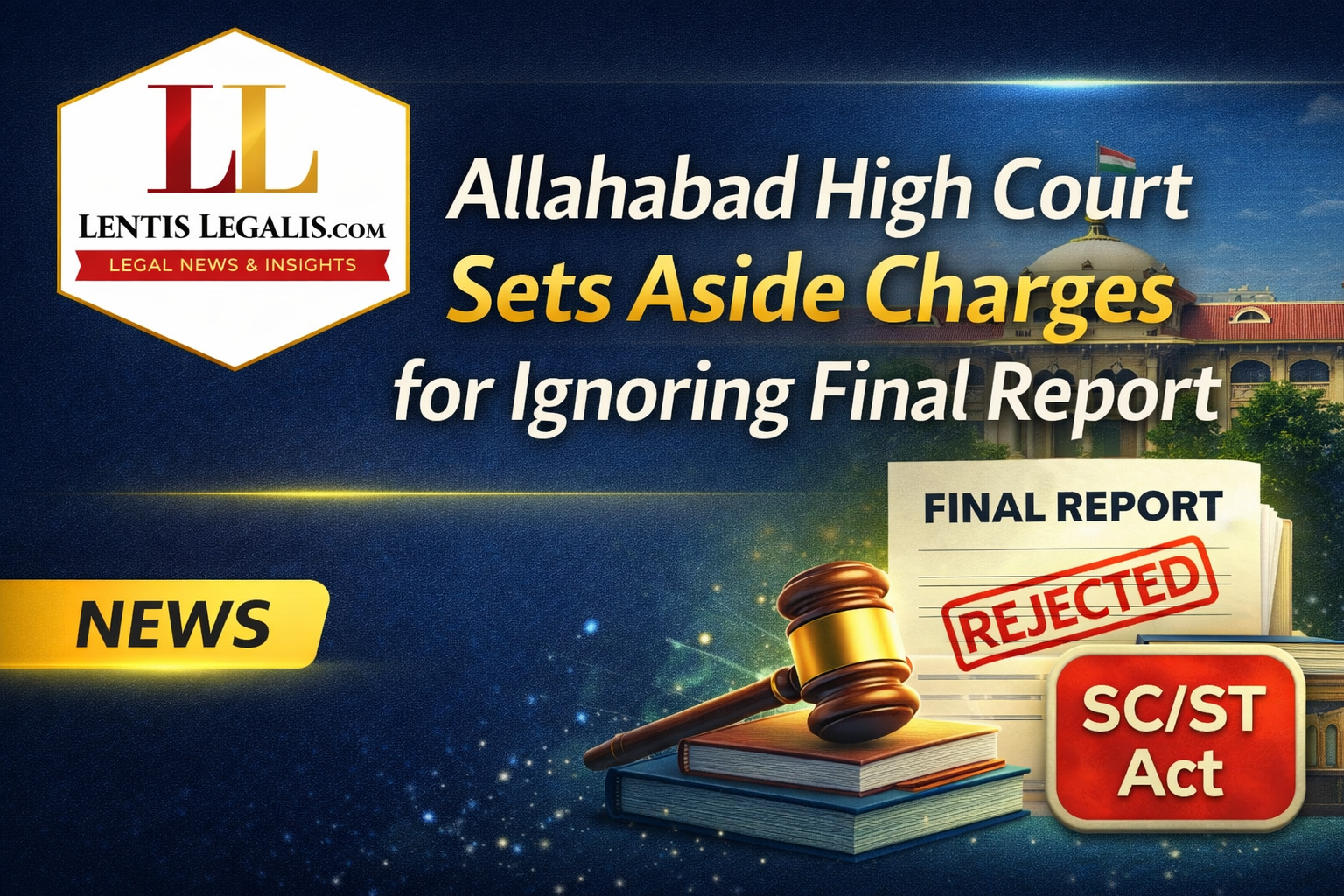
Allahabad High Court Sets Aside Charges for Ignoring Subsequent Closure Report Filed After Cognizance
LENTIS LEGALIS
ALLAHABAD| 14.02.2026
The Allahabad High Court has allowed a criminal appeal and set aside multiple orders passed by the Special Judge (SC/ST Act), Kannauj, holding that a trial court cannot ignore a Final Report (closure report) filed after further investigation merely because cognizance had already been taken on an earlier charge sheet.
The present criminal appeal under Section 14-A(1) Scheduled Castes & Scheduled Tribes (Prevention of Atrocities) Act has been preferred to allow this present appeal and set aside the impugned order dated 21.08.2024, 27.06.2024 and 10.05.2024 and all other consequential orders also passed by Special Judge SC/ST Act, District-Kannauj in S.C. No.1374/2023 (State Vs. Sonu @ Bhagwan Bhakt and others) arising out of Case Crime No.627/2023 U/s 147, 452, 323, 504, 506 I.P.C. and 3 (1)(d) SC/St Act, Police Station Kotwali Kannauj District-Kannauj. The Investigating Officer initially filed a charge sheet on 15.09.2023, on which cognizance was taken on 21.12.2023.
As the investigation was still under progress, supplementary report under Section 173(2) Cr.P.C. was submitted by I.O. on 31.3.2024 by concluding that allegations against the appellants were found false. It can be said that a final report was submitted by I.O. subsequent to the order of taking cognizance upon the charge sheet on 21.12.2023
During further investigation under Section 173(8) Cr.P.C., the I.O. submitted a Final Report/Closure Report on 31.03.2024, concluding that the allegations were false. Despite this, the trial court proceeded to frame charges on 07.08.2025 without passing any order on the Final Report.
The central question before the High Court was:
What is the duty of a Magistrate when, after taking cognizance on a charge sheet, a subsequent Final Report (negative report) is filed following further investigation?
The High Court held that A supplementary report, including a Final Report, is an integral part of the primary police report under Section 173 Cr.P.C. A Magistrate is duty-bound to consider every subsequent report filed during investigation, even after cognizance has been taken. Ignoring a Final Report and proceeding to frame charges amounts to a procedural illegality. Passing a fresh order on a Final Report does not amount to a review barred under Section 362 Cr.P.C., as cognizance does not finally dispose of the case.
The Court relied on landmark judgments including:
- Vinay Tyagi v. Irshad Ali (2013) – holding that primary and supplementary reports must be read conjointly.
- Ram Lal Narang v. State (Delhi Administration) – recognising the necessity of further investigation even after cognizance.
- Dharmatma Singh v. Harminder Singh – reiterating the Magistrate’s duty to independently assess conflicting police reports.
- Mariam Fasihuddin v. State (2024) – emphasising that courts must apply judicial mind to every valid supplementary report.
The impugned orders dated 21.08.2024, 27.06.2024 and 10.05.2024, including the order framing charges on 07.08.2025, were set aside. The trial court has been directed to first decide the Final Report after considering it along with the initial charge sheet. Charges may be framed only if a conjoint reading of both reports discloses a prima facie case.
See Here to read full Judgement
High Court Updates
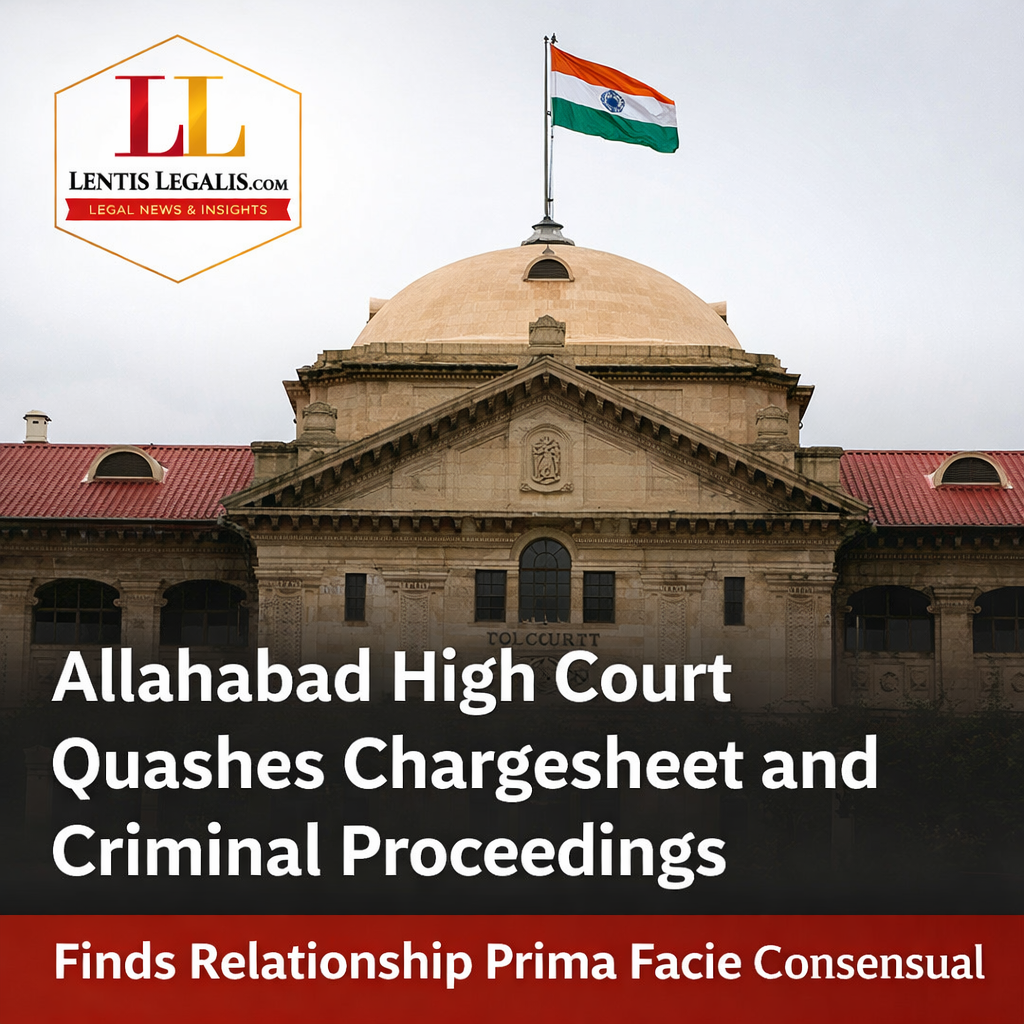
Allahabad High Court Quashes Chargesheet and other Proceedings, Holds Relationship Prima Facie Consensual
LENTIS LEGALIS
Prayagraj | 16 February 2026
The Allahabad High Court has quashed the criminal proceedings, including charges under Section 376(2)(n) IPC and Section 67 of the Information Technology Act, in a case alleging repeated sexual assault and blackmail, holding that the material on record did not disclose a prima facie case warranting trial.
Justice Avnish Saxena allowed an application under Section 528 of the Bharatiya Nagarik Suraksha Sanhita (BNSS) filed by the accused persons, setting aside the charge-sheet dated 12.02.2025, the cognizance order dated 28.02.2025, and all consequential proceedings arising out of Case Crime No. 883 of 2024, Police Station Izzatnagar, District Bareilly.
The FIR, lodged on 01.12.2024 by the complainant, a married woman, alleged that she was repeatedly raped by the first accused between August 2022 and November 2023 on the pretext of guidance for the Provincial Civil Services examination. It was further alleged that obscene videos were recorded and later used for blackmail, with the second accused allegedly circulating the videos to the complainant’s family members.
Applicants submit that the FIR is grossly delayed. The informant is a married lady having two children, who has some oblique motive to fulfil. The record shows that the victim herself has sent friend request to the sister of accused through facebook, came closer to her and thereafter made distance and came closer to accused applicant.
After examining the FIR, statements under Sections 180 and 183 BNSS, and material collected during investigation, the Court noted multiple inconsistencies and improbabilities in the prosecution story. The Court observed that:
- The complainant was a married, educated woman with children and allegedly maintained prolonged physical relations over several years without reporting the matter.
- The alleged blackmail was based on videos which the complainant admitted she had never seen.
- There was no recoverable electronic evidence to substantiate claims of circulation of obscene material.
- Statements of the complainant’s husband and father did not conclusively support the allegation of transmission of videos.
- WhatsApp chats placed on record indicated intimate communication beyond mere academic guidance.
Relying on recent Supreme Court precedents, the Court held that prolonged and repeated physical relations, in the absence of compelling evidence of coercion or threat, cannot be presumed to be non-consensual.
The Court concluded that continuation of the criminal proceedings would amount to an abuse of the process of law. Consequently, all proceedings against both accused persons were quashed.
read judgement below

Supreme Court Reserves Judgement on Review Petitions Clubbed with Bhumika Trust’s Writ Petition Challenging the Mandatory Three-Year Practice Rule for Entry-Level Judicial Officers

Uttar Pradesh Information Commission Imposes Maximum Statutory Penalty Rs. 25,000/- and warned for further departmental action on Gram Panchayat Officer of Ayodhya district for not providing information under RTI Act 2005.

Right to Information Act, 2005: A Comprehensive Legal Insight into the Citizen’s Right to Information
Section 107 of the Bharatiya Nyaya Sanhita, 2023: Abetment of suicide of child or person of unsound mind.

Supreme Court to Hear Review Petition on 10 February 2026 Challenging Mandatory Three-Year Practice Requirement for Entry-Level Judicial Services

Major Relief for Law Students as Supreme Court Opens Review on Mandatory 3-Year Practice Rule

-
Bharatiya Nyaya Sanhita (BNS)7 months ago
Section 107 of the Bharatiya Nyaya Sanhita, 2023: Abetment of suicide of child or person of unsound mind.
-
 Supreme Court Highlights9 months ago
Supreme Court to Hear Review Petition on 10 February 2026 Challenging Mandatory Three-Year Practice Requirement for Entry-Level Judicial Services
-
 Landmark judgements8 months ago
Major Relief for Law Students as Supreme Court Opens Review on Mandatory 3-Year Practice Rule
-
Bharatiya Nyaya Sanhita (BNS)7 months ago
Section 125 of the Bharatiya Nyaya Sanhita, 2023: Act endangering life or personal safety of others.
-
Bharatiya Nyaya Sanhita (BNS)7 months ago
Section 111 of the Bharatiya Nyaya Sanhita, 2023: Organised crime.
-
Bharatiya Nyaya Sanhita (BNS)7 months ago
Section 109 of the Bharatiya Nyaya Sanhita, 2023: Attempt to murder.
-
Bharatiya Nyaya Sanhita (BNS)7 months ago
Section 120 of the Bharatiya Nyaya Sanhita, 2023: Voluntarily causing hurt or grievous hurt to extort confession, or to compel restoration of property.
-
Bharatiya Nyaya Sanhita (BNS)7 months ago
Section 34 of the Bharatiya Nyaya Sanhita, 2023: Things done in private defence.