
Opinions & Columns
When Insolvency Overrides Everything: The Expanding Shadow of the IBC


Lentis Legalis | 03 April 2026
Reviewed by Adv. Chandrasen Yadav
In the evolving landscape of India’s financial and legal architecture, few legislations have reshaped the balance of power across courts and statutes as profoundly as the Insolvency and Bankruptcy Code, 2016 (IBC). Conceived as a time-bound mechanism to address corporate distress, the Code has, over the years, transcended its initial objective. It now stands not merely as a debt resolution framework, but as a dominant legal regime capable of overriding parallel proceedings, subordinating competing laws, and centralising adjudicatory authority.
At the heart of this transformation lie two critical stages: the imposition of a moratorium upon initiation of the Corporate Insolvency Resolution Process (CIRP) and the approval of a resolution plan by the National Company Law Tribunal (NCLT). Together, they create a legal effect that extends far beyond insolvency, fundamentally altering how and where disputes can be pursued.
The Moment of Admission: A Jurisdictional Shift
The process begins under Section 7 of the Code, where a financial creditor initiates CIRP upon the occurrence of a default. What may appear to be a procedural step is, in reality, a jurisdictional turning point. The admission of an insolvency application marks the beginning of a centralised process, effectively shifting the axis of legal control to the NCLT.
From this moment onward, the fragmented pursuit of claims across multiple forums such as civil courts, arbitral tribunals, and statutory authorities begins to dissolve. The insolvency forum becomes the focal point, not only for resolution but also for the determination of competing rights.
Moratorium: The Legal Freeze
The declaration of a moratorium under Section 14 is perhaps the most immediate and visible consequence of CIRP. It imposes a legal freeze on all proceedings against the corporate debtor, including suits, execution actions, and arbitration and thereby other proceedings generally put in abeyance until CIRP is not resolved.
This is not merely a procedural pause; it is a deliberate legislative intervention aimed at preserving the corporate debtor as a going concern. By halting all recovery actions, the law seeks to prevent a chaotic scramble among creditors and ensures that value is not dissipated through piecemeal litigation.
However, the moratorium also raises significant questions. It temporarily silences other courts, irrespective of the nature or merit of the proceedings before them. A civil court, despite being properly seized of a matter, must step aside. An arbitral tribunal, despite having progressed substantially, must halt its proceedings. In effect, the moratorium subordinates all other legal processes to the insolvency framework.
Exclusion of Civil Court Jurisdiction
The exclusivity of the insolvency regime is further reinforced by Section 63, which expressly bars civil courts and authorities from entertaining matters within the jurisdiction of the NCLT and the National Company Law Appellate Tribunal (NCLAT).
This provision is not merely declaratory; it is transformative. It redraws jurisdictional boundaries and compels litigants to abandon parallel remedies. The traditional autonomy of civil courts gives way to a specialised, centralised forum designed to address insolvency in a holistic manner.
While such exclusivity enhances efficiency, it also narrows the avenues available to stakeholders. Parties who may have legitimate claims under different legal frameworks find themselves channelled into a single process, often governed by strict timelines and procedural constraints.
The Overriding Effect: Supremacy of the IBC
If there were any lingering doubts about the supremacy of the IBC, Section 238 dispels them unequivocally. It provides that the provisions of the Code shall have effect notwithstanding anything inconsistent contained in any other law.
The breadth of this clause is striking. It places the IBC at the apex of the statutory hierarchy in matters of insolvency, enabling it to override not only general laws but also special statutes. Contractual rights, statutory remedies, and even governmental claims must yield if they conflict with the insolvency process.
This overriding effect has been the subject of extensive judicial interpretation, with courts consistently affirming that the objectives of the IBC would be defeated if parallel or inconsistent proceedings were allowed to continue.
Resolution Plan: The Clean Slate Doctrine
The culmination of the insolvency process is the approval of a resolution plan under Section 31. At this stage, the law takes an even more decisive turn. The approved plan becomes binding on all stakeholders creditors, employees, shareholders, and even government authorities.
The Supreme Court, in Ghanashyam Mishra & Sons Pvt. Ltd. v. Edelweiss Asset Reconstruction Co. Ltd., articulated what has come to be known as the “clean slate” doctrine. It held that all claims not forming part of the resolution plan stand extinguished, and no proceedings can be continued in respect of such claims.
This principle was further reinforced in Electrosteel Steel Ltd. v. Ispat Carrier Pvt. Ltd., where the Court emphasised the finality and binding nature of an approved resolution plan. Once the plan is sanctioned, the corporate debtor emerges free from past liabilities, enabling a fresh start.
While this ensures certainty and encourages resolution applicants, Approval of a resolution plan under Section 31 also has far-reaching consequences. Claims that may have been valid in law can disappear simply because they were not included in the resolution plan. Pending proceedings in other courts, irrespective of their stage, may become infructuous overnight.
A System of Centralisation and Finality
Taken together, the provisions relating to moratorium, jurisdictional bar, overriding effect, and binding resolution create a system characterised by centralisation and finality. The IBC consolidates disputes, restricts parallel litigation, and ensures that insolvency resolution is not derailed by competing claims.
From a policy perspective, this is both necessary and desirable. Insolvency, by its very nature, requires a coordinated approach. Allowing multiple proceedings to continue simultaneously would defeat the objective of timely resolution and erode the value of the corporate debtor.
The Tension Between Efficiency and Justice
Yet, the very features that make the IBC effective also give rise to tensions. The exclusion of other courts, the extinguishment of claims, and the overriding of statutory rights raise important questions about access to justice and procedural fairness.
Operational creditors, small vendors, and even government authorities may find themselves at a disadvantage, particularly if they fail to assert their claims within the prescribed framework. The rigid timelines and procedural requirements, while essential for efficiency, can sometimes operate harshly against less-informed stakeholders.
Moreover, the near-total dominance of the insolvency framework risks marginalising other legal regimes, each of which serves its own purpose within the broader justice system.
Conclusion: Redefining Legal Authority
The Insolvency and Bankruptcy Code has undoubtedly transformed India’s approach to corporate distress. But in doing so, it has also redefined the relationship between laws and forums. The acceptance of a moratorium and the approval of a resolution plan do not merely affect the corporate debtor; they reshape the entire legal landscape surrounding it.
The challenge, going forward, lies in maintaining a delicate balance. The efficiency and finality offered by the IBC must be preserved, but not at the cost of fairness and inclusivity. As the jurisprudence continues to evolve, courts and policymakers must ensure that the pursuit of economic resolution does not overshadow the foundational principles of justice.
Author
Adv. Chandrasen Yadav
B.Sc., LL.B. & LL.M.



Lentis Legalis | 26 April 2026
Reviewed by Adv. Chandrasen Yadav
The recognition of a company as a separate legal person provided the much-needed stability and confidence in the business community. This limits the liability of the promoters, investors and subscribers only to the extent of their unpaid share capital, the law insulated personal assets from business risks, thereby encouraging investment, innovation, and entrepreneurial ventures. This legal assurance fostered confidence among investors, creditors, and stakeholders, enabling the pooling of resources and the expansion of trade on an unprecedented scale.
In landmark judgment of Salomon v. Salomon & Co. Ltd., it was cemented that a company is a separate legal person, and its shareholders are not personally liable for its debts beyond their unpaid share capital.
However, the corporate veil was never intended to be an instrument of injustice. As judicial wisdom has consistently emphasized, the doctrine of separate legal personality exists to promote commerce and not to facilitate fraud or illegality. While courts exercise caution in piercing the corporate veil, but not hesitate to do so where the corporate form is abused, ensuring the true actors behind the corporate mask held accountable.
The Supreme Court, in Delhi Development Authority v. Skipper Construction Co. (P) Ltd., categorically held that the concept of corporate entity was evolved to encourage and promote trade and commerce but not to commit illegalities or to defraud people. Where, therefore, the corporate character is employed for the purpose of committing illegality or for defrauding others, the court would ignore the corporate character and will look at the reality behind the corporate veil so as to enable it to pass appropriate orders to do justice between the parties concerned.
The Hon’ble Supreme Court in State of U.P. Vs. Renusagar Power Co., (1988) 4 SCC 59 observed that lifting of veil is permissible, its frontiers are unlimited, it must, however, depend primarily on the realities of the situation. The aim of the legislation is to do justice to all the parties.
Over time, courts have identified several circumstances where lifting the corporate veil becomes necessary:
- Fraud or Unlawful Conduct: Where the company is incorporated or used as a device to perpetrate fraud, defeat legal obligations, or mislead creditors. [Delhi Development Authority v Skipper Construction Co (P) Ltd]
- Tax Evasion: When the corporate structure is employed as a sham or colorable device to evade tax liabilities unlawfully.[McDowell & Co Ltd v Commercial Tax Officer]
- Avoidance of Welfare Legislation: Where the entity is used to circumvent statutory obligations relating to labor welfare, including payment of wages, bonuses, or other employee benefits. [Workmen Employed in Associated Rubber Industry Ltd v Associated Rubber Industry Ltd]
- Enemy Character: Particularly in times of war, courts may look beyond the corporate personality to ascertain whether those in control belong to an enemy nation. [Daimler Co Ltd vs. Continental Tyre and Rubber Co (Great Britain) Ltd]
- Evasion of Court Orders / Execution of Decrees: When the corporate form is misused to frustrate or evade compliance with judicial orders or to avoid satisfaction of a decree. [Prem Prakash Rajpurohit vs. M/s Ansal Hi Tech Township Ltd. And 2 Ors.]
- Public Interest: Where maintaining the corporate veil would be contrary to public interest, public policy, or would result in injustice. [State of Uttar Pradesh v Renusagar Power Co]
However, the courts have come to recognize several exceptions to the general rule as held in the Soloman Case that a company is a separate legal person, and its shareholders are not personally liable for its debts beyond their unpaid share capital. When the corporate personality is blatantly used as à cloak for fraud or improper conduct, Courts pierce the veil in the interest of public policy. [Gower: Modern Company Law- 4th Edn. (1979) at p. 137.]
The doctrine of separate legal entity remains one of the most profound legal innovations in the history of commerce. It has enabled generations of entrepreneurs to take calculated risks without the fear of losing their entire personal estates, thereby fostering investment, innovation, and economic growth on an unprecedented scale. The principle, as affirmed in Salomon v. Salomon & Co. Ltd., continues to be the bedrock of corporate law.
Yet, this legal fiction was never meant to be absolute. The doctrine of lifting the corporate veil, therefore, acts as a necessary corrective judicial measure ensuring that the privilege of limited liability does not become a licence for abuse. Judicial experience has consistently shown that while courts remain cautious in disregarding corporate personality, they will not hesitate to do so where justice so demands. Whether it is fraud, evasion of statutory obligations, or misuse of corporate structures to frustrate judicial orders, the law looks beyond form to substance, and beyond the company to the real actors controlling it.
Ultimately, the corporate veil is a shield, not a sanctuary. When it is used to protect legitimate enterprise, the law upholds it; but when it is used to conceal wrongdoing, the veil must fall, so that accountability, fairness, and public confidence in the legal system are not compromised.
Author
Adv. Chandrasen Yadav
B.Sc., LL.B. & LL.M.
Explainers
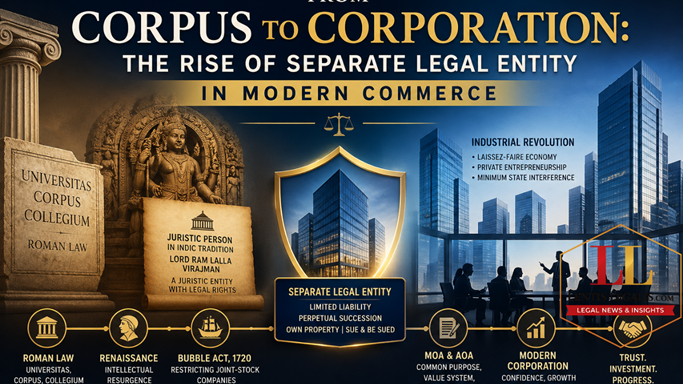
From Corpus to Corporation: How Separate Legal Entities Shaped Modern Corporate Structures
Lentis Legalis | 26 April 2026
Reviewed by Adv. Chandrasen Yadav
The idea of a company, as we understand it today, has evolved over centuries. The very term “corporation” finds its origin in the Latin word corpus, meaning thereby a body or a collective of persons. Even under Roman law, entities such as universitas, corpus, or collegium were recognized as distinct bodies capable of holding property, entering contracts, and suing or being sued. Interestingly, Indic legal thought reflects a similar conceptualization where a consecrated deity is treated as a juristic person with independent legal identity as example Lord Ram Lalla Virajman itself sued the wrongdoers who encroached land owned by Ayodhya Mandir deity Lord Ram Lalla.
The doctrine of separate legal entity has been indispensable in the evolution of modern commerce, primarily because it mitigates the harsh consequences of unlimited personal liability that existed in earlier forms of trade. In pre-corporate systems, merchants and traders bore unlimited liability, meaning that business losses could extend to their entire personal estates, often wiping out wealth accumulated over generations. The intellectual resurgence during the Renaissance Period, followed by the economic transformation of the Industrial Revolution, created an urgent need for legal structures that could support large-scale enterprise, capital aggregation, and risk-taking.
An important historical turning point in this journey was the enactment of the Bubble Act, 1720 (also Royal Exchange and London Assurance Corporation Act, 1719) in England, which came in the aftermath of the South Sea Bubble crisis. The Act sought to restrict the formation of joint-stock companies without royal charter, reflecting the State’s concern over speculative excesses and fraudulent ventures. Although restrictive in nature, it highlighted the growing significance and potential risks of collective commercial enterprises. Its eventual repeal in 1825 paved the way for freer incorporation and the development of modern company law.
The Industrial Revolution marked a decisive shift towards laissez-faire economic theory, advocating minimal state interference and promoting private entrepreneurship as the engine of economic growth. In such an environment, large-scale industrial and commercial activities required a structured yet flexible legal mechanism to mobilize capital and coordinate collective effort. This gave rise to the modern corporation – an organized body formed around a common purpose and governed by a defined value system, embodied in its Memorandum of Association (MOA) and Articles of Association (AOA). While the MOA outlines the fundamental objectives and scope of the company, the AOA regulates its internal management and operational framework. Together, they institutionalize trust, discipline, and predictability in business functioning. Coupled with the doctrine of separate legal entity and limited liability, this corporate structure instilled confidence among investors and entrepreneurs, enabling them to undertake ventures without exposing their personal wealth to unlimited risk, thereby accelerating industrial and economic expansion.
The recognition of a company as a separate legal person thereafter provided the much-needed stability and confidence. By limiting liability to the extent of unpaid share capital, the law insulated personal assets from business risks, thereby encouraging investment, innovation, and entrepreneurial ventures. This legal assurance fostered confidence among investors, creditors, and stakeholders, enabling the pooling of resources and the expansion of trade on an unprecedented scale. In essence, the concept of separate legal entity did not merely facilitate business, it became the cornerstone of economic growth by balancing risk with protection.
The landmark judgment in Salomon v. Salomon & Co. Ltd. cemented this principle by holding that once incorporated, a company is a separate legal person, and its shareholders are not personally liable for its debts beyond their unpaid share capital. This doctrine was crucial in fostering industrial growth during the Industrial Revolution, where laissez-faire economics encouraged private entrepreneurship and minimized state interference. The corporate form with its attributes of limited liability, perpetual succession, and centralized management became the engine of economic expansion.
Author
Adv. Chandrasen Yadav
B.Sc., LL.B. & LL.M.


Lentis Legalis | 08 April 2026
Reviewed by Adv. Chandrasen Yadav
On 13 March 2026, the Transgender Persons (Protection of Rights) Amendment Bill, 2026 was introduced in the Lok Sabha, proposing significant changes to the Transgender Persons (Protection of Rights) Act, 2019. The Statement of Objects and Reasons accompanying the Bill underscores a distinct legislative policy: to recognise and protect a specific class of transgender (TG) persons who suffer from acute social exclusion.
The Bill asserts that the original legislative intent was, and continues to be, the protection of individuals who face severe social discrimination owing to biological factors beyond their control and without any element of choice. It emphasises that the Act was designed to safeguard a narrowly defined class of persons—those historically and socially recognised as transgender—who endure extreme and systemic marginalisation. According to the proposed amendment, the statute was never intended to extend protection to all categories of gender identities, including self-perceived identities or gender fluid expressions.
A central concern highlighted by the Bill is the alleged vagueness in the existing definition of “transgender person.” It contends that such ambiguity hampers the identification of genuinely oppressed individuals and renders the implementation of various provisions—across penal, civil, and personal laws—ineffective and unworkable. Consequently, the Amendment Bill seeks to introduce a more precise and restrictive definition to ensure that the benefits of the Act reach its intended beneficiaries through clearer identification mechanisms.
The foundation of transgender jurisprudence in India can be traced to the landmark decision in National Legal Services Authority v. Union of India (2014), popularly known as the NALSA case. In this seminal judgment, the Supreme Court recognised transgender persons as a “third gender” and affirmed their entitlement to fundamental rights under the Constitution. The Court unequivocally held that gender identity lies at the core of an individual’s personal autonomy and must be determined by self-identification rather than biological or medical criteria. It observed:
“Gender identity is integral to the dignity of an individual and is based on self-identification, not on surgical or medical procedures. No person can be discriminated against on the ground of gender identity.”
Justice K.S. Radhakrishnan, drawing upon a catena of judicial precedents and international human rights instruments, elaborated that gender identity is among the most fundamental aspects of life. It reflects a person’s deeply felt internal and individual experience of gender, which may or may not correspond with the sex assigned at birth. This understanding firmly situates gender identity within the domain of personal liberty and dignity.
The jurisprudential evolution continued with Navtej Singh Johar v. Union of India (2018), where the Supreme Court decriminalised consensual same-sex relations by reading down Section 377 of the Indian Penal Code. The Court, in doing so, foregrounded the primacy of constitutional morality over societal or majoritarian morality. It also recognised rights relating to sexual orientation, autonomy, and choice of partner as intrinsic to Article 21.
Further strengthening this framework, the nine-judge bench decision in K.S. Puttaswamy v. Union of India (2017) affirmed that the right to privacy encompasses sexual orientation and gender identity as essential attributes of individual dignity and liberty, immune from majoritarian disapproval.
More recently, in Supriyo v. Union of India (the “Marriage Equality Case”), the Supreme Court acknowledged that transgender persons in heterosexual relationships possess the right to marry under existing legal frameworks, thereby reinforcing their legal recognition and dignity.
In light of this established jurisprudence, the 2026 Amendment Bill appears, prima facie, to depart from the constitutional principles articulated by the Supreme Court. While judicial precedents have consistently upheld self-perceived gender identity as central to personal autonomy, the proposed amendments introduce a certification regime requiring recognition by a district magistrate based on the recommendation of a designated medical board headed by a chief medical officer.
This shift from self-identification to medical verification raises critical constitutional questions. It potentially reintroduces elements of external validation and bureaucratic control over identity, which the Supreme Court had expressly sought to eliminate. Whether such a framework can withstand constitutional scrutiny—particularly in light of the principles of dignity, autonomy, and privacy—remains an open and significant question.
Read the full judgment of NALSA case. – Click Here
Read the Full Judgement of Navtej Singh Johar vs. Union of India. – Click Here
Read the Full Judgement of Justice K.S. Puttaswamy vs. Union of India. – Click Here
Author
Adv. Chandrasen Yadav
B.Sc., LL.B. & LL.M.

Supreme Court Reserves Judgement on Review Petitions Clubbed with Bhumika Trust’s Writ Petition Challenging the Mandatory Three-Year Practice Rule for Entry-Level Judicial Officers

Uttar Pradesh Information Commission Imposes Maximum Statutory Penalty Rs. 25,000/- and warned for further departmental action on Gram Panchayat Officer of Ayodhya district for not providing information under RTI Act 2005.

Right to Information Act, 2005: A Comprehensive Legal Insight into the Citizen’s Right to Information
Section 107 of the Bharatiya Nyaya Sanhita, 2023: Abetment of suicide of child or person of unsound mind.

Supreme Court to Hear Review Petition on 10 February 2026 Challenging Mandatory Three-Year Practice Requirement for Entry-Level Judicial Services

Major Relief for Law Students as Supreme Court Opens Review on Mandatory 3-Year Practice Rule

-
Bharatiya Nyaya Sanhita (BNS)7 months ago
Section 107 of the Bharatiya Nyaya Sanhita, 2023: Abetment of suicide of child or person of unsound mind.
-
 Supreme Court Highlights9 months ago
Supreme Court to Hear Review Petition on 10 February 2026 Challenging Mandatory Three-Year Practice Requirement for Entry-Level Judicial Services
-
 Landmark judgements8 months ago
Major Relief for Law Students as Supreme Court Opens Review on Mandatory 3-Year Practice Rule
-
Bharatiya Nyaya Sanhita (BNS)7 months ago
Section 125 of the Bharatiya Nyaya Sanhita, 2023: Act endangering life or personal safety of others.
-
Bharatiya Nyaya Sanhita (BNS)7 months ago
Section 111 of the Bharatiya Nyaya Sanhita, 2023: Organised crime.
-
Bharatiya Nyaya Sanhita (BNS)7 months ago
Section 109 of the Bharatiya Nyaya Sanhita, 2023: Attempt to murder.
-
Bharatiya Nyaya Sanhita (BNS)7 months ago
Section 120 of the Bharatiya Nyaya Sanhita, 2023: Voluntarily causing hurt or grievous hurt to extort confession, or to compel restoration of property.
-
Bharatiya Nyaya Sanhita (BNS)7 months ago
Section 34 of the Bharatiya Nyaya Sanhita, 2023: Things done in private defence.