
Explainers
From Corpus to Corporation: How Separate Legal Entities Shaped Modern Corporate Structures

Lentis Legalis | 26 April 2026
Reviewed by Adv. Chandrasen Yadav
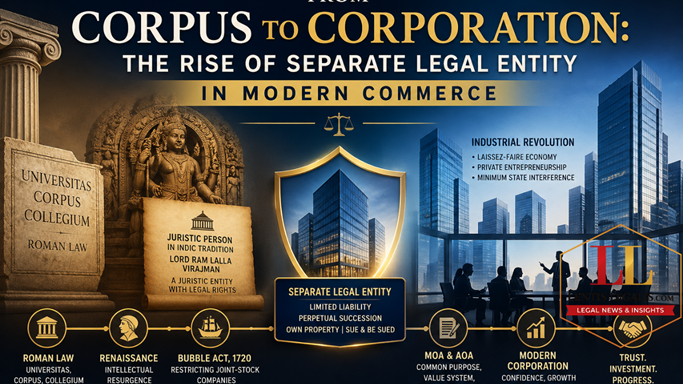
The idea of a company, as we understand it today, has evolved over centuries. The very term “corporation” finds its origin in the Latin word corpus, meaning thereby a body or a collective of persons. Even under Roman law, entities such as universitas, corpus, or collegium were recognized as distinct bodies capable of holding property, entering contracts, and suing or being sued. Interestingly, Indic legal thought reflects a similar conceptualization where a consecrated deity is treated as a juristic person with independent legal identity as example Lord Ram Lalla Virajman itself sued the wrongdoers who encroached land owned by Ayodhya Mandir deity Lord Ram Lalla.
The doctrine of separate legal entity has been indispensable in the evolution of modern commerce, primarily because it mitigates the harsh consequences of unlimited personal liability that existed in earlier forms of trade. In pre-corporate systems, merchants and traders bore unlimited liability, meaning that business losses could extend to their entire personal estates, often wiping out wealth accumulated over generations. The intellectual resurgence during the Renaissance Period, followed by the economic transformation of the Industrial Revolution, created an urgent need for legal structures that could support large-scale enterprise, capital aggregation, and risk-taking.
An important historical turning point in this journey was the enactment of the Bubble Act, 1720 (also Royal Exchange and London Assurance Corporation Act, 1719) in England, which came in the aftermath of the South Sea Bubble crisis. The Act sought to restrict the formation of joint-stock companies without royal charter, reflecting the State’s concern over speculative excesses and fraudulent ventures. Although restrictive in nature, it highlighted the growing significance and potential risks of collective commercial enterprises. Its eventual repeal in 1825 paved the way for freer incorporation and the development of modern company law.
The Industrial Revolution marked a decisive shift towards laissez-faire economic theory, advocating minimal state interference and promoting private entrepreneurship as the engine of economic growth. In such an environment, large-scale industrial and commercial activities required a structured yet flexible legal mechanism to mobilize capital and coordinate collective effort. This gave rise to the modern corporation – an organized body formed around a common purpose and governed by a defined value system, embodied in its Memorandum of Association (MOA) and Articles of Association (AOA). While the MOA outlines the fundamental objectives and scope of the company, the AOA regulates its internal management and operational framework. Together, they institutionalize trust, discipline, and predictability in business functioning. Coupled with the doctrine of separate legal entity and limited liability, this corporate structure instilled confidence among investors and entrepreneurs, enabling them to undertake ventures without exposing their personal wealth to unlimited risk, thereby accelerating industrial and economic expansion.
The recognition of a company as a separate legal person thereafter provided the much-needed stability and confidence. By limiting liability to the extent of unpaid share capital, the law insulated personal assets from business risks, thereby encouraging investment, innovation, and entrepreneurial ventures. This legal assurance fostered confidence among investors, creditors, and stakeholders, enabling the pooling of resources and the expansion of trade on an unprecedented scale. In essence, the concept of separate legal entity did not merely facilitate business, it became the cornerstone of economic growth by balancing risk with protection.
The landmark judgment in Salomon v. Salomon & Co. Ltd. cemented this principle by holding that once incorporated, a company is a separate legal person, and its shareholders are not personally liable for its debts beyond their unpaid share capital. This doctrine was crucial in fostering industrial growth during the Industrial Revolution, where laissez-faire economics encouraged private entrepreneurship and minimized state interference. The corporate form with its attributes of limited liability, perpetual succession, and centralized management became the engine of economic expansion.
Author
Adv. Chandrasen Yadav
B.Sc., LL.B. & LL.M.
Explainers
The Law of Maintenance in India under the Bharatiya Nagarik Suraksha Sanhita, 2023 (BNSS): A Detailed Legal Analysis
Lentis Legalis | 03 May 2026
Reviewed by Adv. Chandrasen Yadav
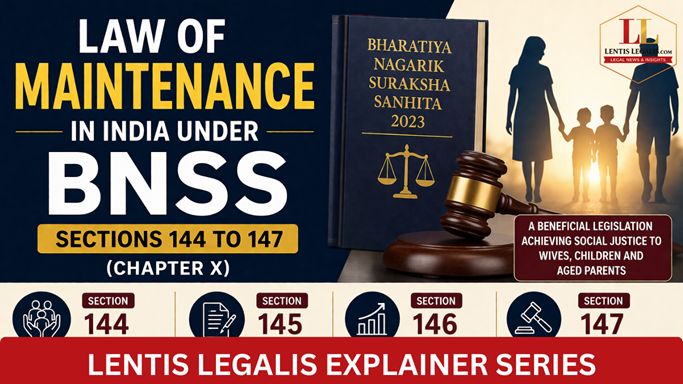
Maintenance provisions under the Bharatiya Nagarik Suraksha Sanhita, 2023 (Hereinafter refereed as BNSS) are contained in Chapter X, comprising Sections 144 to 147. These provisions constitute a beneficial piece of social welfare legislation intended to secure social justice for neglected and destitute wives, children, and aged parents. Section 144 deals with orders for maintenance of wives, children, and parents; Section 145 prescribes the procedure for such proceedings; Section 146 provides for alteration in the allowance granted; and Section 147 concerns the enforcement of maintenance orders. Maintenance laws have been enacted as a measure of social justice to provide recourse to dependant wives and children and aged parents for their financial support, so as to prevent them from falling into destitution and vagrancy.
| CHAPTER X OF BHARATIYA NAGARIK SURAKSHA SANHITA, 2023 | ||
| Sr. No. | Section | Maintenance laws |
| 1. | 144 | Order for maintenance of wives, children and parents. |
| 2. | 145 | Procedure. |
| 3. | 146 | Alteration in allowance. |
| 4. | 147 | Enforcement of order of maintenance. |
Justice Krishna Iyer in his judgment in Captain Ramesh Chander Kaushal v. Mrs. Veena Kaushal and Ors held that the provision of maintenance is a measure of social justice and specially enacted to protect women and children and falls within the constitutional sweep of Article 15(3) reinforced by Article 39. We have no doubt that sections of statutes calling for construction by courts are not petrified print but vibrant words with social functions to fulfil the brooding presence of the constitutional empathy for the weaker sections.
Bare Act Provisions –
Section 144. Order for maintenance of wives, children and parents.
(1) If any person having sufficient means neglects or refuses to maintain—
(a) his wife, unable to maintain herself; or
(b) his legitimate or illegitimate child, whether married or not, unable to maintain itself; or
(c) his legitimate or illegitimate child (not being a married daughter) who has attained majority, where such child is, by reason of any physical or mental abnormality or injury unable to maintain itself; or
(d) his father or mother, unable to maintain himself or herself,
a Magistrate of the first class may, upon proof of such neglect or refusal, order such person to make a monthly allowance for the maintenance of his wife or such child, father or mother, at such monthly rate as such Magistrate thinks fit and to pay the same to such person as the Magistrate may from time to time direct:
Provided that the Magistrate may order the father of a female child referred to in clause (b) to make such allowance, until she attains her majority, if the Magistrate is satisfied that the husband of such female child, if married, is not possessed of sufficient means:
Provided further that the Magistrate may, during the pendency of the proceeding regarding monthly allowance for the maintenance under this sub-section, order such person to make a monthly allowance for the interim maintenance of his wife or such child, father or mother, and the expenses of such proceeding which the Magistrate considers reasonable, and to pay the same to such person as the Magistrate may from time to time direct:
Provided also that an application for the monthly allowance for the interim maintenance and expenses of proceeding under the second proviso shall, as far as possible, be disposed of within sixty days from the date of the service of notice of the application to such person.
Explanation. —For the purposes of this Chapter, “wife” includes a woman who has been divorced by, or has obtained a divorce from, her husband and has not remarried.
(2) Any such allowance for the maintenance or interim maintenance and expenses of proceeding shall be payable from the date of the order, or, if so ordered, from the date of the application for maintenance or interim maintenance and expenses of proceeding, as the case may be.
(3) If any person so ordered fails without sufficient cause to comply with the order, any such Magistrate may, for every breach of the order, issue a warrant for levying the amount due in the manner provided for levying fines, and may sentence such person, for the whole or any part of each month’s allowance for the maintenance or the interim maintenance and expenses of proceeding, as the case may be, remaining unpaid after the execution of the warrant, to imprisonment for a term which may extend to one month or until payment if sooner made:
Provided that no warrant shall be issued for the recovery of any amount due under this section unless application be made to the Court to levy such amount within a period of one year from the date on which it became due:
Provided further that if such person offers to maintain his wife on condition of her living with him, and she refuses to live with him, such Magistrate may consider any grounds of refusal stated by her, and may make an order under this section notwithstanding such offer, if he is satisfied that there is just ground for so doing.
Explanation— If a husband has contracted marriage with another woman or keeps a mistress, it shall be considered to be just ground for his wife’s refusal to live with him.
(4) No wife shall be entitled to receive an allowance for the maintenance or the interim maintenance and expenses of proceeding, from her husband under this section if she is living in adultery, or if, without any sufficient reason, she refuses to live with her husband, or if they are living separately by mutual consent.
(5) On proof that any wife in whose favour an order has been made under this section is living in adultery, or that without sufficient reason she refuses to live with her husband, or that they are living separately by mutual consent, the Magistrate shall cancel the order.
Section 144(1) of BNSS primarily identifies the four categories of persons entitled to claim maintenance and the persons from whom such maintenance may be sought. It provides that where any person, having sufficient means, neglects or refuses to maintain his dependents, the law enables such dependents to seek an order of maintenance. The beneficiaries under this provision include: (a) his wife, who is unable to maintain herself; (b) his legitimate or illegitimate child, whether married or unmarried, who is unable to maintain itself; (c) his legitimate or illegitimate child, other than a married daughter, who has attained majority but is unable to maintain itself due to any physical or mental abnormality or injury; and (d) his father or mother, who is unable to maintain himself or herself.
Thus, the provision Section 144(1) BNSS imposes a statutory duty upon persons with sufficient means to support close family members who are financially dependent and incapable of self-maintenance.
The provisos appended to Section 144(1) BNSS substantially widen and strengthen the remedial scope of the maintenance jurisdiction.
The first proviso empowers the Magistrate to direct the father of a female child referred to in clause (b) to provide maintenance until she attains majority, where the Magistrate is satisfied that the husband of such married female child does not possess sufficient means to maintain her. This provision recognises that marriage alone does not extinguish the vulnerability of a minor daughter and ensures that she is not left destitute merely because her husband lacks financial capacity.
The second proviso confers power upon the Magistrate to grant interim maintenance during the pendency of the main proceedings. Accordingly, the Magistrate may order such person to pay a monthly allowance towards the interim maintenance of the wife, child, father, or mother, along with reasonable expenses of litigation.
The third proviso mandates that an application seeking interim maintenance and litigation expenses should, as far as possible, be decided within sixty days from the date of service of notice upon the respondent.
The Explanation appended to the provision gives an expanded meaning to the term “wife” by including a woman who has been divorced by her husband, or who has obtained a divorce from him, provided she has not remarried.
Collectively, these provisos demonstrate that Section 144 is not merely procedural, but a socially beneficial provision designed to secure immediate and effective financial relief to vulnerable dependents.
Upon proof of such neglect or refusal, a Magistrate of the First Class is empowered under Section 144(1) of BNSS to pass an order directing such person to pay a monthly allowance for the maintenance of dependents.
Section 144(2) of the Bharatiya Nagarik Suraksha Sanhita, 2023 deals with the date from which maintenance, interim maintenance, and expenses of proceedings become payable. It provides that such allowance may ordinarily be made payable from the date of the order passed by the Magistrate. However, the provision also confers discretion upon the Magistrate to direct that the maintenance, interim maintenance, or litigation expenses shall be payable from the date of filing of the application itself.
Section 144(3) of the Bharatiya Nagarik Suraksha Sanhita, 2023 provides the mechanism for enforcement of maintenance orders and addresses the consequences of non-compliance. Where a person against whom an order of maintenance, interim maintenance, or litigation expenses has been passed fails, without sufficient cause, to comply with such order, the Magistrate is empowered to enforce the same through coercive legal measures.
In such circumstances, the Magistrate may, for every breach of the order, issue a warrant for recovery of the amount due in the same manner as fines are recovered under criminal procedure. If, even after execution of the warrant, the whole or any part of the monthly allowance remains unpaid, the Magistrate may sentence the defaulter to imprisonment for a term which may extend to one month, or until payment is sooner made. This power acts as a deterrent against deliberate evasion of legal responsibility.
The first proviso imposes a limitation period by providing that no warrant for recovery shall be issued unless an application for recovery is made within one year from the date on which the amount became due. This requires the claimant to seek enforcement within the prescribed period for each arrear.
The second proviso deals specifically with cases involving the wife. If the husband offers to maintain his wife on the condition that she should reside with him, and the wife refuses to do so, the Magistrate must examine the grounds for such refusal. If the Magistrate is satisfied that the refusal is based on just and reasonable grounds, maintenance may still be granted notwithstanding the husband’s offer.
The Explanation appended to the sub-section clarifies an important principle: where the husband has contracted another marriage or keeps a mistress, such conduct shall be deemed to constitute just ground for the wife’s refusal to live with him. In such a case, the wife cannot be denied maintenance merely because she declines cohabitation.
Thus, Section 144(3) not only ensures enforceability of maintenance orders through recovery and imprisonment, but also protects the dignity and autonomy of the wife by recognising legitimate reasons for separate residence.
Section 144(4) BNSS enumerates the circumstances in which a wife shall not be entitled to receive maintenance, interim maintenance, or expenses of proceedings from her husband under this provision. The statute disentitles a wife from claiming such allowance where: (i) she is living in adultery; (ii) she refuses to live with her husband without any sufficient reason; or (iii) the spouses are living separately by mutual consent. These exceptions are founded upon the principle that maintenance is a protective remedy for a neglected spouse and cannot ordinarily be invoked where the separation is attributable to legally recognised disqualifying conduct or consensual arrangement.
The expression “living in adultery” has judicially been interpreted to imply a continuous course of adulterous conduct and not merely an isolated allegation or unproven suspicion. Likewise, refusal to reside with the husband must be without sufficient cause; where the wife establishes cruelty, domestic violence, desertion, second marriage, dowry harassment, or any conduct rendering cohabitation unsafe or unreasonable, such refusal would not operate as a bar to maintenance. Similarly, where parties are living separately by mutual consent, the statutory basis of neglect or refusal may cease to exist.
Section 144(5) further provides for cancellation of an existing maintenance order upon subsequent proof of any of the aforesaid disqualifications. If it is established that the wife in whose favour an order was passed is living in adultery, or is refusing to live with her husband without sufficient reason, or that the parties are living separately by mutual consent, the Magistrate is bound to cancel the maintenance order.
Thus, while Section 144 is a beneficial and welfare-oriented provision, sub-sections (4) and (5) preserve fairness by ensuring that the remedy is available only to a claimant who continues to satisfy the statutory conditions. The legislative intent is to balance the husband’s duty of maintenance with the requirement of bona fide conduct on the part of the claimant wife.
Proceedings under Section 125 of the Cr.P.C. (Now Section 144 BNSS) are summary in nature. In Bhuwan Mohan Singh v Meena and Ors (2015) 6 SCC 353 Hon’ble SC Court held that Section 125 of the Cr.P.C. was conceived to ameliorate the agony, anguish, financial suffering of a woman who had left her matrimonial home, so that some suitable arrangements could be made to enable her to sustain herself and the children. Since it is the sacrosanct duty of the husband to provide financial support to the wife and minor children, the husband was required to earn money even by physical labour, if he is able -bodied, and could not avoid his obligation, except on any legally permissible ground mentioned in the statute.
The issue whether presumption of marriage arises when parties are in a live-in relationship for a long period of time, which would give rise to a claim u/S 125 Cr.P.C. came up for the consideration in Chanmuniya v. Virendra Kumar Singh Kushwaha and Anr. (2011) before the Supreme Court. It was held that where a man and a woman have cohabited for a long period of time, in the absence of legal necessities of a valid marriage, such a woman would be entitled to maintenance. A man should not be allowed to benefit from legal loopholes, by enjoying the advantages of a de facto marriage, without undertaking the duties and obligations of such marriage. A broad and expansive interpretation must be given to the term “wife,” to include even those cases where a man and woman have been living together as husband and wife for a reasonably long period of time. Strict proof of marriage should not be a pre-condition for grant of maintenance u/S. 125 Cr.P.C. The Court relied on the Malimath Committee Report on Reforms of Criminal Justice System published in 2003, which recommended that evidence regarding a man and woman living together for a reasonably long period, should be sufficient to draw the presumption of marriage.
The law presumes in favour of marriage, and against concubinage, when a man and woman cohabit continuously for a number of years. Unlike matrimonial proceedings where strict proof of marriage is essential, in proceedings u/S. 125 CrPC such strict standard of proof is not necessary.”
Important Case:
Badshah v. Urmila Badshah Godse
Rajnesh v. Neha guidelines (2023)
Mohd. Ahmed Khan v. Shah Bano Begum (1985).
Daniel Latifi v. Union of India (2001).
Chaturbhuj v. Sita Bai (2008).
The maintenance provisions under the Bharatiya Nagarik Suraksha Sanhita, 2023 continue one of the most humane features of Indian procedural law. They embody the principle that no person with sufficient means may abandon those legally dependent upon them.
Maintenance law is a shield against poverty, neglect, and domestic injustice. Courts must interpret it liberally, enforce it effectively, and ensure that women, children, and parents are not reduced to helplessness by procedural delay or technical objections. In modern India, maintenance is not merely a monetary allowance but it is a recognition of dignity, responsibility, and social justice.
Author
Adv. Chandrasen Yadav
B.Sc., LL.B. & LL.M.

Lentis Legalis | 26 April 2026
Reviewed by Adv. Chandrasen Yadav
The recognition of a company as a separate legal person provided the much-needed stability and confidence in the business community. This limits the liability of the promoters, investors and subscribers only to the extent of their unpaid share capital, the law insulated personal assets from business risks, thereby encouraging investment, innovation, and entrepreneurial ventures. This legal assurance fostered confidence among investors, creditors, and stakeholders, enabling the pooling of resources and the expansion of trade on an unprecedented scale.
In landmark judgment of Salomon v. Salomon & Co. Ltd., it was cemented that a company is a separate legal person, and its shareholders are not personally liable for its debts beyond their unpaid share capital.
However, the corporate veil was never intended to be an instrument of injustice. As judicial wisdom has consistently emphasized, the doctrine of separate legal personality exists to promote commerce and not to facilitate fraud or illegality. While courts exercise caution in piercing the corporate veil, but not hesitate to do so where the corporate form is abused, ensuring the true actors behind the corporate mask held accountable.
The Supreme Court, in Delhi Development Authority v. Skipper Construction Co. (P) Ltd., categorically held that the concept of corporate entity was evolved to encourage and promote trade and commerce but not to commit illegalities or to defraud people. Where, therefore, the corporate character is employed for the purpose of committing illegality or for defrauding others, the court would ignore the corporate character and will look at the reality behind the corporate veil so as to enable it to pass appropriate orders to do justice between the parties concerned.
The Hon’ble Supreme Court in State of U.P. Vs. Renusagar Power Co., (1988) 4 SCC 59 observed that lifting of veil is permissible, its frontiers are unlimited, it must, however, depend primarily on the realities of the situation. The aim of the legislation is to do justice to all the parties.
Over time, courts have identified several circumstances where lifting the corporate veil becomes necessary:
- Fraud or Unlawful Conduct: Where the company is incorporated or used as a device to perpetrate fraud, defeat legal obligations, or mislead creditors. [Delhi Development Authority v Skipper Construction Co (P) Ltd]
- Tax Evasion: When the corporate structure is employed as a sham or colorable device to evade tax liabilities unlawfully.[McDowell & Co Ltd v Commercial Tax Officer]
- Avoidance of Welfare Legislation: Where the entity is used to circumvent statutory obligations relating to labor welfare, including payment of wages, bonuses, or other employee benefits. [Workmen Employed in Associated Rubber Industry Ltd v Associated Rubber Industry Ltd]
- Enemy Character: Particularly in times of war, courts may look beyond the corporate personality to ascertain whether those in control belong to an enemy nation. [Daimler Co Ltd vs. Continental Tyre and Rubber Co (Great Britain) Ltd]
- Evasion of Court Orders / Execution of Decrees: When the corporate form is misused to frustrate or evade compliance with judicial orders or to avoid satisfaction of a decree. [Prem Prakash Rajpurohit vs. M/s Ansal Hi Tech Township Ltd. And 2 Ors.]
- Public Interest: Where maintaining the corporate veil would be contrary to public interest, public policy, or would result in injustice. [State of Uttar Pradesh v Renusagar Power Co]
However, the courts have come to recognize several exceptions to the general rule as held in the Soloman Case that a company is a separate legal person, and its shareholders are not personally liable for its debts beyond their unpaid share capital. When the corporate personality is blatantly used as à cloak for fraud or improper conduct, Courts pierce the veil in the interest of public policy. [Gower: Modern Company Law- 4th Edn. (1979) at p. 137.]
The doctrine of separate legal entity remains one of the most profound legal innovations in the history of commerce. It has enabled generations of entrepreneurs to take calculated risks without the fear of losing their entire personal estates, thereby fostering investment, innovation, and economic growth on an unprecedented scale. The principle, as affirmed in Salomon v. Salomon & Co. Ltd., continues to be the bedrock of corporate law.
Yet, this legal fiction was never meant to be absolute. The doctrine of lifting the corporate veil, therefore, acts as a necessary corrective judicial measure ensuring that the privilege of limited liability does not become a licence for abuse. Judicial experience has consistently shown that while courts remain cautious in disregarding corporate personality, they will not hesitate to do so where justice so demands. Whether it is fraud, evasion of statutory obligations, or misuse of corporate structures to frustrate judicial orders, the law looks beyond form to substance, and beyond the company to the real actors controlling it.
Ultimately, the corporate veil is a shield, not a sanctuary. When it is used to protect legitimate enterprise, the law upholds it; but when it is used to conceal wrongdoing, the veil must fall, so that accountability, fairness, and public confidence in the legal system are not compromised.
Author
Adv. Chandrasen Yadav
B.Sc., LL.B. & LL.M.
Landmark judgements
Bonafide Need Must Be Judged on the date when the suit for eviction was filed: Supreme Court Sets Aside High Court Order in Eviction Case.

Lentis Legalis | 19 April 2026
Reviewed by Adv. Chandrasen Yadav
By allowing a civil appeal, The Hon’ble Supreme Court in a rent disputes and eviction matter reiterated the legal principle quoting Maganlal son of Kishanlal Godha Vs. Nanasaheb son of Udhaorao Gadewar, that while dealing with a landlord-tenant dispute, it was held that the adjudication of bonafide need should be done as on the date when the suit for eviction was filed, unless some subsequent event materially changes the ground of relief. It was further held that subsequent events may be considered to have overshadowed the genuineness of the landlord’s requirement only if they are of such nature and dimension as to make it lose its significance altogether.
Facts of the case: On 5th December, 1994, suit for eviction came to be filed under Section 28 of the Bombay Rents, Hotel and Lodging House Rates Control Act, 1947 by the legal heirs of Mr. Martins. The eviction of the sub-tenant was sought on the ground of bonafide need of the family of the principal tenant. It was specifically pleaded that the plaintiffs required the suit premises for their bonafide need so as to occupy the same.
Before the Trial Court, the parties led evidence. By judgment dated 18th July 2001, the learned Judge of the Trial Court recorded a finding that the plaintiffs had proved their bonafide need in respect of Room No.59 that was occupied by the defendants as the said premises was required for privacy of the widow of Mr. Martins, who was an old lady having 87 years of age and there were six daughters who used to visit her place. It was further held that greater hardship would be caused to the plaintiffs if the decree for eviction was not passed. The suit was, accordingly, decreed.
The defendants being aggrieved by the decree of eviction challenged the same by filing an appeal. The Appellate Court reversed the said decree on the reasoning that the plaintiff No.1, who was the widow of Mr. Martins had expired and, therefore, the bonafide need of the plaintiffs did not survive. Accordingly, the decree for eviction was set aside and the suit for eviction was dismissed.
The original plaintiffs being aggrieved by the reversal of the decree for eviction approached the High Court under Article 227 of the Constitution of India and challenged the aforesaid judgment. During pendency of the petition, the original defendants placed on record an affidavit in reply dated 12th April 2023, wherein it was stated that Room No.63 that was in occupation of the original plaintiffs was not being utilised by them and that the said room was occupied by some other persons. When the petition was taken up for hearing, it was noticed that the original plaintiffs had not filed any rejoinder to the defendants’ affidavit. The High Court, thus, held that the plaintiffs had let out Room No.63 despite the same being available to them which indicated that they did not bonafide require the suit premises. Accordingly, the petition was dismissed. Being aggrieved, one of the original plaintiffs has filed the present appeal before the Hon’ble Supreme Court.
Observations and Findings: Hon’ble Supreme Court after hearing the learned counsel for the parties and perusing the documentary material on record, opined that the writ petition did not warrant dismissal solely on the ground that the original plaintiffs failed to file any rejoinder to the defendants’ affidavit in reply dated 12th April 2023 and concluded on the point that all relevant material that was brought on record by both the parties ought to have been examined while deciding the writ petition. The affidavit in reply dated 12th April 2023 could have been considered as additional material in opposing the claim for eviction on the ground of bonafide need. Dismissal of the writ petition solely on the ground of NON-TRAVERSE has, in our view, vitiated the impugned judgment.
Supreme Court further observed that the High Court failed to consider whether the subsequent event as urged by the defendants had material bearing on the right claimed by the plaintiffs. It has to be borne in mind that the Trial Court had passed a decree for eviction on the basis of the evidence on record which was reversed by the Appellate Court. It was, therefore, necessary for the High Court to have taken into consideration the entire material available on record including the affidavit dated 12th April 2023. Thus, by failing to do so, the High Court failed to exercise jurisdiction vested in it while deciding the challenge to the reversal of the decree for eviction.
Accordingly, the order dated 4th February 2025 passed in Writ Petition No.1458 of 2003 was set aside. The proceedings in R.A.E. Suit No.70 of 1995 are remanded to the Small Causes Court, Mumbai for being decided afresh in accordance with law. The parties were given liberty to amend their pleadings and thereafter lead further evidence in accordance with law.
HON’BLE MR. JUSTICE J.K. MAHESHWARI and HON’BLE MR. JUSTICE ATUL S. CHANDURKAR
Read Full Judgement: Click Here
Author
Adv. Chandrasen Yadav
B.Sc., LL.B. & LL.M.

Supreme Court Reserves Judgement on Review Petitions Clubbed with Bhumika Trust’s Writ Petition Challenging the Mandatory Three-Year Practice Rule for Entry-Level Judicial Officers

Uttar Pradesh Information Commission Imposes Maximum Statutory Penalty Rs. 25,000/- and warned for further departmental action on Gram Panchayat Officer of Ayodhya district for not providing information under RTI Act 2005.

Right to Information Act, 2005: A Comprehensive Legal Insight into the Citizen’s Right to Information
Section 107 of the Bharatiya Nyaya Sanhita, 2023: Abetment of suicide of child or person of unsound mind.

Supreme Court to Hear Review Petition on 10 February 2026 Challenging Mandatory Three-Year Practice Requirement for Entry-Level Judicial Services

Major Relief for Law Students as Supreme Court Opens Review on Mandatory 3-Year Practice Rule

-
Bharatiya Nyaya Sanhita (BNS)7 months ago
Section 107 of the Bharatiya Nyaya Sanhita, 2023: Abetment of suicide of child or person of unsound mind.
-
 Supreme Court Highlights9 months ago
Supreme Court to Hear Review Petition on 10 February 2026 Challenging Mandatory Three-Year Practice Requirement for Entry-Level Judicial Services
-
 Landmark judgements8 months ago
Major Relief for Law Students as Supreme Court Opens Review on Mandatory 3-Year Practice Rule
-
Bharatiya Nyaya Sanhita (BNS)7 months ago
Section 125 of the Bharatiya Nyaya Sanhita, 2023: Act endangering life or personal safety of others.
-
Bharatiya Nyaya Sanhita (BNS)7 months ago
Section 111 of the Bharatiya Nyaya Sanhita, 2023: Organised crime.
-
Bharatiya Nyaya Sanhita (BNS)7 months ago
Section 109 of the Bharatiya Nyaya Sanhita, 2023: Attempt to murder.
-
Bharatiya Nyaya Sanhita (BNS)7 months ago
Section 120 of the Bharatiya Nyaya Sanhita, 2023: Voluntarily causing hurt or grievous hurt to extort confession, or to compel restoration of property.
-
Bharatiya Nyaya Sanhita (BNS)7 months ago
Section 34 of the Bharatiya Nyaya Sanhita, 2023: Things done in private defence.