
Right to Information Act
Uttar Pradesh Information Commission Imposes Maximum Statutory Penalty Rs. 25,000/- and warned for further departmental action on Gram Panchayat Officer of Ayodhya district for not providing information under RTI Act 2005.


Lentis Legalis | 01.06.2026
Ayodhya
In a significant order UP State Information Commissioner reinforcing accountability under the Right to Information Act, 2005, has imposed the maximum statutory penalty of Rs. 25,000 on the Public Information Officer (PIO) / Gram Panchayat Officer of Village Jaisukhpur, Block Mavai, Tehsil Rudauli, District Ayodhya, for repeatedly failing to furnish information sought under the RTI Act and for ignoring repeated directions of the Commission.
The case originated from an RTI application filed by Roop Chandra Yadav on 18 March 2025 under Section 6(1) of the Right to Information Act, 2005, seeking certified copies of the family register maintained by the Gram Panchayat. Under Section 7(1) of the Act, the information was required to be supplied within 30 days. However, the Public Information Officer neither provided the requested information within the prescribed period nor furnished any legally sustainable response.
Aggrieved by the inaction, the applicant filed a first appeal before the concerned First Appellate Authority on 30-04-2025. Despite the statutory obligation to decide the appeal within the prescribed period, the First Appellate Authority also failed to ensure disclosure of the information. According to the applicant, no effective relief was granted, compelling him to pursue the matter further.
Subsequently, on 14-06-2025, the applicant approached the UP State Information Commission by filing a second appeal and complaint under Sections 19(3) and 18 of the Right to Information Act, 2005, alleging denial of information and non-compliance with the provisions of the Act.
During the proceedings before the Commission, repeated opportunities were granted to the Public Information Officer. Notices were issued directing the officer to provide the requested information and explain the reasons for non-compliance. On 16-09-2025, the Commission directed the PIO to furnish the information within fifteen days in a point-wise tabular format along with all relevant enclosures and warned that failure to comply would invite proceedings under Section 20(1) of the Act.
Despite these directions, the Public Information Officer neither supplied the information nor appeared before the Commission. At the hearing held on 17-03-2026, the Commission noted that no information had been furnished even after nearly one year from the date of the RTI application. Consequently, a fresh show-cause notice was issued directing the concerned officer, Gram Panchayat Officer and Public Information Officer, to appear personally and explain why the maximum statutory penalty should not be imposed.
Despite show-cause notice had been duly served upon the officer, at the subsequent hearing on 01-06-2026, the Public Information Officer once again remained absent and failed to file any written explanation or justification for withholding the information.
Taking serious note of the repeated disregard for the statutory mandate, the Commission held that the Public Information Officer had violated the provisions of the Right to Information Act by failing to provide information within the stipulated period, disobeying the Commission’s repeated directions, remaining absent despite service of notice, and failing to respond to the show-cause proceedings.
Accordingly, the Commission imposed the maximum penalty of Rs 25,000/- calculated at the statutory rate of Rs 250 per day under Section 20(1) of the Right to Information Act, 2005. It directed that the entire amount be recovered from the salary of the Public Information Officer in a single instalment.
The Commission also instructed the District Magistrate, Ayodhya, and the District Panchayat Raj Officer, Ayodhya, to recover the penalty from the officer’s salary and directed that his salary and other dues be withheld until the recovery is completed.
In addition to the financial penalty, the Commission once again directed the Public Information Officer to furnish the requested information to the applicant within fifteen days. It warned that any further non-compliance would result in a recommendation for departmental disciplinary proceedings under Section 20(2) of the Right to Information Act, 2005.
The Commission further directed the District Panchayat Raj Officer to ensure that information sought from Gram Panchayats across the district is supplied within one month, cautioning that failure to do so may result in the concerned authority being treated as a Deemed Public Information Officer, making it liable for further legal action under the Act.
Right to Information Act
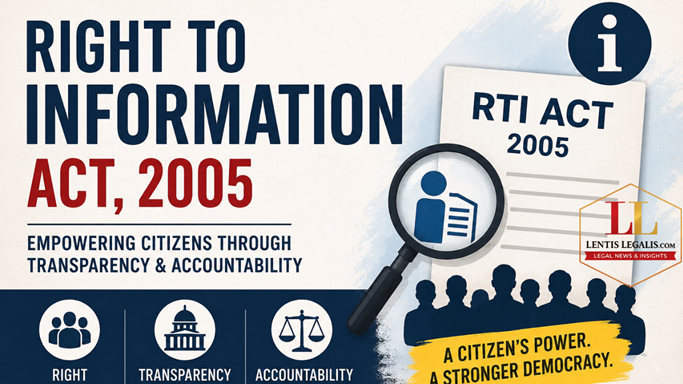
Right to Information Act, 2005: A Comprehensive Legal Insight into the Citizen’s Right to Information

Lentis Legalis | 06 May 2026
Reviewed by Adv. Chandrasen Yadav
The Parliament of India enacted the Right to Information Act, 2005 to give concrete shape to the citizen’s “right to know.” Its passage marked a decisive shift in Indian governance from a culture of secrecy to one of transparency and accountability. The jurisprudential foundation of this right had already been laid by the Supreme Court of India in landmark rulings such as State of UP v. Raj Narain and S. P. Gupta v. President of India, wherein the Court recognised the right to information as an intrinsic facet of the freedom of speech and expression under Article 19(1)(a) of the Constitution.
In a democratic polity, the citizen’s voice must be informed to be meaningful. Transparency is essential not only for the effective functioning of democracy but also for curbing corruption and ensuring governmental accountability. By transforming the abstract “right to know” into a legally enforceable entitlement, the RTI Act strengthens participatory governance and deepens democratic values.
The RTI Act, which came into force on 12 October 2005, comprises a Preamble, six chapters, 31 sections, and two schedules. It establishes a statutory mechanism enabling citizens to access information held by public authorities.
Section 3 of the Act lays down the foundational principle stating “Subject to the provisions of this Act, all citizens shall have the right to information.” The phrase “subject to the provisions” indicates that the right is not absolute and operates within the limitations prescribed under Section – 8, Section- 9 and Section -11.
Section 4: Obligations of Public Authorities – A defining feature of the RTI regime is proactive disclosure. Section 4 imposes a positive obligation on public authorities to:
- Maintain records in a catalogued and indexed manner
- Digitise and computerise information for wider access
- Publish key institutional and operational details suo motu
Such disclosures include organisational structure, powers and duties of officials, decision-making processes, budget allocations, subsidy details, and particulars of beneficiaries, among others.
Importantly, authorities must also Publish relevant facts while framing policies, Provide reasons for administrative or quasi-judicial decisions. This shifts the regime from reactive disclosure to a culture of openness, reducing the need for individual RTI applications. Section 5 provides Designation of Public Information Officers.
Procedure for Seeking Information (Section 6) – The Act provides a simple and citizen-friendly procedure: Applications may be filed in writing or electronically in any Languages English or Hindi, or in any local official language, no requirement to provide reasons and Minimal personal details required
If an applicant cannot submit a written request, the Public Information Officer (PIO) must assist in reducing it into writing. If the application is filed before the wrong authority, it must be transferred within 5 days.
Time-bound Disposal of Requests (Section 7) – The Act ensures strict timelines:30 days for general information and 48 hours where life or liberty is involved, and Failure to respond within time results in deemed refusal, triggering the right to appeal.
Exemptions and Limitations (Sections 8 & 9) – The RTI Act balances transparency with legitimate restrictions. Information may be denied where disclosure:
- Affect, sovereignty and integrity of India, the security, strategic, scientific or economic interests of the State, relation with foreign State or lead to incitement of an offence,
- expressly forbidden to be published by any court of law or tribunal or the disclosure of which may constitute contempt of court;
- Breach parliamentary privilege,
- Harm commercial or fiduciary interests, endanger life or safety, impede investigation, relate to personal information without public interest and additionally requests may be rejected if disclosure would involve an infringement of copyright subsisting in a person other than the State.
However, a crucial safeguard exists under section 10 dealing with Severability ensures that non-exempt portions of records must still be disclosed.
Third-Party Information (Section 11)- Where information relates to a third party and is confidential, the PIO must: Issue notice to the third party, Consider its representation, Decide within 40 days and Disclosure is permitted if public interest outweighs potential harm of such third party.
Institutional Mechanism: Information Commissions
The Act establishes independent bodies: Central Information Commission and State Information Commission. These bodies function with powers similar to civil courts and ensure enforcement of the Act.
Appeal and Complaint Mechanism (Section 19 & 18) – A two-tier appeal structure is provided:
First Appeal Filed before a senior officer (FAA) Within 30 days and Second Appeal Filed before the Information Commission within 90 days
Additionally, complaints may be filed for: Refusal to accept application, in case of No response, Unreasonable fees, False or misleading information and The burden of proof lies on the PIO, not on the applicant.
Penalties and Accountability (Section 20) – To ensure effectiveness, strict penalties are prescribed:Rs. 250 per day for delayandMaximum penalty of Rs. 25,000 additionally Recommendation of disciplinary action in serious cases. This makes the Act enforceable, not merely declaratory.
Overriding Effect and Limited Exclusions – The RTI Act overrides conflicting laws, including the Official Secrets Act, 1923, reinforcing transparency. However, certain intelligence and security organisations are exempt, except in cases involving: Corruption and Human rights violations The RTI Act, 2005 is not merely a legal framework but it is a democratic instrument of empowerment. It enables citizens to question authority, demand accountability, and participate meaningfully in governance. By ensuring transparency while safeguarding national interest and privacy, the Act strikes a delicate but essential balance. Its true strength, however, lies not merely in its provisions, but in its active use by an informed and vigilant citizenry. A democracy thrives not just on the right to speak but on the right to know.
Author
Adv. Chandrasen Yadav
B.Sc., LL.B. & LL.M.

Supreme Court Reserves Judgement on Review Petitions Clubbed with Bhumika Trust’s Writ Petition Challenging the Mandatory Three-Year Practice Rule for Entry-Level Judicial Officers

Uttar Pradesh Information Commission Imposes Maximum Statutory Penalty Rs. 25,000/- and warned for further departmental action on Gram Panchayat Officer of Ayodhya district for not providing information under RTI Act 2005.

Right to Information Act, 2005: A Comprehensive Legal Insight into the Citizen’s Right to Information
Section 107 of the Bharatiya Nyaya Sanhita, 2023: Abetment of suicide of child or person of unsound mind.

Supreme Court to Hear Review Petition on 10 February 2026 Challenging Mandatory Three-Year Practice Requirement for Entry-Level Judicial Services

Major Relief for Law Students as Supreme Court Opens Review on Mandatory 3-Year Practice Rule

-
Bharatiya Nyaya Sanhita (BNS)7 months ago
Section 107 of the Bharatiya Nyaya Sanhita, 2023: Abetment of suicide of child or person of unsound mind.
-
 Supreme Court Highlights9 months ago
Supreme Court to Hear Review Petition on 10 February 2026 Challenging Mandatory Three-Year Practice Requirement for Entry-Level Judicial Services
-
 Landmark judgements8 months ago
Major Relief for Law Students as Supreme Court Opens Review on Mandatory 3-Year Practice Rule
-
Bharatiya Nyaya Sanhita (BNS)7 months ago
Section 125 of the Bharatiya Nyaya Sanhita, 2023: Act endangering life or personal safety of others.
-
Bharatiya Nyaya Sanhita (BNS)7 months ago
Section 111 of the Bharatiya Nyaya Sanhita, 2023: Organised crime.
-
Bharatiya Nyaya Sanhita (BNS)7 months ago
Section 109 of the Bharatiya Nyaya Sanhita, 2023: Attempt to murder.
-
Bharatiya Nyaya Sanhita (BNS)7 months ago
Section 120 of the Bharatiya Nyaya Sanhita, 2023: Voluntarily causing hurt or grievous hurt to extort confession, or to compel restoration of property.
-
Bharatiya Nyaya Sanhita (BNS)7 months ago
Section 34 of the Bharatiya Nyaya Sanhita, 2023: Things done in private defence.