Latest Judgments
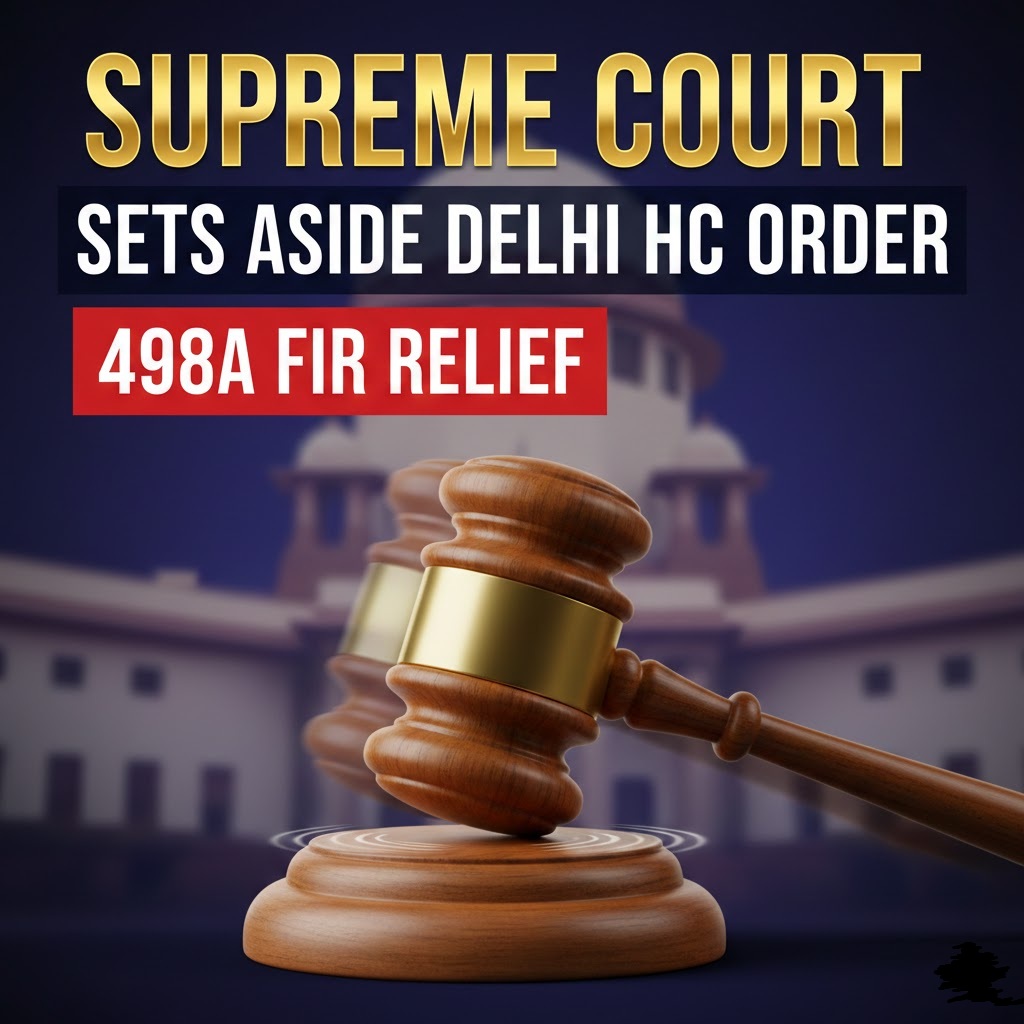
Supreme Court Sets Aside Delhi High Court Order in 498A FIR Case; Restores Plea for Quashing
The Supreme Court has set aside an order of the Delhi High Court which had dismissed a writ petition seeking quashing of an FIR lodged under Sections 498A and 406 read with Section 34 of the Indian Penal Code, holding that the High Court committed a gross and patent error by refusing to examine the merits of the challenge.

New Delhi:
The Supreme Court has set aside an order of the Delhi High Court which had dismissed a writ petition seeking quashing of an FIR lodged under Sections 498A and 406 read with Section 34 of the Indian Penal Code, holding that the High Court committed a gross and patent error by refusing to examine the merits of the challenge.
The ruling came in Rajnish Kumar Biswakarma v. State of NCT of Delhi & Anr., arising out of SLP (Criminal) No. 5290 of 2024, wherein the appellant-husband was accused pursuant to an FIR registered on 8 May 2019 at the instance of his wife.
Before registration of the FIR, the appellant had approached the Family Court under Section 12 of the Hindu Marriage Act, 1955, seeking a declaration of nullity of marriage. Although an earlier writ petition for quashing the FIR was withdrawn in November 2020, the Family Court subsequently passed a decree of nullity on 23 June 2021.
Thereafter, the appellant again approached the Delhi High Court seeking quashing of the FIR, contending inter alia that the criminal proceedings were an abuse of the process of law, having been initiated after the matrimonial proceedings were set in motion.
However, by its order dated 7 November 2023, the High Court dismissed the writ petition without examining its merits and directed the Trial Court to consider the decree of nullity and the appeal filed against it at the stage of framing of charge.
Disapproving the High Court’s approach, the Supreme Court observed that directing the Trial Court to consider documents not forming part of the charge-sheet at the stage of framing of charge was contrary to settled law.
Relying on State of Orissa v. Debendra Nath Padhi (2005) 1 SCC 568, the Court reiterated that at the stage of framing of charge or considering discharge, the Trial Court cannot look into documents beyond the charge-sheet.
The Court further noted that the High Court failed to examine the challenge to the FIR on merits under Section 482 CrPC, rendering its order legally unsustainable.
Rejecting the submission of the Additional Solicitor General that a challenge to an FIR must be raised at the inception itself, the Supreme Court clarified that:
An accused can seek quashing of an FIR or criminal proceedings at any stage of the proceedings under Section 482 CrPC or Article 226 of the Constitution, subject to the discretion of the High Court.
The Court categorically held that a quashing petition cannot be dismissed solely on the ground of delay or earlier withdrawal.
Relief Granted
Accordingly, the Supreme Court has Set aside the Delhi High Court’s order dated 7 November 2023; Restored Writ Petition (Criminal) No. 696 of 2022 to the file of the Delhi High Court; Directed that the petition be listed before the Roster Bench on 17 December 2024; Ordered continuation of the interim protection granted on 10 April 2024 till disposal of the writ petition and the Court clarified that all issues are left open to be decided by the High Court.
The judgment reinforces two crucial principles that High Courts must examine FIR-quashing petitions on merits, especially when abuse of process is alleged; and Quashing jurisdiction is not confined to the inception stage of criminal proceedings.





Constitution
Supreme Court Reserves Judgement on Review Petitions Clubbed with Bhumika Trust’s Writ Petition Challenging the Mandatory Three-Year Practice Rule for Entry-Level Judicial Officers
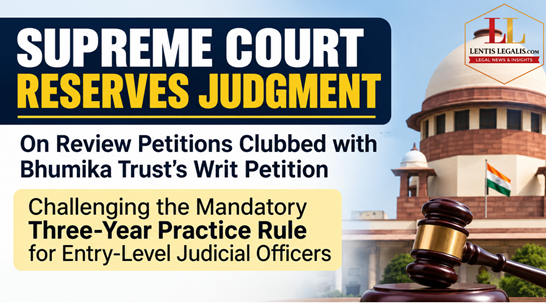
A bench of Supreme Court comprising Chief Justice of India Surya Kant, Justice August George Masih and Justice K. Vinod Chandran has reserved judgment after hearing a batch of review petitions clubbed with the writ petition filed by Bhumika Trust, which seeks relaxation of the mandatory three-year practice requirement for persons with disabilities.
The writ Petition filed on 14-11-2025 by Bhumika Trust, prayed for following reliefs as mentioned hereinbelow-
“a. Issue an appropriate writ order or direction in nature of Mandamus or any other appropriate writ, thereby declaring order, and declaring the application of the mandatory three-year practice requirement for appointment to the post of Civil Judge (Junior Division), as upheld in the judgment dated 20.05.2025 in All India Judges Association v. Union of India, All India Judges Association & Ors. v. Union of India & Ors., (2025) INSC 735, W.P. (C) No. 1022 of 1989 to be unconstitutional and violative of Articles 14, 16, and 21 of the Constitution of India, insofar as it applies to persons with benchmark disabilities.
b. Issue an appropriate writ order or direction in nature of Mandamus or any other appropriate writ , thereby direct the respondents to frame a comprehensive policy on reasonable accommodation for persons with benchmark disabilities in judicial service recruitment, in compliance with Sections 3, 20, 32, 33, and 34 of the Rights of Persons with Disabilities Act, 2016, including but not limited to:
i. Provide exemption from or alternate requirements in place of the mandatory three-year practice rule to avoid indirect discrimination against persons with disabilities, ensuring fair access to judicial recruitment.
ii. Conduct all judicial service examinations and interviews in accessible formats, including screen reader compatibility for visually impaired candidates, provision of sign language interpreters for the hearing impaired, scribes for those with writing difficulties, and any other necessary accommodations to enable full participation.
iii. Judicial academies must develop and implement training materials and methods tailored to the specific accessibility needs of persons with benchmark disabilities, such as accessible digital content and inclusive teaching practices.
iv. Ensure provision of necessary assistive technologies (e.g., screen readers, hearing aids), accessible physical infrastructure (ramps, elevators, accessible toilets), and reasonable support services during judicial training and throughout the tenure of service.
v. Provide continuous reasonable support, such as interpreters, scribes, and personal assistance during both training and judicial service to enable effective and dignified participation These measures are essential to eliminate systemic exclusion and to uphold the constitutional rights to equality, non-discrimination, and dignity under Articles 14, 16, and 21 of the Constitution of India, ensuring the judicial service recruitment process is inclusive, accessible, and equitable for persons with benchmark disabilities.
c. Issue an appropriate writ order or direction in nature of Mandamus or any other appropriate writ, thereby direct the appropriate respondents to identify job positions vacant and all backlogs in various departments in Indian judiciary that can be suitably held by persons with benchmark disabilities for the purpose of filling reserved vacancies as mandated under Section 33 of the Rights of Persons with Disabilities Act, 2016. This includes constituting an expert committee, which must include representation from persons with benchmark disabilities, to assist in identifying these suitable posts. Further, the Government should undertake a periodic review of the identified posts at intervals not exceeding three years to ensure that these positions remain appropriate, accessible, and equitable for persons with disabilities, thereby promoting inclusive and fair employment opportunities in public services.
d. Issue an appropriate writ order or direction in nature of Mandamus or any other appropriate writ, thereby declare that the failure to provide reasonable accommodation in judicial appointments amounts to systemic exclusion of persons with disabilities and violates their constitutionally protected rights to equality, non-discrimination, and dignity under Articles 14, 16, and 21 of the Constitution of India.”
The review petitions challenged the Supreme Court’s judgment dated 20-05-2025, whereby the Court mandated a minimum of three years’ legal practice as pre-requisite eligibility condition for candidates seeking direct recruitment to the post of Civil Judge (Junior Division) after obtaining a law degree.
Among the review petitions, one was filed on 16-06-2025 by Chandrasen Yadav, through Advocate-on-Record Kunal Yadav. In addition to seeking a review of the judgment dated 20 May 2025, the petitioner also proposed an alternative remedy in the form of a “cooling-off period.” It was contended that such a transitional arrangement would mitigate the immediate hardship caused by the newly introduced eligibility criterion.
The bench of Hon’ble Supreme Court comprising Chief Justice of India Surya Kant, Justice August George Masih and Justice K. Vinod Chandran in above Review Petition having diary number 33086 of 2025 [Review Petition number 420/2026] with another Review petition Diary number 30163 of 2025 [Review Petition number 421/2026] after perusing the record available in these review petitions allowed the Application for permission to file Review Petitions and listed the review petitions in the open court and allowed oral hearing.
On 28-07-2026 the Bench heard extensive submissions from various counsels, intervenors, and the Amicus Curiae before reserving the judgment.
Before Starting the deliberations on the issue counsel of Maharashtra Public Service Commission put up the point that they have already notified 286 posts for the civil judge junior division and they are facing hardship in starting the selection process because of the interim order which had stalled the selection process nationwide.
Mr. Jayant Singh Raghav appearing in person on behalf of Bhumika trust, Writ Petition contended that he has compiled some suggestions in the form of written submissions and presented before the court.
The review petitioner Chandrasen Yadav was represented by Sr. Advocate Pinky Anand in the Review Petition number 420/2026. During Arguments she not only highlighted the grounds why the judgement dated 20-05-2025 must be reviewed but also suggested few recommendations
Grounds taken by Sr. Advocate Pinky Anand on behalf of review petitioner Chandrasen yadav is mentioned hereinbelow –
- Absence of Empirical Data: No empirical or statistical evidence has been provided to justify the claim that fresh law graduates perform inadequately as judges, making the basis of the restriction speculative and arbitrary.
- Financial and Institutional Barriers: The judgment fails to account for the lack of financial and institutional support available to first-generation lawyers and students from economically weaker sections, who cannot afford to spend three unpaid years in litigation practice before becoming eligible.
- Lack of Structured Mentorship: No mechanism has been proposed for how fresh law graduates will secure practical training or mentorship during the mandated three-year practice period.
- Impugned judgment does not provide a transition clause and affects students retrospectively even those who were previously eligible.
- Disproportionate Impact on Women candidates and Marginalized Groups: The rule disproportionately affects Women candidates and students from socially and educationally disadvantaged backgrounds, including SC, ST, OBC, and EWS categories and, many of whom aspire to judiciary as a means of social mobility and justice.
- Disregard for Institutional Training: The judgment fails to appreciate the structured and institutional training imparted during LL.B. courses and the mandatory training provided post-selection by State Judicial Academies.
- Neglect of Shetty Commission Report: The decision erroneously ignores the findings and recommendations of the Shetty Commission, particularly paragraphs 8.31, 8.34, and 8.35, which emphasize the sufficiency of post-selection training over prior practice.
- Violation of Fundamental Rights: The judgment infringes upon the fundamental rights guaranteed under Articles 14 (equality before the law), 16 (equal opportunity in public employment), and 19(1)(g) (freedom to practice any profession), especially for law graduates who had fulfilled the eligibility criteria prevailing at the time of their education.
- Suggestions provided by Sr. Advocate Pinky Anand on behalf of review petitioner Chandrasen yadav is mentioned hereinbelow –
- Replace the mandatory pre-recruitment three-year practice requirement with structured post-selection training.
Instead of insisting on three years of Bar practice before recruitment, selected candidates should receive supervised practical training during their induction period.
- Introduce a judicial apprenticeship model.
Newly selected Civil Judges should be attached to District Judges as apprentices, law clerks, or judges-in-training to gain practical exposure to judicial administration, legal reasoning, ethics, and courtroom management.
- Provide structured exposure in advocates’ chambers.
During training, judicial recruits may be attached to designated Senior Advocates, Government Pleaders, Advocate Generals, Standing Counsel, or Legal Aid Defence Counsel under NALSA’s LADC Scheme to obtain meaningful litigation experience.
- Adopt international best practices.
Consider a model similar to Germany, where judicial aspirants undergo a structured preparatory training programme across courts, prosecution offices, administrative authorities, and law offices instead of relying solely on independent Bar practice.
- Create a uniform national induction curriculum.
Standardize judicial training across all State Judicial Academies through the National Judicial Academy or a permanent committee headed by the Chief Justice of India to ensure consistent quality and practical orientation.
- Strengthen practical legal education during law school.
Introduce optional structured six-month practice modules and specialized judicial-track courses within LL.B. programmes to equip aspiring judges with practical skills before recruitment.
- Promote continuous judicial education.
Encourage lifelong professional development through scholarships for higher legal studies, exchange programmes, deputations, and periodic training linked to career advancement and elevation.
- Grant a transitional (“cooling-off”) period.
Instead of immediate implementation of the three-year practice requirement, provide a transitional window for candidates who had legitimately prepared under the previous eligibility criteria so that they are not rendered ineligible overnight.
Senior Advocate Colin Gonsalves, appearing for review petitioner Jaideep Subudhi, urged the Supreme Court to adopt experiential learning models in place of a rigid pre-recruitment litigation requirement. He advocated for structured legal aid work, judicial clerkships, internships, and continuous judicial training as more effective alternatives to the mandatory three-year Bar practice requirement.
Drawing the Court’s attention to the views of National Law Universities (NLUs) and other premier law institutions, Gonsalves submitted that they had overwhelmingly opposed the three-year litigation mandate. He argued that such a requirement would discourage meritorious law graduates from joining the judicial service, pointing out that only around 20% of graduates from the National Law School of India University (NLSIU) pursue active litigation. He further submitted that the requirement could aggravate the existing shortage of judicial officers by making entry into the subordinate judiciary less attractive.
Questioning the procedural correctness of the judgment dated 20 May 2025, Gonsalves argued that a three-Judge Bench could not have effectively overruled an earlier decision of a coordinate three-Judge Bench without referring the issue to a larger Bench.
Addressing the Court, he submitted:
“The suggestion made here is experiential learning… judges who are taken from day one through legal aid, clerkship, and internship-based models, continuous evaluation, accountable mechanisms, and holistic, evolving judicial training. The NLUs and leading law colleges have emphatically opposed the three-year rule… Only 20% of NLSIU graduates are entering law practice.”
Special provisions were also proposed for persons with disabilities, including limiting the mandatory practice requirement to one year—preferably after selection—and recognising judicial clerkships and research assignments as equivalent forms of practical legal experience until accessible judicial infrastructure is fully developed.
Appearing as Amicus Curiae, Senior Advocate Siddharth Bhatnagar also favoured a staggered implementation if the Court ultimately retained the three-year eligibility criterion. He suggested permitting fresh law graduates to participate in the 2026 judicial service examinations while progressively increasing the practice requirement—from zero years in 2026, one year in 2027, two years in 2028, and three years from 2029 onwards.
Referring to applications seeking relaxation of the upper age limit due to delayed recruitment cycles, Chief Justice Surya Kant observed that age-related relief may require consideration before the Court reserved judgment. Bhatnagar further suggested that concessions such as lower qualifying marks could be considered for women and persons with disabilities and recommended that judicial clerkships be recognised towards the prescribed legal practice requirement.
Case Title:
Writ Petition –
All India Judges Association v. Union of India (W.P. (C) No. 1110/2025)
&
Review Petition –
Chandrasen Yadav Vs. Union Of India & Ors. [ RP(C) 420/2026]
Falguni Mittal Vs. Union of India & Ors. Jaideep Subudhi Vs.Union Of India & Ors etc.
Crime And Justice
Case Review of the Landmark Judgement : Imran Pratapgadhi v. State of Gujarat 2025 INSC 410

Lentis Legalis| 04.03.2026
Chandrasen Yadav
The appellant in the present matter, Imran Pratapgadhi who was a Member of the Rajya Sabha. The 2nd respondent Kishan Bhai Dipak Bhai Nanda was the first informant at whose instance a First Information Report (for short, ‘FIR’) was registered with Jamnagar Police Station for the offences punishable under Sections 196, 197(1), 302, 299, 57 and 3(5) of the Bharatiya Nyaya Sanhita, 2023 (for short, ‘the BNS’).
| Offence | Section No. of BNS |
| Promoting enmity between different groups on ground of religion, race, place of birth, residence, language, etc , and doing acts prejudicial to maintenance of harmony. | 196 |
| Imputations, assertions prejudicial to national integration | 197(1) |
| Uttering words, etc., with deliberate intent to wound religious feelings of any person. | 302 |
| Deliberate and malicious acts, intended to outrage religious feelings of any class by insulting its religion or religious beliefs. | 299 |
| Abetting commission of offence by the public or by more than ten persons. | 57 |
| Rule of evidence for Constructive liability in case of act done in furtherance of any Common intention | 3(5) |
In the complaint of the 2nd respondent, he stated that on 29th December 2024, on the occasion of the birthday of one Altaf Ghafarbhai Khafi, a member of the Municipal Corporation of Jamnagar, a mass wedding program was held at Sanjari Education and Charitable Trust. The said Municipal Councillor invited the present appellant to the function. A video of the event was made. The appellant posted the video on the social media platform ‘X’ from his verified account. The video has the recitation of a poem reproduced hereinbelow-
“ए खून (blood) के प्यासो (thirsty) बात सुनो ग ़र हक्क़ (truth) की लडाई जुल्म (excesses/injustice) सही
हम जुल्म (excesses/injustice) से इश्क़ (love) ननभा देंगे गर शम- ए- नगररया (melting of a candle which resembles tears) आनतश (flame) है
हर राह वो शम्मा (light) जला देंगे गर लाश हमारे अपनोोंकी खतरा है तुम्हारी मसनद (throne) का
उस रब (god) की ़सम हस्ते हस्ते नकतनी लाशे दफ़ना देंगे ए खूनके प्यासोों बात सुनो”
The allegation in the complaint is that the spoken words of the poem incite people of one community against another, and it hurts a community’s religious and social sentiments. It is alleged that the song had lyrics that incited people of other communities to fight for the community’s rights. It is alleged that the video posted by the appellant created enmity between two communities at the national level and hatred towards each other. It was further alleged that it had a detrimental effect on national unity.
The appellant before coming to the Supreme Court had filed a petition under Section 528 of the Bharatiya Nagarik Suraksha Sanhita (for short, ‘the BNSS’) read with Article 226 of the Constitution of India, praying for quashing the said FIR in the High Court. While issuing notice on the said petition, the learned Judge had directed the appellant to file an affidavit disclosing the poem’s source. Accordingly, an affidavit was filed by the appellant but could not disclose the specific origin of the source.
The learned Single Judge of the High Court by impugned judgment and order, rejected the petition by holding that as the investigation is at a very nascent stage, interference cannot be made in view of the judgement of the Hon’ble Supreme Court in the case of Neeharika Infrastructure Pvt. Ltd. v State of Maharashtra 2021 SCC Online SC 315.
Appellant in support of the appeal had taken following grounds-
- That none of the ingredients of the offences alleged against the appellant are made out on the plain reading of the complaint and the poem.
- It cannot be said that the poem caused social disharmony amongst the people.
- the poem does not promote disharmony or feelings of enmity, hatred or ill-will between the various religious, racial, language or regional groups and castes or communities.
- The plain reading of the poem indicated that it was all about sacrificing oneself to fight for rights and truth.
- That registration of the FIR based on the said poem violates the appellant’s fundamental right guaranteed under Article 19(1)(a) of the Constitution.
Supreme Court highlighting the role of dissent mentioned that Free expression of thoughts and views by individuals or groups of individuals is an integral part of a healthy, civilised society. Without freedom of expression of thoughts and views, it is impossible to lead a dignified life guaranteed by Article 21 of the Constitution. In a healthy democracy, the views, opinions or thoughts expressed by an individual or group of individuals must be countered by expressing another point of view. Even if a large number of persons dislike the views expressed by another, the right of the person to express the views must be respected and protected.
Supreme Court in the Judgement mounted a standard that The Courts are duty-bound to uphold and enforce fundamental rights guaranteed under the Constitution of India. Sometimes, we, the Judges, may not like spoken or written words. But, still, it is our duty to uphold the fundamental right under Article 19 (1)(a). We Judges are also under an obligation to uphold the Constitution and respect its ideals. If the police or executive fail to honour and protect the fundamental rights guaranteed under Article 19 (1)(a) of the Constitution, it is the duty of the Courts to step in and protect the fundamental rights. There is no other institution which can uphold the fundamental rights of the citizens.
Supreme court not only set aside the impugned order of the High Court but also quashed the FIR which was registered against the Imran Pratapgaradhi.
Read full Judgement:
https://api.sci.gov.in/supremecourt/2025/3511/3511_2025_4_1501_60508_Judgement_28-Mar-2025.pdf

This appeal was at the instance of the State of Madhya Pradesh and was directed against the judgment and order dated 29.06.2010 passed by the High Court of Madhya Pradesh of judicature at Gwalior in Criminal Appeal No. 524 of 2004 whereby the High Court allowed the appeal filed by the respondent herein and acquitted him of the offence under Section(s) 302, 201 and 34 respectively of the Indian Penal Code, 1860 (for short, the ‘IPC’).
The deceased, namely, Birendra Kumari was married to the respondent accused. In the wedlock, two sons and a daughter named Rani were born. Rani at the time of the incident in 2003, was seven years of age.
On 15.07.2003 sometime during the midnight, Bhoora Singh @ Yashpal i.e., the complainant along with his father Bharat Singh; reported an incident of unnatural death to the Indar Police Station at around 9:00 AM . In the said report, the Complainants stated that on the fateful night of the incident, at around 12:00 AM, they heard the cries and screams of the deceased which eventually ceased. Shortly, thereafter they saw the accused along with his family members cremating the deceased in their field. It was further stated that when they went to the house of the accused to inquire about the incident, the daughter of the deceased (Rani) informed that her mother had died.
Upon enquiry done by ASI Mahendra Singh Chauhan an FIR was lodged bearing no. 142 of 2003 dated 20.07.2003 came to be registered against the respondent and her sister, Jatan Bai for the offence punishable under Section(s) 302, 201 read with 34 respectively of the IPC.
Trial Court vide its final judgment and order dated 09.08.2004 passed in Sessions Trial No. 197 of 2003 held the respondent accused guilty of the said offences of IPC.
The accused convict being dissatisfied with the judgment and order passed by the Trial Court, went in appeal before the High Court by way of Criminal Appeal No. 524 of 2004. The High Court vide its final judgment and order dated 29.06.2010 allowed the appeal and acquitted the respondent accused.
The High Court holding the oral evidence of the daughter, who was just 7 years old at the time of incidence being unreliable and some other reasons to extended the benefit of doubt to the accused.
The Supreme Court of India, in the present matter, examined the law relating to the evidentiary value of a child witness and the tests for identifying tutored testimony. The Court held that the evidence of a child witness stands on the same footing as that of any other witness, subject to certain well-recognised safeguards and caution. Accordingly, the appeal was allowed, the impugned judgment and order of acquittal passed by the High Court were set aside, and the judgment and order of conviction passed by the Trial Court in S.T. No. 197 of 2003 were restored.
Author
Chandrasen Yadav
B.Sc, LL.B& LL.M

Supreme Court Reserves Judgement on Review Petitions Clubbed with Bhumika Trust’s Writ Petition Challenging the Mandatory Three-Year Practice Rule for Entry-Level Judicial Officers

Uttar Pradesh Information Commission Imposes Maximum Statutory Penalty Rs. 25,000/- and warned for further departmental action on Gram Panchayat Officer of Ayodhya district for not providing information under RTI Act 2005.

Right to Information Act, 2005: A Comprehensive Legal Insight into the Citizen’s Right to Information
Section 107 of the Bharatiya Nyaya Sanhita, 2023: Abetment of suicide of child or person of unsound mind.

Supreme Court to Hear Review Petition on 10 February 2026 Challenging Mandatory Three-Year Practice Requirement for Entry-Level Judicial Services

Major Relief for Law Students as Supreme Court Opens Review on Mandatory 3-Year Practice Rule

-
Bharatiya Nyaya Sanhita (BNS)7 months ago
Section 107 of the Bharatiya Nyaya Sanhita, 2023: Abetment of suicide of child or person of unsound mind.
-
 Supreme Court Highlights9 months ago
Supreme Court to Hear Review Petition on 10 February 2026 Challenging Mandatory Three-Year Practice Requirement for Entry-Level Judicial Services
-
 Landmark judgements8 months ago
Major Relief for Law Students as Supreme Court Opens Review on Mandatory 3-Year Practice Rule
-
Bharatiya Nyaya Sanhita (BNS)7 months ago
Section 125 of the Bharatiya Nyaya Sanhita, 2023: Act endangering life or personal safety of others.
-
Bharatiya Nyaya Sanhita (BNS)7 months ago
Section 109 of the Bharatiya Nyaya Sanhita, 2023: Attempt to murder.
-
Bharatiya Nyaya Sanhita (BNS)7 months ago
Section 111 of the Bharatiya Nyaya Sanhita, 2023: Organised crime.
-
Bharatiya Nyaya Sanhita (BNS)7 months ago
Section 120 of the Bharatiya Nyaya Sanhita, 2023: Voluntarily causing hurt or grievous hurt to extort confession, or to compel restoration of property.
-
Bharatiya Nyaya Sanhita (BNS)7 months ago
Section 121 of the Bharatiya Nyaya Sanhita, 2023: Voluntarily causing hurt or grievous hurt to deter public servant from his duty.