
Bharatiya Sakshya Adhiniyam (BSA)
Section 3 of the Bharatiya Sakshya Adhiniyam, 2023: Evidence may be given of facts in issue and relevant facts.

Lentis Legalis | 30 March 2026
Reviewed by Adv. Chandrasen Yadav
Section -3 BSA: Evidence may be given of facts in issue and relevant facts.—
Evidence may be given in any suit or proceeding of the existence or non-existence of every fact in issue and of such other facts as are hereinafter declared to be relevant, and of no others.
Explanation.—This section shall not enable any person to give evidence of a fact which he is disentitled to prove by any provision of the law for the time being in force relating to civil procedure.
Illustrations
(a) A is tried for the murder of B by beating him with a club with the intention of causing his death. At A’s trial the following facts are in issue:— A’s beating B with the club; A’s causing B’s death by such beating; A’s intention to cause B’s death.
(b) A suitor does not bring with him, and have in readiness for production at the first hearing of the case, a bond on which he relies. This section does not enable him to produce the bond or prove its contents at a subsequent stage of the proceedings, otherwise than in accordance with the conditions prescribed by the Code of Civil Procedure, 1908 (5 of 1908).
Author
Adv. Chandrasen Yadav
B.Sc., LL.B. & LL.M.
Bharatiya Sakshya Adhiniyam (BSA)
Section 1 of the Bharatiya Sakshya Adhiniyam, 2023: Short title, application and commencement.
Lentis Legalis | 30 March 2026
Reviewed by Adv. Chandrasen Yadav
Section – 1 : BSA – Short title, application and commencement.–
(1) This Act may be called the Bharatiya Sakshya Adhiniyam, 2023.
(2) It applies to all judicial proceedings in or before any Court, including Courts-martial, but not to affidavits presented to any Court or officer, nor to proceedings before an arbitrator.
(3) It shall come into force on such date as the Central Government may, by notification in the Official Gazette, appoint.
__________
Short title
Bharatiya Sakshya Adhiniyam, 2023
Application
This Act applies to all judicial proceedings in or before any Court, including Court Martial.
This Act does not applies to affidavits presented to any Court or officer, and
This Act also does not applies to proceedings before an arbitrator.
Commencement.
Enforcement Date – 01.07.2024
Author
Adv. Chandrasen Yadav
B.Sc., LL.B. & LL.M.
Bharatiya Nagarik Suraksha Sanhita (BNSS)
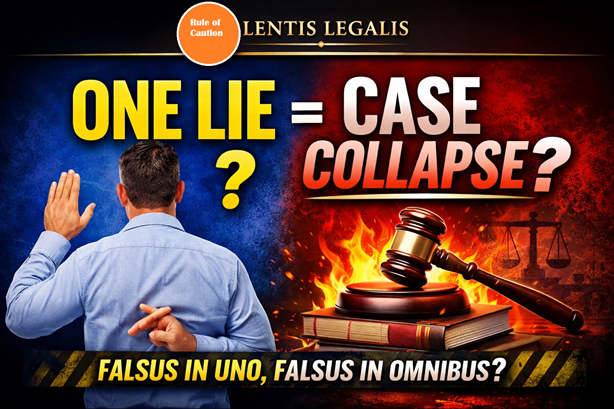
Falsus in Uno, Falsus in Omnibus: Rule of Law or Rule of Caution?

Lentis Legalis | 22 March 2026
Reviewed by Adv. Chandrasen Yadav
The principle of falsus in uno, falsus in omnibus, meaning “false in one thing, false in everything,” suggests that if a witness is found to have made a false statement on a material point, their entire testimony should be discarded. In its strict form, the doctrine implies that once a witness is proved untruthful in any part, it becomes desirable to reject the whole of their evidence, and consequently, the prosecution case built upon it.
The doctrine originated in the common law system, tracing back to the late seventeenth century. At one point, it operated as a mandatory presumption that a witness who had lied in any respect was wholly unreliable. However, by the nineteenth century, English courts began to dilute this rigidity, holding that the maxim should not be applied as an inflexible rule of law, but rather as a rule of caution. Courts were advised to assess evidence carefully, separating truth from falsehood instead of discarding the entire testimony outright.
Status of the Maxim in India:
Maxim falsus in uno, falsus in omnibus has no application in India and the witnesses cannot be branded as liars. It is the duty of the court to separate the grain from the chaff. Where chaff can be separated from the grain, it would be open to the court to convict an accused notwithstanding the fact that evidence has been found to be deficient to prove guilt of other accused persons. Falsity of a particular material witness or material particular would not ruin it from the beginning to end.
Maxim falsus in uno, falsus in omnibus has not received general acceptance nor has this maxim come to occupy the status of the rule of law. It is merely a rule of caution. The doctrine merely involves the question of weight of evidence which a court may apply in a given set of circumstances, but it is not what may be called a mandatory rule of evidence.’
Important Cases on the Point:
Gangadhar Behera And Ors vs State Of Orissa, 2002
Nisar Ali v. State of U.P. [AIR 1957 SC 366 : 1957 Cri LJ 550]
Author
Adv. Chandrasen Yadav
B.Sc., LL.B. & LL.M.

Supreme Court Reserves Judgement on Review Petitions Clubbed with Bhumika Trust’s Writ Petition Challenging the Mandatory Three-Year Practice Rule for Entry-Level Judicial Officers

Uttar Pradesh Information Commission Imposes Maximum Statutory Penalty Rs. 25,000/- and warned for further departmental action on Gram Panchayat Officer of Ayodhya district for not providing information under RTI Act 2005.

Right to Information Act, 2005: A Comprehensive Legal Insight into the Citizen’s Right to Information
Section 107 of the Bharatiya Nyaya Sanhita, 2023: Abetment of suicide of child or person of unsound mind.

Supreme Court to Hear Review Petition on 10 February 2026 Challenging Mandatory Three-Year Practice Requirement for Entry-Level Judicial Services

Major Relief for Law Students as Supreme Court Opens Review on Mandatory 3-Year Practice Rule

-
Bharatiya Nyaya Sanhita (BNS)7 months ago
Section 107 of the Bharatiya Nyaya Sanhita, 2023: Abetment of suicide of child or person of unsound mind.
-
 Supreme Court Highlights9 months ago
Supreme Court to Hear Review Petition on 10 February 2026 Challenging Mandatory Three-Year Practice Requirement for Entry-Level Judicial Services
-
 Landmark judgements8 months ago
Major Relief for Law Students as Supreme Court Opens Review on Mandatory 3-Year Practice Rule
-
Bharatiya Nyaya Sanhita (BNS)7 months ago
Section 125 of the Bharatiya Nyaya Sanhita, 2023: Act endangering life or personal safety of others.
-
Bharatiya Nyaya Sanhita (BNS)7 months ago
Section 111 of the Bharatiya Nyaya Sanhita, 2023: Organised crime.
-
Bharatiya Nyaya Sanhita (BNS)7 months ago
Section 109 of the Bharatiya Nyaya Sanhita, 2023: Attempt to murder.
-
Bharatiya Nyaya Sanhita (BNS)7 months ago
Section 120 of the Bharatiya Nyaya Sanhita, 2023: Voluntarily causing hurt or grievous hurt to extort confession, or to compel restoration of property.
-
Bharatiya Nyaya Sanhita (BNS)7 months ago
Section 121 of the Bharatiya Nyaya Sanhita, 2023: Voluntarily causing hurt or grievous hurt to deter public servant from his duty.