
Supreme Court Highlights
CASE REVIEW OF DELHI RIOTS CASE: bail denied to Sharjeel Imam and Umar Khalid but granted to five others

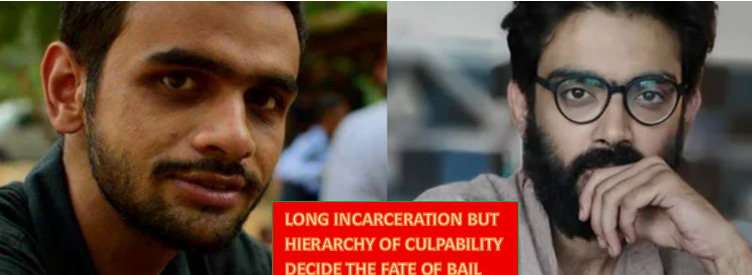
The Supreme Court denied bail to Umar Khalid and Sharjeel Imam in a judgement out of a common judgment and order passed denying the bail to all the accused of the Delhi riot case by the High Court of Delhi. The appellants stand arraigned as accused in FIR No. 59 of 2020 registered by the Crime Branch, Delhi, arising out of the incidents that occurred in several parts of Delhi in February 2020.
The appellants Sharjeel Imam, Umar Khalid, Shifa Ur Rehman, Mohd. Saleem Khan, Meeran Haider, Shadab Ahmed, and Gulfisha Fatima had filed appeal against the judgement of the High Court of Delhi before the Supreme Court.
At the inception, the appellants were booked under Sections 147, 148, 149 and 120B of the Indian Penal Code. Upon completion of investigation, a chargesheet came to be filed alleging offences under Sections 120B read with Sections 109, 114, 124A, 147, 148, 149, 153A, 186, 201, 212, 295, 302, 307, 341, 353, 395, 420, 427, 435, 436, 452, 454, 468, 471 and 34 of the Indian Penal Code, as also under Sections 13, 16, 17 and 18 of the Unlawful Activities (Prevention) Act, 1967, Sections 25 and 27 of the Arms Act, and Sections 3 and 4 of the Prevention of Damage to Public Property Act, 1984.
The prosecution case, as placed before the Court, proceeded on the ground that the incidents of violence were not isolated or spontaneous, but were the outcome of a larger conspiracy in which several accused persons are alleged to have participated at different stages and in different capacities. While the FIR and the impugned judgment are common, the role attributed to each appellant, the nature of the allegations, and the material relied upon by the prosecution are not uniform.
According to the prosecution it was alleged that a pre-planned criminal conspiracy involving several accused persons, including the present appellants was hatched with the object of orchestrating riots, which culminated in the deliberate incitement of widespread communal violence on and around 22nd, 23rd, and 24th February 2020. The acts allegedly committed during this period were not spontaneous but were the outcome of coordinated efforts to inflame tensions, mobilise crowds, and execute violent actions across various parts of Delhi as a form of protest against the enactment of the Citizenship Amendment Act, 2019 and the proposed National Register of Citizens.
The riots resulted in grave consequences, including the loss of 54 lives, among them a senior police officer and an Intelligence Bureau official, as well as grievous injuries to several police personnel and civilians. In addition, extensive damage was caused to over 1,500 public and private properties, alongside substantial intangible harm to public order, social harmony, and the nation at large.
It was also alleged that, as part of the said conspiracy, Umar Khalid delivered provocative speeches calling upon people to come out on the streets and block roads during the visit of the then President of the United States of America, Mr. Donald Trump, on 24th and 25th February 2020. The alleged objective of such actions was to internationalise a narrative that minorities in India were being illtreated and tortured. It is further alleged that women and children were deliberately mobilised to come out on the streets in various localities of Delhi to escalate tensions and precipitate communal violence.
The FIR further reveals that, in several areas’ weapons and incendiary materials such as firearms, petrol bombs, acid bottles, stones, slingshots and other dangerous substances were allegedly stockpiled in homes in advance.
| SL. No. | Name Of Appellant | Date of Arrest |
| 1 | Gulfisha Fatima | 11.04.2020 |
| 2 | Sharjeel Imam | 28.01.2020 |
| 3 | Meeran Haider | 01.04.2020 |
| 4 | Umar Khalid | 01.10.2020 |
| 5 | Shifa Ur Rehman | 26.04.2020 |
| 6 | Mohd Saleem Khan | 25.06.2020 |
| 7 | Shadab Ahmed | 20.05.2020 |
A fervent plea was addressed on behalf of the appellants resting on constitutional grounds that prolonged incarceration, coupled with the absence of any realistic prospect of early conclusion of trial, rendered continued detention constitutionally impermissible and mandate of Article 21 of the Constitution is at peril.
Relying on the Supreme Court’s judgement which recognised earlier that personal liberty cannot be sacrificed at the altar of procedural stagnation, and that prolonged pretrial incarceration may, in appropriate cases, justify constitutional intervention notwithstanding statutory restrictions on bail. It was submitted by the appellants that they had been in custody for a substantial length of time; that the progress of trial had been slow; and that the complexity of the prosecution rendered the likelihood of its early conclusion uncertain.
Reference was made to the nature of the allegations, the statutory framework invoked, and the role attributed to individual appellants. It is the reflection of the legal reality that the constitutional question of delay does not arise in a vacuum.
The highlighted that record discloses that all the appellants do not stand on an equal footing as regards culpability. The allegations against the principal accused indicate a central and directive role in conceptualising, planning, and coordinating the alleged terrorist act, whereas the material against certain co-accused reflects conduct of a subsidiary or facilitative nature. The hierarchy of participation, emerging from the prosecution’s case itself, requires the Court to assess each application individually, rather than proceed on the premise of equivalence. Such differentiation is intrinsic to criminal adjudication and operates irrespective of the uniformity of charges framed.
In the case of the alleged masterminds i.e., Sharjeel Imam and Umar Khalid, the prosecution material comprises direct, corroborative, and contemporaneous evidence, including recoveries, digital communication trails, and statements indicative of managerial responsibility. In contrast, the involvement of others is sought to be established mainly through associative or peripheral conduct. The Court cannot ignore that where evidentiary strength varies materially between accused persons, the need for continued detention likewise varies. Detention that remains necessary to secure ongoing prosecutorial 30 objectives for the principal offenders may not retain the same necessity for those of limited attribution.
The alleged masterminds are stated to have exercised command authority and to possess the ability to mobilise or influence individuals within and outside their immediate circle. Such allegations, when supported by preliminary material, compel heightened caution regarding the possibility of interference with witnesses or reactivation of dormant networks. As against this, co-accused with no independent capacity to mobilise resources or exert organisational leverage do not present the same systemic risk. The logic of detention cannot be applied homogenously where the risk profiles of the accused are markedly dissimilar.
The alleged masterminds are stated to have exercised command authority and to possess the ability to mobilise or influence individuals within and outside their immediate circle. Such allegations, when supported by preliminary material, compel heightened caution regarding the possibility of interference with witnesses or reactivation of dormant networks. As against this, co-accused with no independent capacity to mobilise resources or exert organisational leverage do not present the same systemic risk. The logic of detention cannot be applied homogenously where the risk profiles of the accused are markedly dissimilar.
It is well recognised that Article 21 rights, though not absolute, require the State and the Court to justify continued custody with reference to the specific individual before it. Treating all accused identically irrespective of their roles would risk transforming pre-trial detention into a punitive mechanism divorced from individual circumstances. The constitutional mandate demands a differentiated inquiry: where prolonged custody disproportionately burdens those whose roles are limited, the balance between individual liberty and collective security may call for conditional release, while the same balance may tilt differently for those alleged to have orchestrated the offence.
The statutory restrictions under special enactments do not preclude the Court from recognising distinctions between accused persons based on the quality of material, the nature of involvement, and the necessity of further detention.
At the outset, Umar Khalid and Sharjeel Imam are prima facie attributed a central role and alleged to be ideological drivers of the alleged conspiracy.
Even in the narrative concerning escalation into violence, the role attributed to the remaining accused is largely proximate and reactive, arising from developments at specific protest sites. Umar Khalid and Sharjeel Imam, on the 33 other hand, are alleged to have operated remotely away from the sites of violence, with no direct attribution of participation in acts of arson, assault, or destruction of property. The prosecution case thus proceeds on the footing that the former category of accused was involved in facilitating execution, whereas the latter were involved in conceptualisation and supervision.
A principle lies at the heart of constitutional adjudication in matters of this nature. The Constitution guarantees personal liberty, but it does not conceive liberty as an isolated or absolute entitlement, detached from the security of the society in which it operates. The sovereignty, integrity, and security of the nation, as well as the preservation of public order, are not abstract concerns rather they are constitutional values which Parliament is entitled to protect through law.
This Court is satisfied that the prosecution material, taken at face value as required at this stage, discloses a prima facie attribution of a central and formative role by the appellants i.e. Umar Khalid and Sharjeel Imam in the alleged conspiracy. The material suggests involvement at the level of planning, mobilisation, and strategic direction, extending beyond episodic or localised acts. The statutory threshold under Section 43D (5) of the Unlawful Activities (Prevention) Act, 1967, therefore stands attracted qua these appellants.
Supreme Court held that on the completion of the examination of the protected witnesses relied upon by the prosecution, or upon the expiry of a period of one year from the date of this order, whichever is earlier, these two appellants would be at liberty to renew their prayer for grant of bail before the jurisdictional Court.
The bail applications of appellants Gulfisha Fatima, Meeran Haider, Shifa-ur-Rehman, Mohd. Saleem Khan and Shadab Ahmed are allowed as the Court is of the view that, having regard to the role attributed, the nature of the material relied upon, and the present stage of the proceedings, continued incarceration is not shown to be indispensable to the conduct of a fair trial, provided strict safeguards are imposed. The grant of bail in their favour does not reflect any dilution of the seriousness of the allegations, nor does it amount to a finding on guilt. It represents a calibrated exercise of constitutional discretion, structured to preserve both liberty of the individual and security of the nation.
Advocate Chandrasen Yadav
B.Sc & LL.B from Allahabad University
LL.M from Central University of Punjab
Lucknow
Corporate Desk
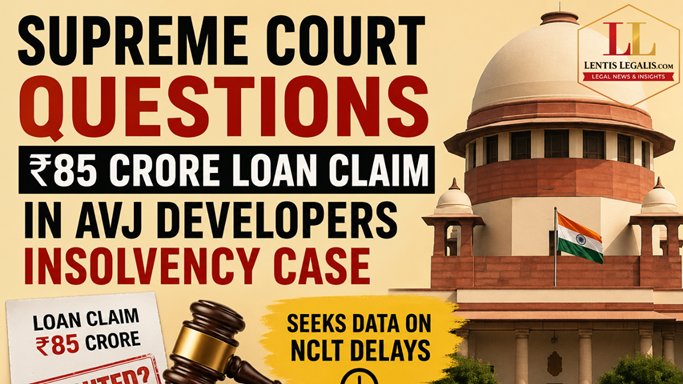
Supreme Court Flags Alleged Sham Rs. 85 Crore Claim in AVJ Developers Insolvency Case, Seeks Nationwide Data on NCLT Delays

Lentis Legalis | 16 April 2026
Reviewed by Adv. Chandrasen Yadav
New Delhi, April 29: In a significant hearing concerning the insolvency resolution of AVJ Developers (India) Private Limited, the Supreme Court of India on 16-04-2026 raised serious concerns over an alleged Rs. 85 crore financial claim described before it as “sham and bogus,” while also taking note of increasing delays in approval of resolution plans by insolvency tribunals across the country.
The matter came up in two connected appeals one filed by the AVJ Heightss Apartment Owners Association and another by a suspended director of the corporate debtor. Both appeals challenge a common judgment of the National Company Law Appellate Tribunal (NCLAT), which had upheld the admission of the claim of India Infoline Finance Limited (IIFL).
Disputed Rs. 85 Crore Claim Under Scrutiny
The Bench noted that the Resolution Professional had earlier rejected IIFL’s claim on January 24, 2020, citing inability to verify the claim from the company’s records. However, the National Company Law Tribunal (NCLT) later allowed the claim, and the NCLAT affirmed that decision.
During the hearing, counsel for the appellants argued that the entire claim was fraudulent. The Court was also informed of an arbitral award dated July 3, 2024, containing serious findings concerning the alleged loan transaction of Rs. 85 crores.
According to portions of the award referred to in court, the claimed loan amount was allegedly routed through multiple accounts instead of the sanctioned account, while certain documents relied upon to support the transaction were said to be tainted or inconsistent.
The arbitral tribunal reportedly questioned whether documents were backdated and whether signatures were genuine. It also made observations suggesting attempts to evergreen earlier loan accounts and avoid regulatory classification norms.
Court Concerned Over Delay in Resolution Plan Approval
Apart from the disputed financial claim, the Supreme Court expressed strong concern that the Committee of Creditors (CoC) had approved a resolution plan on July 4, 2024, and an application for approval was filed before the NCLT on July 12, 2024, yet no final adjudication has taken place even after a prolonged period.
Calling the situation “very unfortunate,” the Court observed that many such approval applications are reportedly pending before the NCLT Principal Bench, New Delhi, and other benches for years.
Directions to NCLT and IBBI
The Court directed the Registrar of the NCLT Principal Bench, New Delhi, to furnish details on:
- Number of pending resolution plan approval applications
- Duration of pendency
- Reasons for non-disposal
The Insolvency and Bankruptcy Board of India (IBBI) was also impleaded as a party respondent and directed to place necessary figures and statistics across the country, within two weeks.
Senior Advocates Appointed as Amicus
The Court requested Gopal Jain and Navin Pahwa, senior advocates, to assist the Court as amici curiae.
Case Title: AVJ HEIGHTSS APARTMENT OWNERS ASSOCIATION VS. IIFL FINANCE LIMITED & OTHERS
Read Full Judgement – Click Heare
Author
Adv. Chandrasen Yadav
B.Sc., LL.B. & LL.M.
Landmark judgements
Bonafide Need Must Be Judged on the date when the suit for eviction was filed: Supreme Court Sets Aside High Court Order in Eviction Case.

Lentis Legalis | 19 April 2026
Reviewed by Adv. Chandrasen Yadav
By allowing a civil appeal, The Hon’ble Supreme Court in a rent disputes and eviction matter reiterated the legal principle quoting Maganlal son of Kishanlal Godha Vs. Nanasaheb son of Udhaorao Gadewar, that while dealing with a landlord-tenant dispute, it was held that the adjudication of bonafide need should be done as on the date when the suit for eviction was filed, unless some subsequent event materially changes the ground of relief. It was further held that subsequent events may be considered to have overshadowed the genuineness of the landlord’s requirement only if they are of such nature and dimension as to make it lose its significance altogether.
Facts of the case: On 5th December, 1994, suit for eviction came to be filed under Section 28 of the Bombay Rents, Hotel and Lodging House Rates Control Act, 1947 by the legal heirs of Mr. Martins. The eviction of the sub-tenant was sought on the ground of bonafide need of the family of the principal tenant. It was specifically pleaded that the plaintiffs required the suit premises for their bonafide need so as to occupy the same.
Before the Trial Court, the parties led evidence. By judgment dated 18th July 2001, the learned Judge of the Trial Court recorded a finding that the plaintiffs had proved their bonafide need in respect of Room No.59 that was occupied by the defendants as the said premises was required for privacy of the widow of Mr. Martins, who was an old lady having 87 years of age and there were six daughters who used to visit her place. It was further held that greater hardship would be caused to the plaintiffs if the decree for eviction was not passed. The suit was, accordingly, decreed.
The defendants being aggrieved by the decree of eviction challenged the same by filing an appeal. The Appellate Court reversed the said decree on the reasoning that the plaintiff No.1, who was the widow of Mr. Martins had expired and, therefore, the bonafide need of the plaintiffs did not survive. Accordingly, the decree for eviction was set aside and the suit for eviction was dismissed.
The original plaintiffs being aggrieved by the reversal of the decree for eviction approached the High Court under Article 227 of the Constitution of India and challenged the aforesaid judgment. During pendency of the petition, the original defendants placed on record an affidavit in reply dated 12th April 2023, wherein it was stated that Room No.63 that was in occupation of the original plaintiffs was not being utilised by them and that the said room was occupied by some other persons. When the petition was taken up for hearing, it was noticed that the original plaintiffs had not filed any rejoinder to the defendants’ affidavit. The High Court, thus, held that the plaintiffs had let out Room No.63 despite the same being available to them which indicated that they did not bonafide require the suit premises. Accordingly, the petition was dismissed. Being aggrieved, one of the original plaintiffs has filed the present appeal before the Hon’ble Supreme Court.
Observations and Findings: Hon’ble Supreme Court after hearing the learned counsel for the parties and perusing the documentary material on record, opined that the writ petition did not warrant dismissal solely on the ground that the original plaintiffs failed to file any rejoinder to the defendants’ affidavit in reply dated 12th April 2023 and concluded on the point that all relevant material that was brought on record by both the parties ought to have been examined while deciding the writ petition. The affidavit in reply dated 12th April 2023 could have been considered as additional material in opposing the claim for eviction on the ground of bonafide need. Dismissal of the writ petition solely on the ground of NON-TRAVERSE has, in our view, vitiated the impugned judgment.
Supreme Court further observed that the High Court failed to consider whether the subsequent event as urged by the defendants had material bearing on the right claimed by the plaintiffs. It has to be borne in mind that the Trial Court had passed a decree for eviction on the basis of the evidence on record which was reversed by the Appellate Court. It was, therefore, necessary for the High Court to have taken into consideration the entire material available on record including the affidavit dated 12th April 2023. Thus, by failing to do so, the High Court failed to exercise jurisdiction vested in it while deciding the challenge to the reversal of the decree for eviction.
Accordingly, the order dated 4th February 2025 passed in Writ Petition No.1458 of 2003 was set aside. The proceedings in R.A.E. Suit No.70 of 1995 are remanded to the Small Causes Court, Mumbai for being decided afresh in accordance with law. The parties were given liberty to amend their pleadings and thereafter lead further evidence in accordance with law.
HON’BLE MR. JUSTICE J.K. MAHESHWARI and HON’BLE MR. JUSTICE ATUL S. CHANDURKAR
Read Full Judgement: Click Here
Author
Adv. Chandrasen Yadav
B.Sc., LL.B. & LL.M.
Crime And Justice
Case Review of the Landmark Judgement : Imran Pratapgadhi v. State of Gujarat 2025 INSC 410

Lentis Legalis| 04.03.2026
Chandrasen Yadav
The appellant in the present matter, Imran Pratapgadhi who was a Member of the Rajya Sabha. The 2nd respondent Kishan Bhai Dipak Bhai Nanda was the first informant at whose instance a First Information Report (for short, ‘FIR’) was registered with Jamnagar Police Station for the offences punishable under Sections 196, 197(1), 302, 299, 57 and 3(5) of the Bharatiya Nyaya Sanhita, 2023 (for short, ‘the BNS’).
| Offence | Section No. of BNS |
| Promoting enmity between different groups on ground of religion, race, place of birth, residence, language, etc , and doing acts prejudicial to maintenance of harmony. | 196 |
| Imputations, assertions prejudicial to national integration | 197(1) |
| Uttering words, etc., with deliberate intent to wound religious feelings of any person. | 302 |
| Deliberate and malicious acts, intended to outrage religious feelings of any class by insulting its religion or religious beliefs. | 299 |
| Abetting commission of offence by the public or by more than ten persons. | 57 |
| Rule of evidence for Constructive liability in case of act done in furtherance of any Common intention | 3(5) |
In the complaint of the 2nd respondent, he stated that on 29th December 2024, on the occasion of the birthday of one Altaf Ghafarbhai Khafi, a member of the Municipal Corporation of Jamnagar, a mass wedding program was held at Sanjari Education and Charitable Trust. The said Municipal Councillor invited the present appellant to the function. A video of the event was made. The appellant posted the video on the social media platform ‘X’ from his verified account. The video has the recitation of a poem reproduced hereinbelow-
“ए खून (blood) के प्यासो (thirsty) बात सुनो ग ़र हक्क़ (truth) की लडाई जुल्म (excesses/injustice) सही
हम जुल्म (excesses/injustice) से इश्क़ (love) ननभा देंगे गर शम- ए- नगररया (melting of a candle which resembles tears) आनतश (flame) है
हर राह वो शम्मा (light) जला देंगे गर लाश हमारे अपनोोंकी खतरा है तुम्हारी मसनद (throne) का
उस रब (god) की ़सम हस्ते हस्ते नकतनी लाशे दफ़ना देंगे ए खूनके प्यासोों बात सुनो”
The allegation in the complaint is that the spoken words of the poem incite people of one community against another, and it hurts a community’s religious and social sentiments. It is alleged that the song had lyrics that incited people of other communities to fight for the community’s rights. It is alleged that the video posted by the appellant created enmity between two communities at the national level and hatred towards each other. It was further alleged that it had a detrimental effect on national unity.
The appellant before coming to the Supreme Court had filed a petition under Section 528 of the Bharatiya Nagarik Suraksha Sanhita (for short, ‘the BNSS’) read with Article 226 of the Constitution of India, praying for quashing the said FIR in the High Court. While issuing notice on the said petition, the learned Judge had directed the appellant to file an affidavit disclosing the poem’s source. Accordingly, an affidavit was filed by the appellant but could not disclose the specific origin of the source.
The learned Single Judge of the High Court by impugned judgment and order, rejected the petition by holding that as the investigation is at a very nascent stage, interference cannot be made in view of the judgement of the Hon’ble Supreme Court in the case of Neeharika Infrastructure Pvt. Ltd. v State of Maharashtra 2021 SCC Online SC 315.
Appellant in support of the appeal had taken following grounds-
- That none of the ingredients of the offences alleged against the appellant are made out on the plain reading of the complaint and the poem.
- It cannot be said that the poem caused social disharmony amongst the people.
- the poem does not promote disharmony or feelings of enmity, hatred or ill-will between the various religious, racial, language or regional groups and castes or communities.
- The plain reading of the poem indicated that it was all about sacrificing oneself to fight for rights and truth.
- That registration of the FIR based on the said poem violates the appellant’s fundamental right guaranteed under Article 19(1)(a) of the Constitution.
Supreme Court highlighting the role of dissent mentioned that Free expression of thoughts and views by individuals or groups of individuals is an integral part of a healthy, civilised society. Without freedom of expression of thoughts and views, it is impossible to lead a dignified life guaranteed by Article 21 of the Constitution. In a healthy democracy, the views, opinions or thoughts expressed by an individual or group of individuals must be countered by expressing another point of view. Even if a large number of persons dislike the views expressed by another, the right of the person to express the views must be respected and protected.
Supreme Court in the Judgement mounted a standard that The Courts are duty-bound to uphold and enforce fundamental rights guaranteed under the Constitution of India. Sometimes, we, the Judges, may not like spoken or written words. But, still, it is our duty to uphold the fundamental right under Article 19 (1)(a). We Judges are also under an obligation to uphold the Constitution and respect its ideals. If the police or executive fail to honour and protect the fundamental rights guaranteed under Article 19 (1)(a) of the Constitution, it is the duty of the Courts to step in and protect the fundamental rights. There is no other institution which can uphold the fundamental rights of the citizens.
Supreme court not only set aside the impugned order of the High Court but also quashed the FIR which was registered against the Imran Pratapgaradhi.
Read full Judgement:
https://api.sci.gov.in/supremecourt/2025/3511/3511_2025_4_1501_60508_Judgement_28-Mar-2025.pdf

Uttar Pradesh Information Commission Imposes Maximum Statutory Penalty Rs. 25,000/- and warned for further departmental action on Gram Panchayat Officer of Ayodhya district for not providing information under RTI Act 2005.

Right to Information Act, 2005: A Comprehensive Legal Insight into the Citizen’s Right to Information

The Law of Maintenance in India under the Bharatiya Nagarik Suraksha Sanhita, 2023 (BNSS): A Detailed Legal Analysis
Section 107 of the Bharatiya Nyaya Sanhita, 2023: Abetment of suicide of child or person of unsound mind.

Supreme Court to Hear Review Petition on 10 February 2026 Challenging Mandatory Three-Year Practice Requirement for Entry-Level Judicial Services

Major Relief for Law Students as Supreme Court Opens Review on Mandatory 3-Year Practice Rule

-
Bharatiya Nyaya Sanhita (BNS)4 months ago
Section 107 of the Bharatiya Nyaya Sanhita, 2023: Abetment of suicide of child or person of unsound mind.
-
 Supreme Court Highlights6 months ago
Supreme Court to Hear Review Petition on 10 February 2026 Challenging Mandatory Three-Year Practice Requirement for Entry-Level Judicial Services
-
 Landmark judgements5 months ago
Major Relief for Law Students as Supreme Court Opens Review on Mandatory 3-Year Practice Rule
-
Bharatiya Nyaya Sanhita (BNS)4 months ago
Section 34 of the Bharatiya Nyaya Sanhita, 2023: Things done in private defence.
-
Bharatiya Nyaya Sanhita (BNS)4 months ago
Section 120 of the Bharatiya Nyaya Sanhita, 2023: Voluntarily causing hurt or grievous hurt to extort confession, or to compel restoration of property.
-

 Landmark judgements6 months ago
Supreme Court Mandates Free Sanitary Pads, Functional Toilets and Menstrual Hygiene Infrastructure in All Schools
-

 High Court Updates6 months ago
Accessing Wife’s Private Photos Without Consent and Humiliating Her Before Family Amounts to Mental Cruelty
-
Bharatiya Nyaya Sanhita (BNS)4 months ago
Section 109 of the Bharatiya Nyaya Sanhita, 2023: Attempt to murder.