
Law Students
Supreme Court Review Petition Challenges 3-Year Mandatory Practice for Judicial Services: What Law Students Must Know

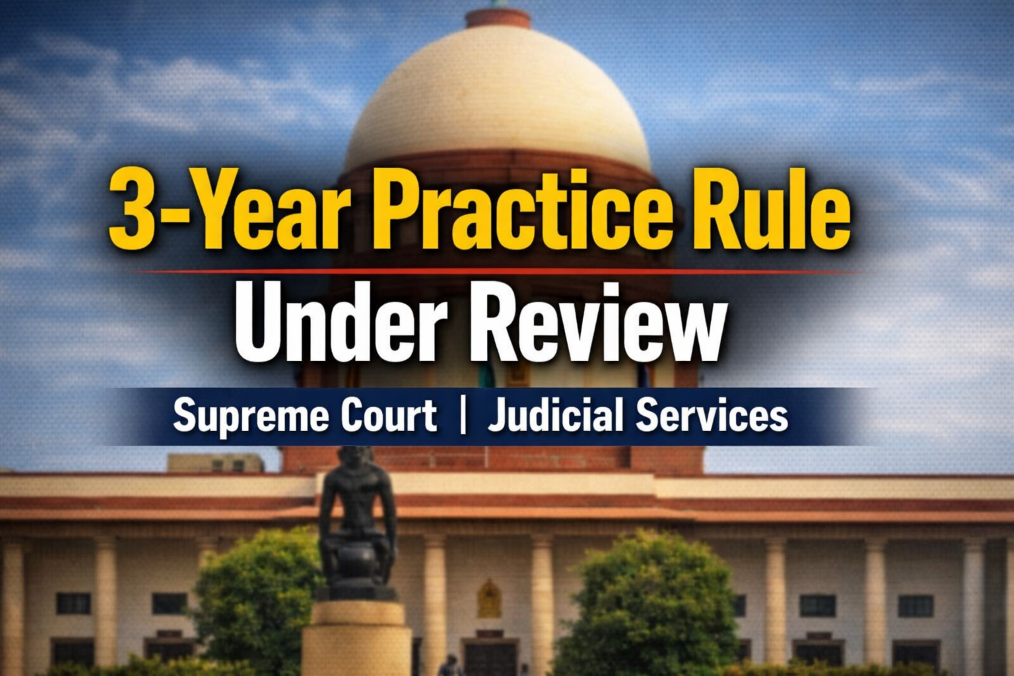
Public debate continues to grip the nation’s attention among newly admitted lawyers and law students regarding the Hon’ble Supreme Court’s decision of May 20, 2025, in I.A. No. 93974/2019, along with I.A. Nos. 72900/2021, 73015/2021, 40695/2021, I.A. No. 50269/2022, and I.A. No. 201893/2022. By this decision, the Hon’ble Supreme Court made a minimum of three years’ experience as a practicing lawyer a mandatory eligibility condition for appointment to the entry-level Judicial Service (Civil Judge Junior Division).
This decision has caused great concern among those preparing for the judicial service, especially fresh law graduates and newly registered lawyers, who now face a long and uncertain path to reach the judiciary.
The requirement of three years’ prior practice places aspiring candidates in an exceptionally difficult position, particularly when viewed against the ground realities of the Indian legal profession. Meaningful courtroom exposure is often hard to obtain, a challenge that is disproportionately severe for women students, persons with disabilities, and first-generation lawyers who lack familial backing, professional networks, or institutional guidance. For many first-generation aspirants, even securing a basic internship proves arduous in the absence of personal connections, making the acquisition of practical skills and professional confidence an uphill task.
The situation is further compounded by entrenched hierarchies within legal education itself. Graduates from National Law Universities are frequently perceived as belonging to an elite category, while students from other universities, despite comparable merit are often overlooked, resulting in unequal access to quality internships and chambers offering substantive work. This systemic disparity deepens existing inequalities within the profession. Moreover, the financial realities of legal training remain stark: stipends during internships or traineeships are either negligible or entirely absent, and earnings in the initial years of practice are generally insufficient to sustain a dignified livelihood.
As a result, a significant number of young aspirants are forced into a prolonged period of professional and economic uncertainty. This raises serious concerns regarding equal access to judicial service, social inclusiveness, and the future composition of the subordinate judiciary, which risks becoming less representative of India’s diverse social realities. The mandate, though aimed at enhancing judicial competence, thus calls for a deeper examination of whether it inadvertently erects structural barriers incompatible with the constitutional promise of equality and fairness in public employment.
Review Petition filed by a young advocate, Chandrasen Yadav, who himself had been preparing for the judicial services, titled Chandrasen Yadav v. Union of India & Others, challenges the judgment dated 20 May 2025 of the Hon’ble Supreme Court which mandates a minimum of three years’ prior practice as an advocate for appointment to the lower judiciary. The Review Petition was instituted on 16 June 2025 and was listed on 10 February 2026. The decision on the petition is presently awaited. In the absence of any immediate public update, a sense of anxiety and uncertainty has emerged among law students and newly enrolled advocates who are closely following the outcome of the matter.
It is important to note that a Review Petition is procedurally distinct from a writ petition or a Special Leave Petition. Review matters are ordinarily decided by circulation in the chambers of the Hon’ble Judges, without oral hearings, and the process often takes time. The absence of an instant order on the listing date does not indicate delay or adverse inference; rather, it reflects the established judicial practice governing review jurisdiction. The final order is issued only after due consideration by the Bench, following which it is uploaded on the official website of the Supreme Court.
A Review Petition serves as an important constitutional and procedural safeguard, enabling the Supreme Court of India to reconsider its own judgments in exceptional circumstances. While the finality of judgments remains a fundamental principle of judicial discipline and legal certainty, the power of review exists to prevent a miscarriage of justice arising from errors apparent on the face of the record. At the same time, the Court’s review jurisdiction is deliberately narrow, exercised with great caution, and invoked only in the rarest of cases, so as to strike a careful balance between correcting palpable errors and preserving the stability of judicial decisions.
The power of review exercised by the Supreme Court of India emanates from distinct constitutional and procedural sources. Article 137 of the Constitution of India expressly empowers the Supreme Court to review any judgment or order passed by it, subject to the provisions of Article 145, which authorises the Court to frame rules regulating its practice and procedure, as well as any law enacted by Parliament.
In furtherance of this constitutional mandate, Order XLVII of the Supreme Court Rules, 2013 governs the procedure for the institution and consideration of review petitions. The review jurisdiction is clearly distinguishable from the Court’s appellate jurisdiction and cannot be invoked as a substitute for an appeal or a rehearing of the case on merits.
Under Order XLVII Rule 2 of the Supreme Court Rules, 2013, a review petition is ordinarily required to be filed within thirty days from the date of the judgment or order sought to be reviewed. Such a petition is placed, as far as practicable, before the same Bench of Hon’ble Judges that delivered the original decision. This procedural framework underscores the limited and exceptional nature of the review power, which is designed not to reopen concluded issues, but to correct manifest errors in the interest of justice.
Review petitions before the Supreme Court are ordinarily considered in chambers by the same Bench of Hon’ble Judges that delivered the original judgment. At this stage, no oral hearing is granted, and the matter is decided solely on the basis of the pleadings and the record. This in-chamber circulation mechanism is intended to uphold judicial efficiency, discipline, and the finality of judgments, while allowing limited scope for correction of manifest errors.
In a review petition, the Supreme Court typically decides the case by reading the papers in chambers, and in most cases, the petition is dismissed by a short order without detailed reasons. Only in rare and exceptional circumstances, when there is a clear and serious error or potential for injustice—does the Court grant review, issue notice, or list the matter for hearing in open court. There is no fixed time limit for deciding a review petition; sometimes it is decided the same day it is listed, and sometimes it can take weeks, and the order is uploaded with some delay. For law students and young lawyers, it is important to remain calm and patient, as a delay in uploading the order does not mean that the review has been accepted or that something unusual has occurred, it is simply part of the normal process followed by the Supreme Court.



Lentis Legalis | 22 March 2026
Reviewed by Adv. Chandrasen Yadav
“Nemo debet bis vexari pro una et eadem causa” means that no person should be punished twice for the same offence. It is a fundamental principle of natural law that underlies the doctrine of double jeopardy.
Applicability of the legal maxim in Indian law
1. Constitution of India
Article 20 of the Constitution of India embodies fundamental protections under the heading “Protection in respect of conviction for offences.” It guarantees certain essential rights in criminal proceedings, including protection against ex post facto (retrospective) punishment, double jeopardy, and self-incrimination. At this instance Article 20(2) which deals with the principle of double jeopardy and gives the maxim a constitutional recognition is of great relevance in the context and its applicability.
Article – 20(2): No person shall be prosecuted and punished for the same offence more than once.
2. Section – 337 of the Bharatiya Nagarik Suraksha Sanhita, 2023 – Person once convicted or acquitted not to be tried for same offence.
Section 337 of the Bharatiya Nagarik Suraksha Sanhita, 2023, gives statutory recognition to the doctrine of double jeopardy, which is rooted in the well-established maxim nemo debet bis vexari pro una et eadem causa—no person ought to be vexed or tried twice for the same cause. The provision mandates that once a person has been tried by a competent court and either convicted or acquitted, such person shall not be tried again for the same offence or on the same set of facts for any other offence that could have been charged in the earlier trial.
Thus, Article 20(2) of the Constitution of India and Section 337 BNSS operationalize this fundamental principle by ensuring finality in criminal proceedings and protecting individuals from repeated prosecutions, harassment, and abuse of the judicial process. At the same time, it carefully carves out limited exceptions, such as where new consequences arise or where the previous court lacked jurisdiction, thereby balancing the rights of the accused in the interests of justice.
Author
Adv. Chandrasen Yadav
B.Sc., LL.B. & LL.M.
Crime And Justice
Case Review of the Landmark Judgement : Imran Pratapgadhi v. State of Gujarat 2025 INSC 410

Lentis Legalis| 04.03.2026
Chandrasen Yadav
The appellant in the present matter, Imran Pratapgadhi who was a Member of the Rajya Sabha. The 2nd respondent Kishan Bhai Dipak Bhai Nanda was the first informant at whose instance a First Information Report (for short, ‘FIR’) was registered with Jamnagar Police Station for the offences punishable under Sections 196, 197(1), 302, 299, 57 and 3(5) of the Bharatiya Nyaya Sanhita, 2023 (for short, ‘the BNS’).
| Offence | Section No. of BNS |
| Promoting enmity between different groups on ground of religion, race, place of birth, residence, language, etc , and doing acts prejudicial to maintenance of harmony. | 196 |
| Imputations, assertions prejudicial to national integration | 197(1) |
| Uttering words, etc., with deliberate intent to wound religious feelings of any person. | 302 |
| Deliberate and malicious acts, intended to outrage religious feelings of any class by insulting its religion or religious beliefs. | 299 |
| Abetting commission of offence by the public or by more than ten persons. | 57 |
| Rule of evidence for Constructive liability in case of act done in furtherance of any Common intention | 3(5) |
In the complaint of the 2nd respondent, he stated that on 29th December 2024, on the occasion of the birthday of one Altaf Ghafarbhai Khafi, a member of the Municipal Corporation of Jamnagar, a mass wedding program was held at Sanjari Education and Charitable Trust. The said Municipal Councillor invited the present appellant to the function. A video of the event was made. The appellant posted the video on the social media platform ‘X’ from his verified account. The video has the recitation of a poem reproduced hereinbelow-
“ए खून (blood) के प्यासो (thirsty) बात सुनो ग ़र हक्क़ (truth) की लडाई जुल्म (excesses/injustice) सही
हम जुल्म (excesses/injustice) से इश्क़ (love) ननभा देंगे गर शम- ए- नगररया (melting of a candle which resembles tears) आनतश (flame) है
हर राह वो शम्मा (light) जला देंगे गर लाश हमारे अपनोोंकी खतरा है तुम्हारी मसनद (throne) का
उस रब (god) की ़सम हस्ते हस्ते नकतनी लाशे दफ़ना देंगे ए खूनके प्यासोों बात सुनो”
The allegation in the complaint is that the spoken words of the poem incite people of one community against another, and it hurts a community’s religious and social sentiments. It is alleged that the song had lyrics that incited people of other communities to fight for the community’s rights. It is alleged that the video posted by the appellant created enmity between two communities at the national level and hatred towards each other. It was further alleged that it had a detrimental effect on national unity.
The appellant before coming to the Supreme Court had filed a petition under Section 528 of the Bharatiya Nagarik Suraksha Sanhita (for short, ‘the BNSS’) read with Article 226 of the Constitution of India, praying for quashing the said FIR in the High Court. While issuing notice on the said petition, the learned Judge had directed the appellant to file an affidavit disclosing the poem’s source. Accordingly, an affidavit was filed by the appellant but could not disclose the specific origin of the source.
The learned Single Judge of the High Court by impugned judgment and order, rejected the petition by holding that as the investigation is at a very nascent stage, interference cannot be made in view of the judgement of the Hon’ble Supreme Court in the case of Neeharika Infrastructure Pvt. Ltd. v State of Maharashtra 2021 SCC Online SC 315.
Appellant in support of the appeal had taken following grounds-
- That none of the ingredients of the offences alleged against the appellant are made out on the plain reading of the complaint and the poem.
- It cannot be said that the poem caused social disharmony amongst the people.
- the poem does not promote disharmony or feelings of enmity, hatred or ill-will between the various religious, racial, language or regional groups and castes or communities.
- The plain reading of the poem indicated that it was all about sacrificing oneself to fight for rights and truth.
- That registration of the FIR based on the said poem violates the appellant’s fundamental right guaranteed under Article 19(1)(a) of the Constitution.
Supreme Court highlighting the role of dissent mentioned that Free expression of thoughts and views by individuals or groups of individuals is an integral part of a healthy, civilised society. Without freedom of expression of thoughts and views, it is impossible to lead a dignified life guaranteed by Article 21 of the Constitution. In a healthy democracy, the views, opinions or thoughts expressed by an individual or group of individuals must be countered by expressing another point of view. Even if a large number of persons dislike the views expressed by another, the right of the person to express the views must be respected and protected.
Supreme Court in the Judgement mounted a standard that The Courts are duty-bound to uphold and enforce fundamental rights guaranteed under the Constitution of India. Sometimes, we, the Judges, may not like spoken or written words. But, still, it is our duty to uphold the fundamental right under Article 19 (1)(a). We Judges are also under an obligation to uphold the Constitution and respect its ideals. If the police or executive fail to honour and protect the fundamental rights guaranteed under Article 19 (1)(a) of the Constitution, it is the duty of the Courts to step in and protect the fundamental rights. There is no other institution which can uphold the fundamental rights of the citizens.
Supreme court not only set aside the impugned order of the High Court but also quashed the FIR which was registered against the Imran Pratapgaradhi.
Read full Judgement:
https://api.sci.gov.in/supremecourt/2025/3511/3511_2025_4_1501_60508_Judgement_28-Mar-2025.pdf
Landmark judgements
Execution Is Not a Mere Formality: Supreme Court on Rights of Post-Award Purchasers and Finality of Arbitral Decrees

Lentis Legalis|04.03.2026
Chandrasen Yadav
The Cotton Corporation of India Limited, the first respondent, had entered into a sale agreement dated 22.01.1998 with M/s Lakshmi Ganesh Textiles Limited, the second respondent, for the supply of cotton bales. Upon failure of the purchaser to pay the sale consideration, the first respondent initiated arbitral proceedings being AP No. 9 of 1999 for recovery of the outstanding amount.
The learned arbitrator passed an award dated 11.06.2001 in favour of the first respondent for a sum of Rs. 26,00,572.90 along with interest at the rate of 18% per annum and costs. The second respondent challenged the said award by filing AOP No. 10 of 2006 under Section 34 of the Arbitration and Conciliation Act, 1996 before the Principal District Judge, Coimbatore. The Section 34 petition came to be dismissed on 21.01.2013, and as no appeal was preferred thereafter, the arbitral award attained finality.
In the meantime, the second respondent, who was a borrower of ICICI Bank, defaulted in repayment of its dues, as a result of which the bank initiated proceedings under the SARFAESI Act on 11.11.2013 and attached the properties of the borrower. Pursuant to a tripartite agreement dated 29.12.2014 entered into between ICICI Bank, the second respondent, and the appellant, a sale deed dated 23.04.2015 was executed in favour of the appellant in respect of the EP Schedule Property.
Subsequently, in the year 2019, the first respondent initiated execution proceedings to enforce the arbitral award, which were later transferred to the court of the Principal District Judge, Tirupur. During the pendency of the execution proceedings, the executing court, by order dated 19.08.2021, directed conditional attachment of the EP Schedule Property. Aggrieved thereby, the appellant, claiming to be a third-party purchaser, filed EA No. 141 of 2021 under Order XXI Rule 58 of the Code of Civil Procedure seeking removal of attachment on the ground that he was a bona fide purchaser for value without notice of the arbitral liability.
The Supreme Court noted that the appellant was a purchaser subsequent to the passing of the arbitral award for recovery of money and that the execution proceedings were pending when the sale deed was executed in his favour. It was further observed that the appellant had failed to discharge the burden of proving that the purchase was made without notice of the existing claim. The Court also took note of the fact that the arbitral award continued to remain unrealised.
In view of these circumstances and by applying the ratio laid down in Danesh (supra), the Court held that the claim petition filed by the appellant had been rightly dismissed by the courts below. Consequently, the Civil Appeal was dismissed, and the executing court was directed to dispose of the execution proceedings within a period of two months.
The Court reiterated the long-standing principle, traceable even to the Privy Council, that the real difficulties of a litigant often begin only after obtaining a decree. While suits may conclude within a few years, execution proceedings frequently take much longer. Recognising this mischief, Order XXI of the CPC was substantially amended in 1976 to operate as a self-contained code, barring separate suits and prescribing strict timelines for objections.
The Court cautioned that accepting the appellant’s argument would permit pendente lite purchasers or third parties to bypass the statutory safeguards, thereby frustrating execution proceedings. Such an approach would encourage judgment-debtors to defeat decrees by transferring properties or setting up proxy objectors, resulting in endless collateral litigation and rendering decrees ineffective.
Relying upon Jini Dhanrajgir v. Shibu Mathew, the Court emphasised that success in litigation is meaningless unless the successful party actually obtains the relief granted. The legal system, it was observed, must ensure not merely disposal of cases, but actual enforcement of rights, so that justice is not only seen to be done but is truly achieved.
Judgement:
R. Savithri Naidu v. M/s The Cotton Corporation of India Ltd. and Another, 2026 INSC 150

Bonafide Need Must Be Judged on the date when the suit for eviction was filed: Supreme Court Sets Aside High Court Order in Eviction Case.

From Self-Identification to State Certification: A Step Back for Transgender Rights?

No More ‘Bona Fide Need’: Allahabad High Court Redefines Eviction Standards Under the UP Tenancy Act, 2021

Supreme Court to Hear Review Petition on 10 February 2026 Challenging Mandatory Three-Year Practice Requirement for Entry-Level Judicial Services

Major Relief for Law Students as Supreme Court Opens Review on Mandatory 3-Year Practice Rule

Supreme Court Mandates Free Sanitary Pads, Functional Toilets and Menstrual Hygiene Infrastructure in All Schools
-
 Supreme Court Highlights2 months ago
Supreme Court to Hear Review Petition on 10 February 2026 Challenging Mandatory Three-Year Practice Requirement for Entry-Level Judicial Services
-
 Landmark judgements2 months ago
Major Relief for Law Students as Supreme Court Opens Review on Mandatory 3-Year Practice Rule
-
 Landmark judgements3 months ago
Supreme Court Mandates Free Sanitary Pads, Functional Toilets and Menstrual Hygiene Infrastructure in All Schools
-
 High Court Updates3 months ago
Accessing Wife’s Private Photos Without Consent and Humiliating Her Before Family Amounts to Mental Cruelty
-

 High Court Updates3 months ago
Surge in Police Encounters in UP: Allahabad High Court Seeks Compliance with PUCL Guidelines
-

 Crime And Justice3 months ago
Pre-Trial Detention, Human Rights, and the rejection of Bail of Umar Khalid and Sharjeel Imam.
-
 Supreme Court Highlights3 months ago
Supreme Court Keeps UGC Equity Regulations, 2026 in Abeyance; Raises Concerns Over Ambiguity and Possible Misuse
-
 Opinions & Columns9 months ago
School Merger in Uttar Pradesh: A Stark Reflection of State Abdication of Educational Duty Undermining the Constitutional Mandate of Article 21-A and the RTE Act, 2009.