Opinions & Columns
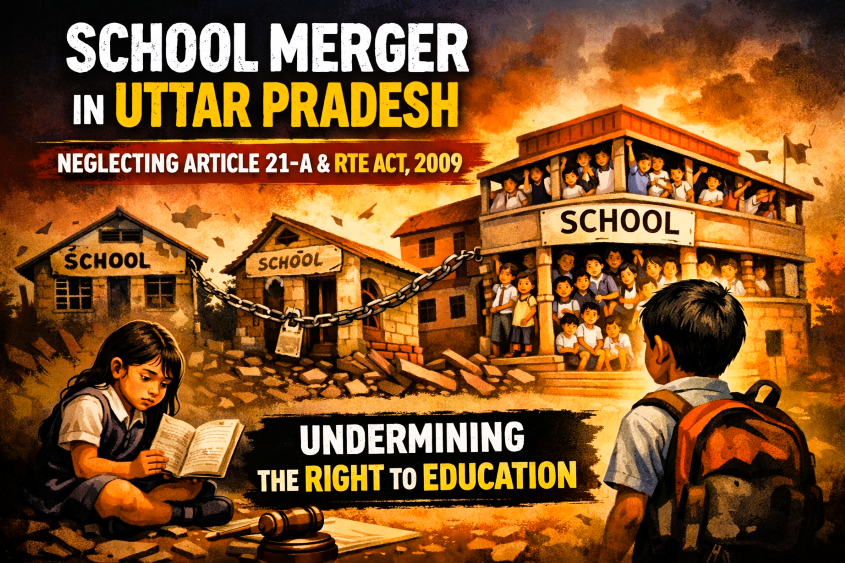
School Merger in Uttar Pradesh: A Stark Reflection of State Abdication of Educational Duty Undermining the Constitutional Mandate of Article 21-A and the RTE Act, 2009.

Lentis Legalis | 24 July 2025
Reviewed by Adv. Chandrasen Yadav
In a regressive policy turn, the Government of Uttar Pradesh has initiated a mass school merger and closure policy, dated 16.06.2025, purportedly aimed at “rationalizing resources” and “improving educational quality.” However, far from advancing the Right to Education, this decision reflects a disturbing abdication of constitutional responsibility by the State. It undermines decades of legislative and judicial progress that culminated in the recognition of education as a justiciable fundamental right under Article 21-A of the Indian Constitution.
The very idea of pairing or merging government schools, as proposed under the impugned policy, is impractical, inequitable, and constitutionally flawed. Unlike the seamless pairing of electronic devices via Bluetooth, Wi-Fi, or USB, the concept of “pairing” schools involves complex socio-geographic realities and without any connecting medium. These institutions are often not located in close proximity, and as such, the infrastructure and academic resources of one school cannot be effectively or frequently accessed by students from another.
The policy of pairing or merging schools, in essence, functions as a linguistically softened version of SCHOOL CLOSURE, which not only undermines the principles of accessibility and continuity in education, but also violates the spirit of the doctrine of “parens patriae,” whereby the State is the guardian of its citizens—particularly children. Such a policy is antithetical to the values enshrined in the Preamble and Fundamental Right to education under Article 21-A of the Constitution, including Equality of status and opportunity, Justice – social, economic and political.
This blog explores how this policy violates the spirit of constitutional jurisprudence laid down in landmark judgments like Mohini Jain and Unni Krishnan, contradicts Article -21 A of the Constitution of India and the Right of Children to Free and Compulsory Education Act, 2009, and defeats the foundational principles of Sarva Shiksha Abhiyan (SSA)—India’s flagship universal education program.
The Legal and Historical Context of the Right to Education
1. Judicial Evolution: From Directive to Fundamental Right
Historically, education in India was deeply exclusionary and gender specific, often restricted to the upper castes and socio-economic elites, with no systemic provision for universal access. Under ancient and medieval regimes, including during Muslim rule in the subcontinent, education remained largely religious and informal, and the State did not assume responsibility for its delivery. The seeds of educational reform were sown during British rule, notably with the Hunter Commission (1882), where visionaries like Dadabhai Naoroji and Jyotiba Phule demanded state-sponsored free education for all. The Commission partially acknowledged this demand and emphasized access for all castes and classes.
The journey toward the constitutionalization of the Right to Education in India began in the early 1990s. In Mohini Jain v. State of Karnataka (1992), the Supreme Court held that the right to education is an intrinsic part of the right to life under Article 21. This position was further solidified in Unni Krishnan J.P. v. State of Andhra Pradesh (1993), which held that the State is obligated to provide free education to all children up to the age of 14.
These judgments laid the foundation for the 86th Constitutional Amendment (2002) which inserted Article 21-A, making the Right to Education a Fundamental Right for children between 6 and 14 years of age.
The first law on compulsory education was enacted in the princely State of Baroda in 1906, covering both boys and girls. In 1937, at the All India National Conference on Education in Wardha, Mahatma Gandhi advocated for a system of basic education grounded in manual and vocational training. The Sargent Plan of 1944, emerging from the Post-War Educational Development Strategy, proposed eight years of free and compulsory education for children aged 6–14 years. However, despite these progressive milestones, when the Constitution was adopted in 1950, education was not recognised as a fundamental right. It was instead relegated to a Directive Principle of State Policy under Article 45, urging the State to provide free and compulsory education within ten years. The turning point came with the Supreme Court’s landmark ruling in Unni Krishnan v. State of Andhra Pradesh (1993), where the Court held that the Right to Education is implicit in the Right to Life under Article 21. This judgment catalysed a wave of Public Interest Litigations across various High Courts demanding admission for poor and marginalised children.
This legal and social movement culminated in the 86th Constitutional Amendment Act, 2002, which inserted Article 21-A, making free and compulsory education a fundamental right for all children aged 6 to 14 years.
To operationalize Article 21-A, the Right of Children to Free and Compulsory Education Act, 2009 was enacted. It mandates universal access to quality elementary education and lays down specific standards such as minimum teacher-pupil ratios, infrastructure norms, and compulsory education for all.
The SSA Framework for Implementation reaffirmed these goals, aiming to bridge gender and social category gaps and enhance learning outcomes. These schemes were not mere welfare measures—they were constitutional mandates to transform India into an inclusive, democratic society.
2. Basic Features of RTE Act, 2009 as per the Sarva Shiksha Abhiyan – FRAMEWORK FOR IMPLEMENTATION based on the Right of Children to free and Compulsory Education Act, 2009
The RTE Act, 2009 provides for:
(i) The right of children to free and compulsory education till completion of elementary education in a neighbourhood school.
(ii) It clarifies that ‘compulsory education’ means obligation of the appropriate government to provide free elementary education and ensure compulsory admission, attendance and completion of elementary education to every child in the six to fourteen age group. ‘Free’ means that no child shall be liable to pay any kind of fee or charges or expenses which may prevent him or her from pursuing and completing elementary education.
(iii) It makes provisions for a non-admitted child to be admitted to an age appropriate class.
(iv) It specifies the duties and responsibilities of appropriate Governments, local authority and parents in providing free and compulsory education, and sharing of financial and other responsibilities between the Central and State Governments.
(v) It lays down the norms and standards relating inter alia to Pupil Teacher Ratios (PTRs), buildings and infrastructure, school-working days, teacher-working hours.
(vi) It provides for rational deployment of teachers by ensuring that the specified pupil-teacher ratio is maintained for each school, rather than just as an average for the State, or District, or Block, thus ensuring that there is no urban-rural imbalance in teacher postings. It also provides for the prohibition of deployment of teachers for non-educational work, other than the decennial census, elections to local authority state legislatures and parliament, and disaster relief.
(vii) It provides for the appointment of appropriately trained teachers, i.e., teachers with the requisite entry and academic qualifications.
Sarva Shiksha Abhiyan (SSA)
SSA has been operational since 2000- 2001. With the passage of the RTE Act, changes need to be incorporated into the SSA approach, strategies, and norms. The changes are not merely confined to norms for providing teachers or classrooms, but encompass the vision and approach to elementary education as evidenced in the shift to child entitlements and quality elementary education in regular schools.
Uttar Pradesh’s School Merger Policy: A Constitutional Violation
On June 16, 2025, the Uttar Pradesh Government issued an order to merge or close government primary and upper primary schools with less than 50 student enrollment. This decision, however, lacks any remedial measures to address the core issues of teacher shortages, infrastructure deficits, or quality learning outcomes as envisaged when the RTE Act was implemented in 2010. It is tantamount to withdrawing access to education for thousands of rural and marginalized children.
1. Violation of Article 21-A and the RTE Act
Rather than rectifying systemic failures like poor pupil-teacher ratios and single-teacher schools—identified by both UNESCO and the Government’s own records, The 238th Project Approval Board Meeting (SSA 2016)—the State has chosen a path that punishes students for its administrative inaction. The move directly contravenes the RTE Act, which mandates proximity-based schooling and inclusive access.
2. Ignoring Judicially Recognized Principles
The doctrine of “parens patriae”, under which the State acts as the guardian of its citizens—especially children—has been blatantly violated. In a constitutional framework that draws upon the ideals of socialism—as expressly enshrined in the Preamble—such deprivation effectively prevents citizens from fulfilling their moral and constitutional obligation under Article 51A(k), thereby defeating the very object and spirit of the constitutional mandate. This affirms that citizens are not merely passive recipients of the right to education, but active constitutional stakeholders, whose ability to perform their duties is intrinsically linked to the State’s responsibility to provide affordable, proximate, and quality educational institutions. This is evidenced by the fact that 51 school students, through their natural guardians, filed a writ petition challenging the adverse impact of the school merger policy.
Data and Reports: The Real Crisis is Not Enrollment, But Governance
UNESCO’s 2021 Report titled “No Teachers, No Class” reveals that:
- Over 1.1 lakh schools in India are single-teacher schools.
- Uttar Pradesh alone had over 3.3 lakh teacher vacancies, with 80% in rural areas.
The 238th Project Approval Board Meeting (SSA 2016) observed that:
- 10,000+ primary schools in UP were single-teacher institutions.
- Over 56% of primary and 19% of upper primary schools had adverse pupil-teacher ratios.
- Enrolment and retention rates were dangerously low, especially among girls and marginalized communities.
Instead of addressing these glaring issues through teacher recruitment and systemic reform, the State has opted for closure—a deeply flawed response to a problem it has long ignored.
Policy Without Process: Undemocratic and Arbitrary
Public education policy must be evidence-based, participatory, and guided by inclusive principles. The policy-making requires a structured process, involving comprehensive data collection, analysis of data, pattern recognition, analysis of underlying causes, and ultimately, consultation with stakeholders to design effective interventions. However, in the present case, no such process was followed. The impugned order has been issued in an arbitrary and mechanical manner, without any genuine effort to identify, address, or cure the root causes of low enrolment—such as teacher shortages, poor infrastructure, or lack of academic support. This approach violates settled principles of administrative fairness and non-arbitrariness under Article 14 of the Constitution, and amounts to abdication of the State’s constitutional responsibility under Article 21-A.
Socio-Economic Discrimination and Structural Harm
The merger/closure of functional government schools, without the provision of viable and accessible alternatives, severely impairs the capacity of parents/guardians —particularly those belonging to rural, Scheduled Castes (SC), Scheduled Tribes (ST), Other Backward Classes (OBC), and economically weaker section students of general category—to discharge the constitutional obligation as mentioned in Article 51A(k). However, the Article 21A and Act of 2009 was enforced only to cater the need of institutionalised education for such kind of children who were due to economic or social or any other kind of disability were not able to get the formal education. In practical terms, such a policy obstructs the fulfilment of a fundamental civic duty and strikes at the core of the participatory and inclusive vision of the Constitution. School closures force them into long commutes or dropouts, pushing them into child labour or domestic responsibilities.
The chronic failure of the State to timely fill teacher vacancies, resulting in loss of public faith in government schools, the consequent withdrawal of children by poor families, who are then pushed into unorganised labour sectors under the pretext of acquiring practical skills, thereby exacerbating the problem of child labour,
Conclusion: A Call for Judicial Intervention and Policy Reversal
The school merger policy of Uttar Pradesh is not a rationalisation; it is a retraction—a roll-back of hard-won educational rights. It disregards decades of reform, data, jurisprudence, and democratic ideals. It jeopardizes SDG 4 and the constitutional promise of a just, egalitarian, and educated society.
In the words of Justice B.P. Jeevan Reddy in Unni Krishnan:
“It is not enough to say that the State is not preventing anyone from pursuing education. The obligation is to make it available and accessible.”
This blog stands as a reminder that education is not a privilege to be rationed—it is a right to be realized. The need of the hour is not closure but commitment—to quality, inclusion, and constitutional fidelity.
Author
Adv. Chandrasen Yadav
B.Sc., LL.B. & LL.M.



Lentis Legalis | 26 April 2026
Reviewed by Adv. Chandrasen Yadav
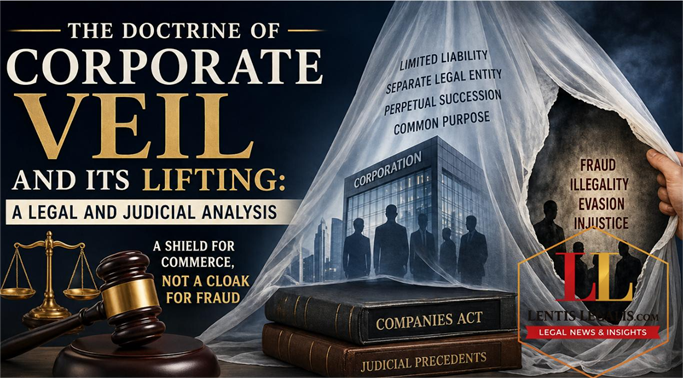
The recognition of a company as a separate legal person provided the much-needed stability and confidence in the business community. This limits the liability of the promoters, investors and subscribers only to the extent of their unpaid share capital, the law insulated personal assets from business risks, thereby encouraging investment, innovation, and entrepreneurial ventures. This legal assurance fostered confidence among investors, creditors, and stakeholders, enabling the pooling of resources and the expansion of trade on an unprecedented scale.
In landmark judgment of Salomon v. Salomon & Co. Ltd., it was cemented that a company is a separate legal person, and its shareholders are not personally liable for its debts beyond their unpaid share capital.
However, the corporate veil was never intended to be an instrument of injustice. As judicial wisdom has consistently emphasized, the doctrine of separate legal personality exists to promote commerce and not to facilitate fraud or illegality. While courts exercise caution in piercing the corporate veil, but not hesitate to do so where the corporate form is abused, ensuring the true actors behind the corporate mask held accountable.
The Supreme Court, in Delhi Development Authority v. Skipper Construction Co. (P) Ltd., categorically held that the concept of corporate entity was evolved to encourage and promote trade and commerce but not to commit illegalities or to defraud people. Where, therefore, the corporate character is employed for the purpose of committing illegality or for defrauding others, the court would ignore the corporate character and will look at the reality behind the corporate veil so as to enable it to pass appropriate orders to do justice between the parties concerned.
The Hon’ble Supreme Court in State of U.P. Vs. Renusagar Power Co., (1988) 4 SCC 59 observed that lifting of veil is permissible, its frontiers are unlimited, it must, however, depend primarily on the realities of the situation. The aim of the legislation is to do justice to all the parties.
Over time, courts have identified several circumstances where lifting the corporate veil becomes necessary:
- Fraud or Unlawful Conduct: Where the company is incorporated or used as a device to perpetrate fraud, defeat legal obligations, or mislead creditors. [Delhi Development Authority v Skipper Construction Co (P) Ltd]
- Tax Evasion: When the corporate structure is employed as a sham or colorable device to evade tax liabilities unlawfully.[McDowell & Co Ltd v Commercial Tax Officer]
- Avoidance of Welfare Legislation: Where the entity is used to circumvent statutory obligations relating to labor welfare, including payment of wages, bonuses, or other employee benefits. [Workmen Employed in Associated Rubber Industry Ltd v Associated Rubber Industry Ltd]
- Enemy Character: Particularly in times of war, courts may look beyond the corporate personality to ascertain whether those in control belong to an enemy nation. [Daimler Co Ltd vs. Continental Tyre and Rubber Co (Great Britain) Ltd]
- Evasion of Court Orders / Execution of Decrees: When the corporate form is misused to frustrate or evade compliance with judicial orders or to avoid satisfaction of a decree. [Prem Prakash Rajpurohit vs. M/s Ansal Hi Tech Township Ltd. And 2 Ors.]
- Public Interest: Where maintaining the corporate veil would be contrary to public interest, public policy, or would result in injustice. [State of Uttar Pradesh v Renusagar Power Co]
However, the courts have come to recognize several exceptions to the general rule as held in the Soloman Case that a company is a separate legal person, and its shareholders are not personally liable for its debts beyond their unpaid share capital. When the corporate personality is blatantly used as à cloak for fraud or improper conduct, Courts pierce the veil in the interest of public policy. [Gower: Modern Company Law- 4th Edn. (1979) at p. 137.]
The doctrine of separate legal entity remains one of the most profound legal innovations in the history of commerce. It has enabled generations of entrepreneurs to take calculated risks without the fear of losing their entire personal estates, thereby fostering investment, innovation, and economic growth on an unprecedented scale. The principle, as affirmed in Salomon v. Salomon & Co. Ltd., continues to be the bedrock of corporate law.
Yet, this legal fiction was never meant to be absolute. The doctrine of lifting the corporate veil, therefore, acts as a necessary corrective judicial measure ensuring that the privilege of limited liability does not become a licence for abuse. Judicial experience has consistently shown that while courts remain cautious in disregarding corporate personality, they will not hesitate to do so where justice so demands. Whether it is fraud, evasion of statutory obligations, or misuse of corporate structures to frustrate judicial orders, the law looks beyond form to substance, and beyond the company to the real actors controlling it.
Ultimately, the corporate veil is a shield, not a sanctuary. When it is used to protect legitimate enterprise, the law upholds it; but when it is used to conceal wrongdoing, the veil must fall, so that accountability, fairness, and public confidence in the legal system are not compromised.
Author
Adv. Chandrasen Yadav
B.Sc., LL.B. & LL.M.
Explainers
From Corpus to Corporation: How Separate Legal Entities Shaped Modern Corporate Structures
Lentis Legalis | 26 April 2026
Reviewed by Adv. Chandrasen Yadav
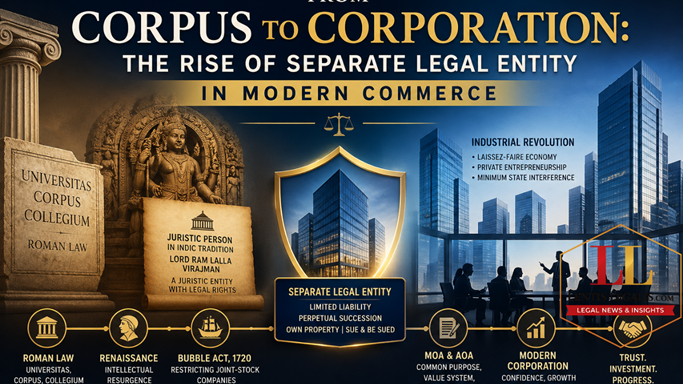
The idea of a company, as we understand it today, has evolved over centuries. The very term “corporation” finds its origin in the Latin word corpus, meaning thereby a body or a collective of persons. Even under Roman law, entities such as universitas, corpus, or collegium were recognized as distinct bodies capable of holding property, entering contracts, and suing or being sued. Interestingly, Indic legal thought reflects a similar conceptualization where a consecrated deity is treated as a juristic person with independent legal identity as example Lord Ram Lalla Virajman itself sued the wrongdoers who encroached land owned by Ayodhya Mandir deity Lord Ram Lalla.
The doctrine of separate legal entity has been indispensable in the evolution of modern commerce, primarily because it mitigates the harsh consequences of unlimited personal liability that existed in earlier forms of trade. In pre-corporate systems, merchants and traders bore unlimited liability, meaning that business losses could extend to their entire personal estates, often wiping out wealth accumulated over generations. The intellectual resurgence during the Renaissance Period, followed by the economic transformation of the Industrial Revolution, created an urgent need for legal structures that could support large-scale enterprise, capital aggregation, and risk-taking.
An important historical turning point in this journey was the enactment of the Bubble Act, 1720 (also Royal Exchange and London Assurance Corporation Act, 1719) in England, which came in the aftermath of the South Sea Bubble crisis. The Act sought to restrict the formation of joint-stock companies without royal charter, reflecting the State’s concern over speculative excesses and fraudulent ventures. Although restrictive in nature, it highlighted the growing significance and potential risks of collective commercial enterprises. Its eventual repeal in 1825 paved the way for freer incorporation and the development of modern company law.
The Industrial Revolution marked a decisive shift towards laissez-faire economic theory, advocating minimal state interference and promoting private entrepreneurship as the engine of economic growth. In such an environment, large-scale industrial and commercial activities required a structured yet flexible legal mechanism to mobilize capital and coordinate collective effort. This gave rise to the modern corporation – an organized body formed around a common purpose and governed by a defined value system, embodied in its Memorandum of Association (MOA) and Articles of Association (AOA). While the MOA outlines the fundamental objectives and scope of the company, the AOA regulates its internal management and operational framework. Together, they institutionalize trust, discipline, and predictability in business functioning. Coupled with the doctrine of separate legal entity and limited liability, this corporate structure instilled confidence among investors and entrepreneurs, enabling them to undertake ventures without exposing their personal wealth to unlimited risk, thereby accelerating industrial and economic expansion.
The recognition of a company as a separate legal person thereafter provided the much-needed stability and confidence. By limiting liability to the extent of unpaid share capital, the law insulated personal assets from business risks, thereby encouraging investment, innovation, and entrepreneurial ventures. This legal assurance fostered confidence among investors, creditors, and stakeholders, enabling the pooling of resources and the expansion of trade on an unprecedented scale. In essence, the concept of separate legal entity did not merely facilitate business, it became the cornerstone of economic growth by balancing risk with protection.
The landmark judgment in Salomon v. Salomon & Co. Ltd. cemented this principle by holding that once incorporated, a company is a separate legal person, and its shareholders are not personally liable for its debts beyond their unpaid share capital. This doctrine was crucial in fostering industrial growth during the Industrial Revolution, where laissez-faire economics encouraged private entrepreneurship and minimized state interference. The corporate form with its attributes of limited liability, perpetual succession, and centralized management became the engine of economic expansion.
Author
Adv. Chandrasen Yadav
B.Sc., LL.B. & LL.M.

Lentis Legalis | 08 April 2026
Reviewed by Adv. Chandrasen Yadav
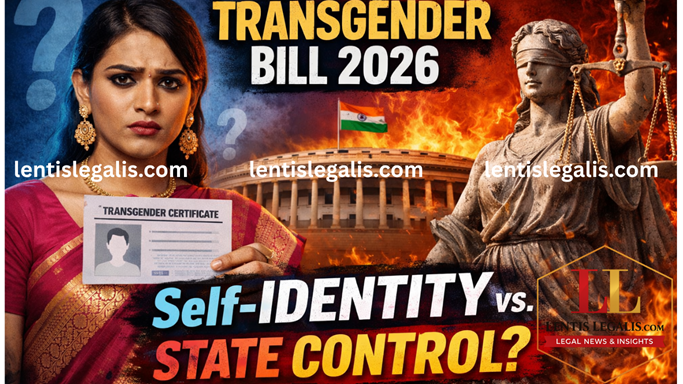
On 13 March 2026, the Transgender Persons (Protection of Rights) Amendment Bill, 2026 was introduced in the Lok Sabha, proposing significant changes to the Transgender Persons (Protection of Rights) Act, 2019. The Statement of Objects and Reasons accompanying the Bill underscores a distinct legislative policy: to recognise and protect a specific class of transgender (TG) persons who suffer from acute social exclusion.
The Bill asserts that the original legislative intent was, and continues to be, the protection of individuals who face severe social discrimination owing to biological factors beyond their control and without any element of choice. It emphasises that the Act was designed to safeguard a narrowly defined class of persons—those historically and socially recognised as transgender—who endure extreme and systemic marginalisation. According to the proposed amendment, the statute was never intended to extend protection to all categories of gender identities, including self-perceived identities or gender fluid expressions.
A central concern highlighted by the Bill is the alleged vagueness in the existing definition of “transgender person.” It contends that such ambiguity hampers the identification of genuinely oppressed individuals and renders the implementation of various provisions—across penal, civil, and personal laws—ineffective and unworkable. Consequently, the Amendment Bill seeks to introduce a more precise and restrictive definition to ensure that the benefits of the Act reach its intended beneficiaries through clearer identification mechanisms.
The foundation of transgender jurisprudence in India can be traced to the landmark decision in National Legal Services Authority v. Union of India (2014), popularly known as the NALSA case. In this seminal judgment, the Supreme Court recognised transgender persons as a “third gender” and affirmed their entitlement to fundamental rights under the Constitution. The Court unequivocally held that gender identity lies at the core of an individual’s personal autonomy and must be determined by self-identification rather than biological or medical criteria. It observed:
“Gender identity is integral to the dignity of an individual and is based on self-identification, not on surgical or medical procedures. No person can be discriminated against on the ground of gender identity.”
Justice K.S. Radhakrishnan, drawing upon a catena of judicial precedents and international human rights instruments, elaborated that gender identity is among the most fundamental aspects of life. It reflects a person’s deeply felt internal and individual experience of gender, which may or may not correspond with the sex assigned at birth. This understanding firmly situates gender identity within the domain of personal liberty and dignity.
The jurisprudential evolution continued with Navtej Singh Johar v. Union of India (2018), where the Supreme Court decriminalised consensual same-sex relations by reading down Section 377 of the Indian Penal Code. The Court, in doing so, foregrounded the primacy of constitutional morality over societal or majoritarian morality. It also recognised rights relating to sexual orientation, autonomy, and choice of partner as intrinsic to Article 21.
Further strengthening this framework, the nine-judge bench decision in K.S. Puttaswamy v. Union of India (2017) affirmed that the right to privacy encompasses sexual orientation and gender identity as essential attributes of individual dignity and liberty, immune from majoritarian disapproval.
More recently, in Supriyo v. Union of India (the “Marriage Equality Case”), the Supreme Court acknowledged that transgender persons in heterosexual relationships possess the right to marry under existing legal frameworks, thereby reinforcing their legal recognition and dignity.
In light of this established jurisprudence, the 2026 Amendment Bill appears, prima facie, to depart from the constitutional principles articulated by the Supreme Court. While judicial precedents have consistently upheld self-perceived gender identity as central to personal autonomy, the proposed amendments introduce a certification regime requiring recognition by a district magistrate based on the recommendation of a designated medical board headed by a chief medical officer.
This shift from self-identification to medical verification raises critical constitutional questions. It potentially reintroduces elements of external validation and bureaucratic control over identity, which the Supreme Court had expressly sought to eliminate. Whether such a framework can withstand constitutional scrutiny—particularly in light of the principles of dignity, autonomy, and privacy—remains an open and significant question.
Read the full judgment of NALSA case. – Click Here
Read the Full Judgement of Navtej Singh Johar vs. Union of India. – Click Here
Read the Full Judgement of Justice K.S. Puttaswamy vs. Union of India. – Click Here
Author
Adv. Chandrasen Yadav
B.Sc., LL.B. & LL.M.

Supreme Court Reserves Judgement on Review Petitions Clubbed with Bhumika Trust’s Writ Petition Challenging the Mandatory Three-Year Practice Rule for Entry-Level Judicial Officers

Uttar Pradesh Information Commission Imposes Maximum Statutory Penalty Rs. 25,000/- and warned for further departmental action on Gram Panchayat Officer of Ayodhya district for not providing information under RTI Act 2005.

Right to Information Act, 2005: A Comprehensive Legal Insight into the Citizen’s Right to Information
Section 107 of the Bharatiya Nyaya Sanhita, 2023: Abetment of suicide of child or person of unsound mind.

Supreme Court to Hear Review Petition on 10 February 2026 Challenging Mandatory Three-Year Practice Requirement for Entry-Level Judicial Services

Major Relief for Law Students as Supreme Court Opens Review on Mandatory 3-Year Practice Rule

-
Bharatiya Nyaya Sanhita (BNS)7 months ago
Section 107 of the Bharatiya Nyaya Sanhita, 2023: Abetment of suicide of child or person of unsound mind.
-
 Supreme Court Highlights9 months ago
Supreme Court to Hear Review Petition on 10 February 2026 Challenging Mandatory Three-Year Practice Requirement for Entry-Level Judicial Services
-
 Landmark judgements8 months ago
Major Relief for Law Students as Supreme Court Opens Review on Mandatory 3-Year Practice Rule
-
Bharatiya Nyaya Sanhita (BNS)7 months ago
Section 125 of the Bharatiya Nyaya Sanhita, 2023: Act endangering life or personal safety of others.
-
Bharatiya Nyaya Sanhita (BNS)7 months ago
Section 111 of the Bharatiya Nyaya Sanhita, 2023: Organised crime.
-
Bharatiya Nyaya Sanhita (BNS)7 months ago
Section 109 of the Bharatiya Nyaya Sanhita, 2023: Attempt to murder.
-
Bharatiya Nyaya Sanhita (BNS)7 months ago
Section 120 of the Bharatiya Nyaya Sanhita, 2023: Voluntarily causing hurt or grievous hurt to extort confession, or to compel restoration of property.
-
Bharatiya Nyaya Sanhita (BNS)7 months ago
Section 121 of the Bharatiya Nyaya Sanhita, 2023: Voluntarily causing hurt or grievous hurt to deter public servant from his duty.