
Landmark judgements
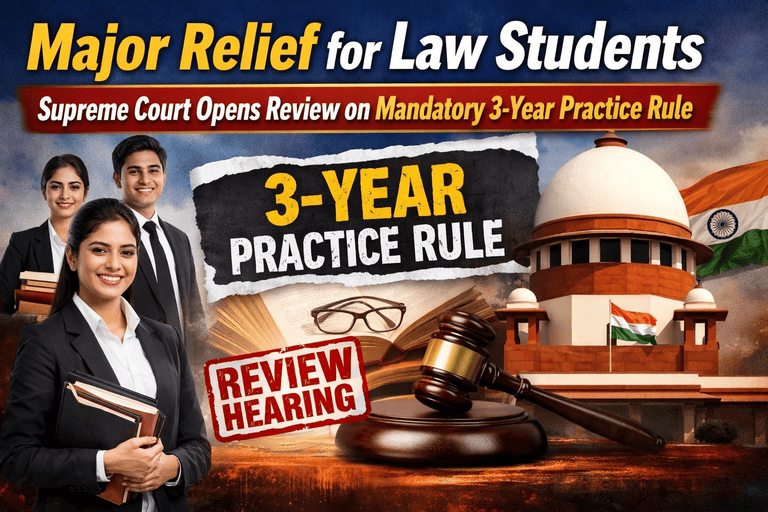
Major Relief for Law Students as Supreme Court Opens Review on Mandatory 3-Year Practice Rule

New Delhi | February 18, 2026
LENTIS LEGALIS BREAKING
The Supreme Court of India has allowed applications seeking permission to file Review Petition(s) in a long-pending matter arising out of Writ Petition (C) No. 1022 of 1989. Importantly, applications requesting that the Review Petition be listed in open court with oral hearing have also been allowed, recognizing the significance of the issues involved. The review petition has been filed by Advocate Chandrasen Yadav, through Advocate-on-Record Kunal Yadav.
The order was passed by a Bench comprising The Chief Justice of India, Justice Augustine George Masih, and Justice K. Vinod Chandran.
The Court has issued notice to the respondents, returnable on 26 February 2026, directing them to respond to the Review Petition. The Review Petition has also been tagged with Writ Petition (C) No. 1110 of 2025 (Diary No. 52914 of 2025 – Bhumika Trust) to ensure comprehensive and consistent adjudication of connected issues.
In the Writ Petition (C) No. 1110 of 2025 (Diary No. 52914 of 2025 – Bhumika Trust vs. Union of India), the Supreme Court of India has already invited suggestions from law universities across the country on the issue of mandatory three-year legal practice as a prerequisite for entry into judicial service. With the Review Petitions now permitted and ordered to be heard in open court, the forthcoming hearing will address the wider constitutional, institutional, and practical issues raised both in the Review Petitions and in the writ petition filed by Bhumika Trust, enabling a comprehensive reconsideration of the policy’s impact on law students, judicial recruitment, and access to justice.
The Review Petition assails the Supreme Court’s judgment dated 20 May 2025 in Writ Petition (C) No. 1022 of 1989, challenging the direction mandating three years’ minimum practice at the Bar for entry into the Civil Judge (Junior Division) cadre. The petitioner, Chandrasen Yadav argues that the decision is unsupported by empirical data, impact studies, or objective evaluation, and rests largely on subjective opinions of certain High Courts while ignoring dissenting views of several States and High Courts. It is contended that no credible evidence establishes that fresh law graduates perform poorly as judges or that prior advocacy experience necessarily enhances judicial competence, particularly when rigorous competitive examinations and structured judicial training exist. The petition further highlights that the judgment selectively overlooks key recommendations of the Justice Shetty Commission, earlier binding precedent in All India Judges Association (1993), and the role of institutional training as an alternative to mandatory practice. The uniform, nationwide imposition of the rule is alleged to be arbitrary, exclusionary, and disproportionate, adversely impacting economically weaker sections, SC/ST/OBC candidates, recent graduates, and those working in law firms, PSUs, or corporate roles. It is also argued that the absence of a transitional mechanism, the impractical certificate requirement, and the coercive nature of forcing graduates into litigation practice infringe Articles 14 and 19(1)(g) of the Constitution. The petitioner asserts that by effectively prescribing eligibility norms without legislative backing or inclusive consultation, the ruling raises serious constitutional concerns regarding arbitrariness, equal opportunity, and access to judicial service, warranting reconsideration by the Supreme Court of India.
The matter is now scheduled for further proceedings upon return of notice on 26.02.2026.




Explainers
Explainer | PUCL Guidelines on Police Encounters: Supreme Court Judgment Declared Law Under Article 141
PUCL Guidelines on Police Encounters: Supreme Court Judgment Declared Law Under Article 141
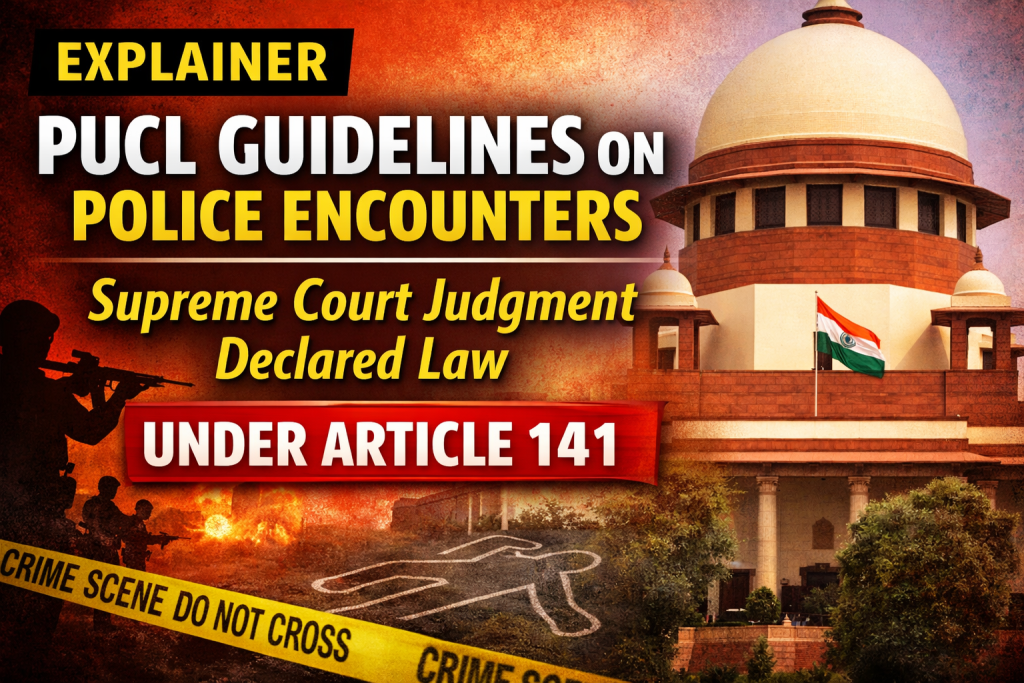
The Hon’ble Supreme Court of India, in People’s Union for Civil Liberties (PUCL) & Anr. v. State of Maharashtra, (2014) 10 SCC 635, has authoritatively laid down mandatory procedural safeguards to be followed in cases of alleged police encounters. The Court categorically held that whenever death or grievous injury is caused to the accused in a police encounter, it is imperative that an F.I.R. be registered forthwith and that an independent, impartial, and effective investigation be conducted.
The Apex Court further directed that such investigation must not be carried out by the police personnel involved in the encounter, but should instead be entrusted to the CBCID or a police team of another police station, and in any event, the investigation must be conducted by a police officer of a rank senior to the head of the police party involved in the encounter, so as to ensure transparency, accountability, and public confidence in the rule of law.
These directions, which are binding in terms of Article 141 of the Constitution of India, are expressly contained in Paragraph 31 of the judgment and are extracted hereinbelow-
31. In the light of the above discussion and having regard to the directions issued by the Bombay High Court, guidelines issued by NHRC, suggestions of the appellant PUCL, amicus curiae and the affidavits filed by the Union of India, the State Governments and the Union Territories, we think it appropriate to issue the following requirements to be followed in the matters of investigating police encounters in the cases of death as the standard procedure for thorough, effective and independent investigation:
31.1. Whenever the police is in receipt of any intelligence or tip-off regarding criminal movements or activities pertaining to the commission of grave criminal offence, it shall be reduced into writing in some form (preferably into case diary) or in some electronic form. Such recording need not reveal details of the suspect or the location to which the party is headed. If such intelligence or tip-off is received by a higher authority, the same may be noted in some form without revealing details of the suspect or the location.
31.2. If pursuant to the tip-off or receipt of any intelligence, as above, encounter takes place and firearm is used by the police party and as a result of that, death occurs, an FIR to that effect shall be registered and the same shall be forwarded to the court under Section 157 of CRPC (Now Section – 176 BNSS) without any delay. While forwarding the report under Section 176 BNSS, the procedure prescribed under 176 of the BNSS shall be followed.
31.3. An independent investigation into the incident/encounter shall be conducted by the CID or police team of another police station under the supervision of a senior officer (at least a level above the head of the police party engaged in the encounter). The team conducting inquiry/investigation shall, at a minimum, seek:
(a) To identify the victim; colour photographs of the victim should be taken;
(b) To recover and preserve evidentiary material, including bloodstained earth, hair, fibres and threads, etc. related to the death;
(c) To identify scene witnesses with complete names, addresses and telephone numbers and obtain their statements (including the statements of police personnel involved) concerning the death;
(d) To determine the cause, manner, location (including preparation of rough sketch of topography of the scene and, if possible, photo/video of the scene and any physical evidence) and time of death as well as any pattern or practice that may have brought about the death;
(e) It must be ensured that intact fingerprints of deceased are sent for chemical analysis. Any other fingerprints should be located, developed, lifted and sent for chemical analysis;
(f) Post-mortem must be conducted by two doctors in the district hospital, one of them, as far as possible, should be incharge/head of the district hospital. Post-mortem shall be videographed and preserved;
(g) Any evidence of weapons, such as guns, projectiles, bullets and cartridge cases, should be taken and preserved. Wherever applicable, tests for gunshot residue and trace metal detection should be performed.
(h) The cause of death should be found out, whether it was natural death, accidental death, suicide or homicide.
31.4. A magisterial inquiry under Section 176 of the CRPC (Now 196 BNSS) must invariably be held in all cases of death which occur in the course of police firing and a report thereof must be sent to the Judicial Magistrate having jurisdiction under Section 190 of the CRPC (Now Section 210).
31.5. The involvement of NHRC is not necessary unless there is serious doubt about independent and impartial investigation. However, the information of the incident without any delay must be sent to NHRC or the State Human Rights Commission, as the case may be.
31.6. The injured criminal/victim should be provided medical aid and his/her statement recorded by the Magistrate or Medical Officer with certificate of fitness.
31.7. It should be ensured that there is no delay in sending FIR, diary entries, panchnamas, sketch, etc. to the court concerned.
31.8. After full investigation into the incident, the report should be sent to the competent court under Section 173 of CRPC (Now Section 193 BNSS). The trial, pursuant to the charge-sheet submitted by the investigating officer, must be concluded expeditiously.
31.9. In the event of death, the next of kin of the alleged criminal/victim must be informed at the earliest.
31.10. Six-monthly statements of all cases where deaths have occurred in police firing must be sent to NHRC by DGPs. It must be ensured that the six-monthly statements reach to NHRC by 15th day of January and July, respectively. The statements may be sent in the following format along with postmortem, inquest and, wherever available, the inquiry reports:
(i) Date and place of occurrence.
(ii) Police station, district.
(iii) Circumstances leading to deaths: (a) Self-defence in encounter. (b) In the course of dispersal of unlawful assembly. (c) In the course of affecting arrest.
(iv) Brief facts of the incident.
(v) Criminal case no.
(vi) Investigating agency.
(vii) Findings of the magisterial inquiry/inquiry by senior officers: (a) disclosing, in particular, names and designation of police officials, if found responsible for the death; and (b) whether use of force was justified and action taken was lawful.
31.11. If on the conclusion of investigation, the materials/evidence having come on record show that death had occurred by use of firearm amounting to offence under IPC (Now BNS), disciplinary action against such officer must be promptly initiated and he be placed under suspension.
31.12. As regards compensation to be granted to the dependants of the victim who suffered death in a police encounter, the scheme provided under Section 357-A of the CRPC (Now Section 396 of the BNSS dealing with Victim Compensation Scheme) must be applied.
31.13. The police officer(s) concerned must surrender his/her weapons for forensic and ballistic analysis, including any other material, as required by the investigating team, subject to the rights under Article 20 of the Constitution.
31.14. An intimation about the incident must also be sent to the police officer’s family and should the family need services of a lawyer/counselling, same must be offered.
31.15. No out-of-turn promotion or instant gallantry rewards shall be bestowed on the officers concerned soon after the occurrence. It must be ensured at all cost that such rewards are given/recommended only when the gallantry of the officers concerned is established beyond doubt.
31.16. If the family of the victim finds that the above procedure has not been followed or there exists a pattern of abuse or lack of independent investigation or impartiality by any of the functionaries as abovementioned, it may make a complaint to the Sessions Judge having territorial jurisdiction over the place of incident. Upon such complaint being made, the Sessions Judge concerned shall look into the merits of the complaint and address the grievances raised therein.
These guidelines were framed to strike a constitutional balance between the legitimate powers of the police and the fundamental right to life guaranteed under Article 21, and continue to operate as mandatory law unless modified by the Supreme Court itself.
Landmark judgements
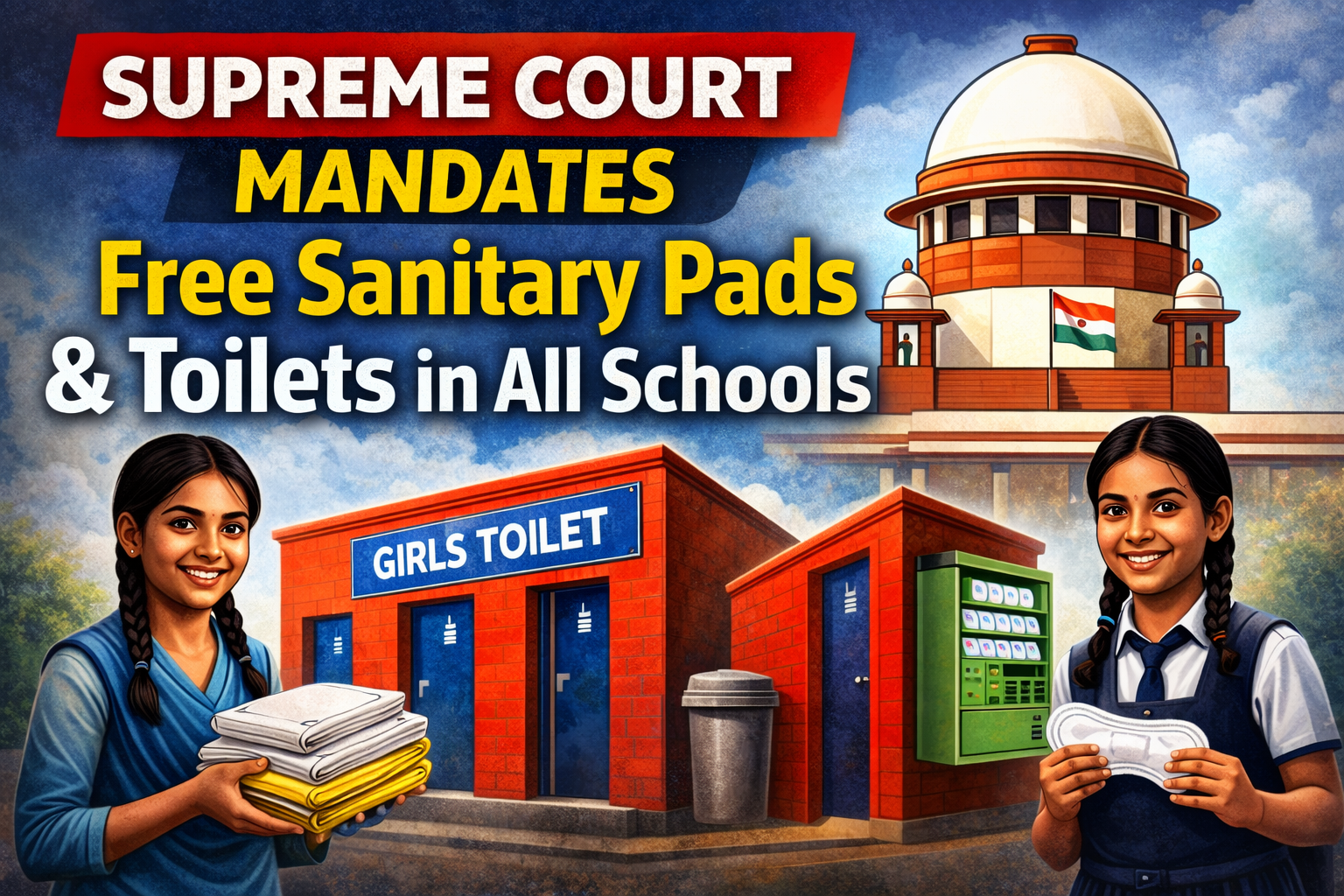
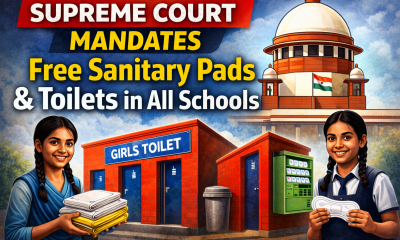
Supreme Court Mandates Free Sanitary Pads, Functional Toilets and Menstrual Hygiene Infrastructure in All Schools
The petition highlighted that lack of access to sanitary pads, absence of separate and functional toilets, poor waste disposal mechanisms, and social taboos surrounding menstruation lead to absenteeism and dropouts among girl students, particularly in government and aided schools.
Lentis Legalis | 31.01.2026
New Delhi
In a landmark judgment reinforcing the constitutional commitment to dignity, equality, and education of the girl child, the Supreme Court of India has issued comprehensive directions to ensure menstrual hygiene management and sanitation facilities in schools across the country.
The judgment was delivered in Writ Petition (Civil) No. 1000 of 2022, Dr. Jaya Thakur v. Government of India & Others, decided under the Court’s Original Civil Jurisdiction.
Opening the judgment with a powerful observation — “A period should end a sentence, not a girl’s education” — the Bench underscored that despite the passage of time, barriers to girls’ education rooted in inadequate sanitation and menstrual stigma continue to persist.
The petitioner, Dr. Jaya Thakur, a social worker, approached the Supreme Court under Article 32 of the Constitution in public interest, seeking directions to the Union of India, States, and Union Territories to address systemic gaps affecting the education and dignity of adolescent girls.
The petition highlighted that lack of access to sanitary pads, absence of separate and functional toilets, poor waste disposal mechanisms, and social taboos surrounding menstruation lead to absenteeism and dropouts among girl students, particularly in government and aided schools.
The petition seeks following relifs-
1. issue a writ order or directions in the nature of Mandamus to the Respondents to provide the free sanitary pads to girl child who are studying from 6th to 12th class and;
2. issue a writ order or directions in the nature of Mandamus to the Respondents to provide the separate girl toilet in all Government, Aided and residential schools;
3. issue a writ order or directions in the nature of Mandamus to the Respondents to provide one cleaner in all Government, Aided and residential schools to clean the toilets and;
4. issue a writ order or directions in the nature of Mandamus to the Respondents to provide three-stage awareness programme i.e. Firstly, the spreading of awareness about menstrual health and unboxing the taboos that surround it; Secondly, providing adequate sanitation facilities and subsidized or free sanitary products to women and young students, especially in disadvantaged areas; Thirdly, to ensure an efficient and sanitary manner of menstrual waste disposal and; e. pass such other or further order/s as this Hon’ble Court may deem it fit in the facts and circumstances of this case.”
Constitutional and Statutory Framework
After an exhaustive analysis of constitutional guarantees under Articles 14, 15, 21, and 21A, along with statutory provisions under the Right of Children to Free and Compulsory Education Act, 2009, Solid Waste Management Rules, and child protection laws, the Court concluded that menstrual hygiene and sanitation are inseparable from the right to education and dignity.
Key Directions Issued by the Supreme Court
1. Toilet and Washing Facilities
The Court directed that:
-
All schools, whether government-run or privately managed, in both rural and urban areas, must have functional, gender-segregated toilets with continuous water supply.
-
Toilets must ensure privacy, safety, and accessibility, including for children with disabilities.
-
Every school toilet must have handwashing facilities with soap and water at all times.
2. Availability of Menstrual Absorbents
The Court mandated that:
-
All schools shall provide oxobiodegradable sanitary napkins, compliant with ASTM D-6954 standards, free of cost.
-
Sanitary pads should preferably be made available through vending machines inside toilet premises, or alternatively through designated authorities within schools.
-
Menstrual Hygiene Management (MHM) corners must be established in every school, equipped with spare uniforms, innerwear, disposable bags, and other essentials to address menstruation-related emergencies.
3. Disposal of Sanitary Waste
The Court directed that:
-
Every school must have a safe, hygienic, and environmentally compliant disposal mechanism for sanitary waste, in accordance with the latest Solid Waste Management Rules.
-
Each toilet unit must be fitted with covered waste bins, which must be cleaned and maintained regularly.
4. Awareness and Training
Recognizing the role of education in breaking stigma, the Court ordered that:
-
NCERT and SCERT shall incorporate gender-responsive curricula covering menstruation, puberty, and related health concerns such as PCOS and PCOD.
-
All teachers, irrespective of gender, must be trained and sensitized to support menstruating students.
-
Information regarding Jan Aushadhi Suvidha Oxo-Biodegradable Sanitary Napkins shall be widely disseminated through social media, print media, radio, television, cinema advertisements, and outdoor publicity.
-
The child helpline established by the National Commission for Protection of Child Rights (NCPCR) must be widely publicized.
Monitoring and Accountability Mechanism
To ensure effective implementation, the Court directed:
-
District Education Officers (DEOs) to conduct annual inspections of schools focusing on sanitation, menstrual hygiene facilities, waste disposal, and awareness programmes.
-
DEOs must collect anonymous feedback from students through tailored surveys and ensure that inspection reports reflect student responses.
-
Inspection reports and survey responses must be annexed with notices issued under the RTE Rules, ensuring transparency and accountability.
The NCPCR and SCPCR were entrusted with overseeing compliance, with liberty to initiate action under the Commissions for Protection of Child Rights Act, 2005 in cases of non-compliance.
Continuing Mandamus and Timeline
Terming the issue one of national importance, the Court issued a continuing mandamus, directing the Union of India to ensure compliance by all States and Union Territories.
All authorities have been given three months from the date of pronouncement to strictly comply with the directions.
Judgment Beyond the Courtroom
In a deeply empathetic closing note, the Court observed that the judgment is not meant only for legal stakeholders but for classrooms, parents, teachers, and society at large. It emphasized that progress is measured by how a society protects its most vulnerable.
The Court reaffirmed that absenteeism caused by menstruation is not a failure of the girl child, but a failure of systems and societal silence — a silence the Constitution does not permit.
The matter has been directed to be listed after three months along with compliance reports from States and Union Territories. Copies of the judgment have been forwarded to all High Courts and relevant Ministries of the Government of India.


Major Relief for Law Students as Supreme Court Opens Review on Mandatory 3-Year Practice Rule

Allahabad High Court Sets Aside Charges for Ignoring Subsequent Closure Report Filed After Cognizance

Allahabad High Court Quashes Chargesheet and other Proceedings, Holds Relationship Prima Facie Consensual

Supreme Court to Hear Review Petition on 10 February 2026 Challenging Mandatory Three-Year Practice Requirement for Entry-Level Judicial Services

Supreme Court Mandates Free Sanitary Pads, Functional Toilets and Menstrual Hygiene Infrastructure in All Schools
Major Relief for Law Students as Supreme Court Opens Review on Mandatory 3-Year Practice Rule
-
 Supreme Court Highlights3 weeks ago
Supreme Court to Hear Review Petition on 10 February 2026 Challenging Mandatory Three-Year Practice Requirement for Entry-Level Judicial Services
-
 Landmark judgements4 weeks ago
Supreme Court Mandates Free Sanitary Pads, Functional Toilets and Menstrual Hygiene Infrastructure in All Schools
-
 High Court Updates1 month ago
Accessing Wife’s Private Photos Without Consent and Humiliating Her Before Family Amounts to Mental Cruelty
-

 High Court Updates3 weeks ago
Surge in Police Encounters in UP: Allahabad High Court Seeks Compliance with PUCL Guidelines
-

 Crime And Justice3 weeks ago
Pre-Trial Detention, Human Rights, and the rejection of Bail of Umar Khalid and Sharjeel Imam.
-
 Supreme Court Highlights4 weeks ago
Supreme Court Keeps UGC Equity Regulations, 2026 in Abeyance; Raises Concerns Over Ambiguity and Possible Misuse
-
 High Court Updates1 month ago
Husband Cannot Deny Maintenance Solely on Wife’s Educational Qualifications
-
 Explainers3 weeks ago
Explainer | PUCL Guidelines on Police Encounters: Supreme Court Judgment Declared Law Under Article 141