
High Court Updates
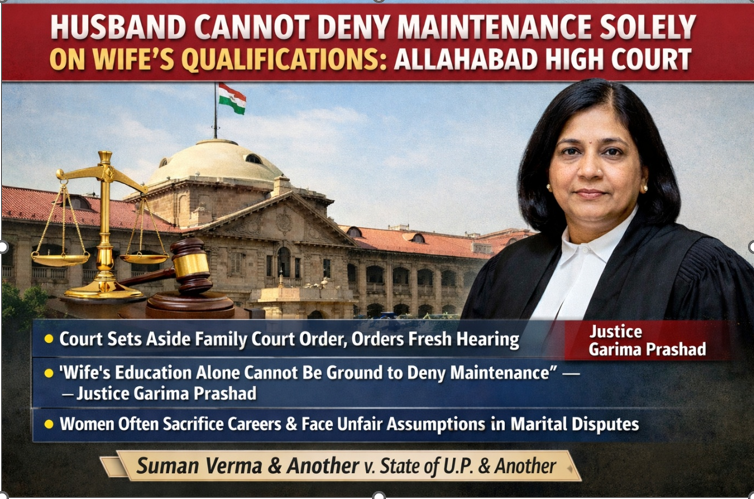
Husband Cannot Deny Maintenance Solely on Wife’s Educational Qualifications

Lentis Legalis | Allahabad High Court | Section 125 CrPC
The Allahabad High Court has set aside an order passed by the Family Court, Bulandshahr, which denied maintenance to a wife on the ground that she was educated and capable of earning. The Court held that mere educational qualification or potential earning capacity of a wife cannot be used by a husband to evade his statutory obligation to maintain her. The revisionist was represented by Counsel Deepak Kumar Yadav.
The judgment was delivered in Criminal Revision No. 5971 of 2024, arising out of proceedings under Section 125 of the Code of Criminal Procedure, by a Bench presided over by Justice Garima Prashad.
The revision was filed by the wife and her minor son challenging the order dated 03.10.2024 passed by the Additional Principal Judge, Family Court, Bulandshahr. By the impugned order, the Family Court had rejected the wife’s claim for maintenance and awarded only ₹3,000 per month to the minor son.
The parties were married on 20 May 2006 according to Hindu rites. From the wedlock, a son was born who is presently around 15 years old and resides with the mother. The wife alleged that she was subjected to physical and mental cruelty and was forced to leave the matrimonial home along with her son. She stated that she is presently residing at her parental home and is financially dependent on them.
The wife sought ₹15,000 per month for herself and ₹10,000 per month for her son, stating that the husband is a Class-IV employee in a primary school in Bulandshahr earning around ₹35,000–₹48,000 per month.
The husband opposed the claim on the ground that the wife is highly educated, having completed M.A. prior to marriage, and also possesses an ITI diploma in tailoring. He claimed that she was working as a teacher and earning through private tuitions. He also denied paternity of the minor child, asserting that there had been no physical relationship since 2007.
The High Court held that the Family Court had misapplied Section 125(4) CrPC by denying maintenance to the wife on the ground that she refused to return to the matrimonial home despite proceedings under Section 9 of the Hindu Marriage Act. Relying on Rina Kumari v. Dinesh Kumar Mahto (2025) 3 SCC 33, the Court held that refusal to resume cohabitation after a restitution decree cannot by itself disqualify a wife from claiming maintenance.
The Court also found fault with the Family Court’s reasoning that absence of criminal complaints for cruelty or dowry demand disentitled the wife from maintenance.
Significantly, the Court observed that while the wife may have concealed her educational qualifications, the husband had also made false statements by denying fatherhood of the minor child without evidence.
The High Court made strong observations on the social realities faced by women:
“The mere fact that she is a post graduate and has done ITI Diploma in tailoring by itself cannot lead to the conclusion that she is working for gain. It is a matter of social reality that women devote themselves to domestic responsibilities and take care of children and are unable to be gainfully employed.”
The Court further held:
“It is misplaced for a husband to rely solely on the qualification of his wife to evade his legal obligation to maintain her. Such sweeping assumptions are not only unfair but deeply insensitive to the social and emotional realities that women face.”
The Court reiterated that capacity to earn or meagre earnings are not sufficient grounds to deny maintenance, relying on Supreme Court judgments in Rajnesh v. Neha (2021), Sunita Kachwaha v. Anil Kachwaha (2014), and Shamima Farooqui v. Shahid Khan (2015).
Holding that the maintenance awarded to the minor son was grossly inadequate and that the wife’s financial incapacity was not properly appreciated, the High Court:
- Set aside the impugned Family Court order
- Remanded the matter to the Family Court for fresh determination of maintenance
- Directed the Family Court to pass a reasoned order within one month
- Held that both the wife and the minor son are entitled to maintenance
The judgment reinforces that maintenance under Section 125 CrPC is a measure of social justice, and that women cannot be denied maintenance merely because they are educated or theoretically capable of earning.
Crime And Justice
Allahabad High Court Sets Aside Charges for Ignoring Subsequent Closure Report Filed After Cognizance
LENTIS LEGALIS
ALLAHABAD| 14.02.2026
The Allahabad High Court has allowed a criminal appeal and set aside multiple orders passed by the Special Judge (SC/ST Act), Kannauj, holding that a trial court cannot ignore a Final Report (closure report) filed after further investigation merely because cognizance had already been taken on an earlier charge sheet.
The present criminal appeal under Section 14-A(1) Scheduled Castes & Scheduled Tribes (Prevention of Atrocities) Act has been preferred to allow this present appeal and set aside the impugned order dated 21.08.2024, 27.06.2024 and 10.05.2024 and all other consequential orders also passed by Special Judge SC/ST Act, District-Kannauj in S.C. No.1374/2023 (State Vs. Sonu @ Bhagwan Bhakt and others) arising out of Case Crime No.627/2023 U/s 147, 452, 323, 504, 506 I.P.C. and 3 (1)(d) SC/St Act, Police Station Kotwali Kannauj District-Kannauj. The Investigating Officer initially filed a charge sheet on 15.09.2023, on which cognizance was taken on 21.12.2023.
As the investigation was still under progress, supplementary report under Section 173(2) Cr.P.C. was submitted by I.O. on 31.3.2024 by concluding that allegations against the appellants were found false. It can be said that a final report was submitted by I.O. subsequent to the order of taking cognizance upon the charge sheet on 21.12.2023
During further investigation under Section 173(8) Cr.P.C., the I.O. submitted a Final Report/Closure Report on 31.03.2024, concluding that the allegations were false. Despite this, the trial court proceeded to frame charges on 07.08.2025 without passing any order on the Final Report.
The central question before the High Court was:
What is the duty of a Magistrate when, after taking cognizance on a charge sheet, a subsequent Final Report (negative report) is filed following further investigation?
The High Court held that A supplementary report, including a Final Report, is an integral part of the primary police report under Section 173 Cr.P.C. A Magistrate is duty-bound to consider every subsequent report filed during investigation, even after cognizance has been taken. Ignoring a Final Report and proceeding to frame charges amounts to a procedural illegality. Passing a fresh order on a Final Report does not amount to a review barred under Section 362 Cr.P.C., as cognizance does not finally dispose of the case.
The Court relied on landmark judgments including:
- Vinay Tyagi v. Irshad Ali (2013) – holding that primary and supplementary reports must be read conjointly.
- Ram Lal Narang v. State (Delhi Administration) – recognising the necessity of further investigation even after cognizance.
- Dharmatma Singh v. Harminder Singh – reiterating the Magistrate’s duty to independently assess conflicting police reports.
- Mariam Fasihuddin v. State (2024) – emphasising that courts must apply judicial mind to every valid supplementary report.
The impugned orders dated 21.08.2024, 27.06.2024 and 10.05.2024, including the order framing charges on 07.08.2025, were set aside. The trial court has been directed to first decide the Final Report after considering it along with the initial charge sheet. Charges may be framed only if a conjoint reading of both reports discloses a prima facie case.
See Here to read full Judgement
High Court Updates
Allahabad High Court Quashes Chargesheet and other Proceedings, Holds Relationship Prima Facie Consensual
LENTIS LEGALIS
Prayagraj | 16 February 2026
The Allahabad High Court has quashed the criminal proceedings, including charges under Section 376(2)(n) IPC and Section 67 of the Information Technology Act, in a case alleging repeated sexual assault and blackmail, holding that the material on record did not disclose a prima facie case warranting trial.
Justice Avnish Saxena allowed an application under Section 528 of the Bharatiya Nagarik Suraksha Sanhita (BNSS) filed by the accused persons, setting aside the charge-sheet dated 12.02.2025, the cognizance order dated 28.02.2025, and all consequential proceedings arising out of Case Crime No. 883 of 2024, Police Station Izzatnagar, District Bareilly.
The FIR, lodged on 01.12.2024 by the complainant, a married woman, alleged that she was repeatedly raped by the first accused between August 2022 and November 2023 on the pretext of guidance for the Provincial Civil Services examination. It was further alleged that obscene videos were recorded and later used for blackmail, with the second accused allegedly circulating the videos to the complainant’s family members.
Applicants submit that the FIR is grossly delayed. The informant is a married lady having two children, who has some oblique motive to fulfil. The record shows that the victim herself has sent friend request to the sister of accused through facebook, came closer to her and thereafter made distance and came closer to accused applicant.
After examining the FIR, statements under Sections 180 and 183 BNSS, and material collected during investigation, the Court noted multiple inconsistencies and improbabilities in the prosecution story. The Court observed that:
- The complainant was a married, educated woman with children and allegedly maintained prolonged physical relations over several years without reporting the matter.
- The alleged blackmail was based on videos which the complainant admitted she had never seen.
- There was no recoverable electronic evidence to substantiate claims of circulation of obscene material.
- Statements of the complainant’s husband and father did not conclusively support the allegation of transmission of videos.
- WhatsApp chats placed on record indicated intimate communication beyond mere academic guidance.
Relying on recent Supreme Court precedents, the Court held that prolonged and repeated physical relations, in the absence of compelling evidence of coercion or threat, cannot be presumed to be non-consensual.
The Court concluded that continuation of the criminal proceedings would amount to an abuse of the process of law. Consequently, all proceedings against both accused persons were quashed.
read judgement below
High Court Updates
Surge in Police Encounters in UP: Allahabad High Court Seeks Compliance with PUCL Guidelines
.

Allahabad | lentis legalis team
The Allahabad High Court has expressed serious concern over the increasing number of police encounters resulting in serious injuries to accused persons. The court observed that police firing, particularly shooting suspects in the legs “has become a common occurrence” and constitutes a misuse of power that cannot be permitted.
These remarks were made while granting bail to an accused named Raju @ Rajkumar, who had sustained serious injuries in a police encounter and was seeking bail in a case registered under Sections 305(a), 331(4), and 317(2) of the Bharatiya Nyaya Sanhita (BNS).
Non-Compliance with Supreme Court Guidelines
Upon examining the FIR and related records, the court found that although an FIR related to the police encounter was eventually registered, the mandatory safeguards laid down by the Supreme Court in the People’s Union for Civil Liberties (PUCL) vs. State of Maharashtra (2014) case were not followed.
Specifically, The injured accused’s statement was neither recorded before a magistrate nor by a medical officer. The investigation was initially assigned to a sub-inspector, whereas the Supreme Court mandates that encounters be investigated by an officer of a rank senior to the head of the police party involved or by an independent agency like the CBCID. Justice Arun Kumar Singh Deshwal stated that such omissions violate binding constitutional law under Article 141, rendering the police action legally flawed.
Court Summons Top State Officials
Taking cognizance of the repeated non-compliance, the High Court directed the Additional Chief Secretary (Home), Uttar Pradesh, and the Director General of Police (DGP), Uttar Pradesh, to appear before it via video conferencing.
Both senior officials acknowledged that despite repeated circulars issued in 2017 and 2024, many police officers were disregarding the Supreme Court’s directives. He assured the court that new guidelines would be issued and strict disciplinary action would be taken against the erring officers. Strong warning against ‘punitive’ encounters
The court strongly condemned the practice of police firing on accused persons under the guise of encounters, stating:
“The power to punish rests exclusively with the courts, not the police. India is a democratic state governed by the rule of law, and such conduct cannot be tolerated.”
The court also noted that in the cases before it, no police officer had sustained any injuries, raising serious doubts about the necessity and proportionality of the use of firearms.
Contempt proceedings for future violations
In a significant warning, the High Court stated that District Police Chiefs (SP/SSP/Commissionerate Police) would be liable for contempt of court, in addition to departmental action, if the Supreme Court guidelines are violated in encounter cases resulting in death or serious injury.
Session Judges have also been empowered to consider complaints regarding non-compliance and, where necessary, refer cases to the High Court for contempt proceedings.
Bail granted keeping in mind constitutional mandate
While granting bail to the applicant, the court took into consideration the Non-compliance with PUCL guidelines, the fact that the applicant’s name was not initially in the FIR, filing of the charge sheet, long period of incarceration since August 2025, and Overcrowding in prisons and pendency of criminal trials. The applicant was released on bail subject to strict conditions to ensure cooperation in the trial and non-interference with evidence.
Reaffirmation of human rights and the rule of law
Reiterating India’s constitutional and international obligations under Article 21, the Universal Declaration of Human Rights, and the UN norms on law enforcement, the court emphasized that human dignity cannot be sacrificed at the altar of expediency or publicity. This decision confirms that the PUCL guidelines are the law of the land and must be strictly followed in every case of a police encounter resulting in death or serious injury.


Major Relief for Law Students as Supreme Court Opens Review on Mandatory 3-Year Practice Rule

Allahabad High Court Sets Aside Charges for Ignoring Subsequent Closure Report Filed After Cognizance

Allahabad High Court Quashes Chargesheet and other Proceedings, Holds Relationship Prima Facie Consensual

Supreme Court to Hear Review Petition on 10 February 2026 Challenging Mandatory Three-Year Practice Requirement for Entry-Level Judicial Services

Supreme Court Mandates Free Sanitary Pads, Functional Toilets and Menstrual Hygiene Infrastructure in All Schools
Major Relief for Law Students as Supreme Court Opens Review on Mandatory 3-Year Practice Rule
-
 Supreme Court Highlights3 weeks ago
Supreme Court to Hear Review Petition on 10 February 2026 Challenging Mandatory Three-Year Practice Requirement for Entry-Level Judicial Services
-
 Landmark judgements4 weeks ago
Supreme Court Mandates Free Sanitary Pads, Functional Toilets and Menstrual Hygiene Infrastructure in All Schools
-
 Landmark judgements1 week ago
Major Relief for Law Students as Supreme Court Opens Review on Mandatory 3-Year Practice Rule
-
 High Court Updates1 month ago
Accessing Wife’s Private Photos Without Consent and Humiliating Her Before Family Amounts to Mental Cruelty
-

 High Court Updates3 weeks ago
Surge in Police Encounters in UP: Allahabad High Court Seeks Compliance with PUCL Guidelines
-

 Crime And Justice3 weeks ago
Pre-Trial Detention, Human Rights, and the rejection of Bail of Umar Khalid and Sharjeel Imam.
-
 Supreme Court Highlights4 weeks ago
Supreme Court Keeps UGC Equity Regulations, 2026 in Abeyance; Raises Concerns Over Ambiguity and Possible Misuse
-

 Explainers3 weeks ago
Explainer | PUCL Guidelines on Police Encounters: Supreme Court Judgment Declared Law Under Article 141