
Supreme Court Highlights
CASE REVIEW OF DELHI RIOTS CASE: bail denied to Sharjeel Imam and Umar Khalid but granted to five others

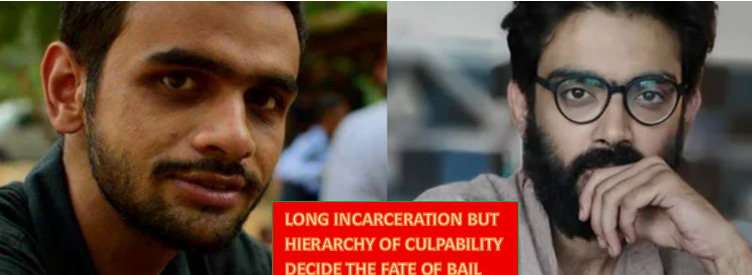
The Supreme Court denied bail to Umar Khalid and Sharjeel Imam in a judgement out of a common judgment and order passed denying the bail to all the accused of the Delhi riot case by the High Court of Delhi. The appellants stand arraigned as accused in FIR No. 59 of 2020 registered by the Crime Branch, Delhi, arising out of the incidents that occurred in several parts of Delhi in February 2020.
The appellants Sharjeel Imam, Umar Khalid, Shifa Ur Rehman, Mohd. Saleem Khan, Meeran Haider, Shadab Ahmed, and Gulfisha Fatima had filed appeal against the judgement of the High Court of Delhi before the Supreme Court.
At the inception, the appellants were booked under Sections 147, 148, 149 and 120B of the Indian Penal Code. Upon completion of investigation, a chargesheet came to be filed alleging offences under Sections 120B read with Sections 109, 114, 124A, 147, 148, 149, 153A, 186, 201, 212, 295, 302, 307, 341, 353, 395, 420, 427, 435, 436, 452, 454, 468, 471 and 34 of the Indian Penal Code, as also under Sections 13, 16, 17 and 18 of the Unlawful Activities (Prevention) Act, 1967, Sections 25 and 27 of the Arms Act, and Sections 3 and 4 of the Prevention of Damage to Public Property Act, 1984.
The prosecution case, as placed before the Court, proceeded on the ground that the incidents of violence were not isolated or spontaneous, but were the outcome of a larger conspiracy in which several accused persons are alleged to have participated at different stages and in different capacities. While the FIR and the impugned judgment are common, the role attributed to each appellant, the nature of the allegations, and the material relied upon by the prosecution are not uniform.
According to the prosecution it was alleged that a pre-planned criminal conspiracy involving several accused persons, including the present appellants was hatched with the object of orchestrating riots, which culminated in the deliberate incitement of widespread communal violence on and around 22nd, 23rd, and 24th February 2020. The acts allegedly committed during this period were not spontaneous but were the outcome of coordinated efforts to inflame tensions, mobilise crowds, and execute violent actions across various parts of Delhi as a form of protest against the enactment of the Citizenship Amendment Act, 2019 and the proposed National Register of Citizens.
The riots resulted in grave consequences, including the loss of 54 lives, among them a senior police officer and an Intelligence Bureau official, as well as grievous injuries to several police personnel and civilians. In addition, extensive damage was caused to over 1,500 public and private properties, alongside substantial intangible harm to public order, social harmony, and the nation at large.
It was also alleged that, as part of the said conspiracy, Umar Khalid delivered provocative speeches calling upon people to come out on the streets and block roads during the visit of the then President of the United States of America, Mr. Donald Trump, on 24th and 25th February 2020. The alleged objective of such actions was to internationalise a narrative that minorities in India were being illtreated and tortured. It is further alleged that women and children were deliberately mobilised to come out on the streets in various localities of Delhi to escalate tensions and precipitate communal violence.
The FIR further reveals that, in several areas’ weapons and incendiary materials such as firearms, petrol bombs, acid bottles, stones, slingshots and other dangerous substances were allegedly stockpiled in homes in advance.
| SL. No. | Name Of Appellant | Date of Arrest |
| 1 | Gulfisha Fatima | 11.04.2020 |
| 2 | Sharjeel Imam | 28.01.2020 |
| 3 | Meeran Haider | 01.04.2020 |
| 4 | Umar Khalid | 01.10.2020 |
| 5 | Shifa Ur Rehman | 26.04.2020 |
| 6 | Mohd Saleem Khan | 25.06.2020 |
| 7 | Shadab Ahmed | 20.05.2020 |
A fervent plea was addressed on behalf of the appellants resting on constitutional grounds that prolonged incarceration, coupled with the absence of any realistic prospect of early conclusion of trial, rendered continued detention constitutionally impermissible and mandate of Article 21 of the Constitution is at peril.
Relying on the Supreme Court’s judgement which recognised earlier that personal liberty cannot be sacrificed at the altar of procedural stagnation, and that prolonged pretrial incarceration may, in appropriate cases, justify constitutional intervention notwithstanding statutory restrictions on bail. It was submitted by the appellants that they had been in custody for a substantial length of time; that the progress of trial had been slow; and that the complexity of the prosecution rendered the likelihood of its early conclusion uncertain.
Reference was made to the nature of the allegations, the statutory framework invoked, and the role attributed to individual appellants. It is the reflection of the legal reality that the constitutional question of delay does not arise in a vacuum.
The highlighted that record discloses that all the appellants do not stand on an equal footing as regards culpability. The allegations against the principal accused indicate a central and directive role in conceptualising, planning, and coordinating the alleged terrorist act, whereas the material against certain co-accused reflects conduct of a subsidiary or facilitative nature. The hierarchy of participation, emerging from the prosecution’s case itself, requires the Court to assess each application individually, rather than proceed on the premise of equivalence. Such differentiation is intrinsic to criminal adjudication and operates irrespective of the uniformity of charges framed.
In the case of the alleged masterminds i.e., Sharjeel Imam and Umar Khalid, the prosecution material comprises direct, corroborative, and contemporaneous evidence, including recoveries, digital communication trails, and statements indicative of managerial responsibility. In contrast, the involvement of others is sought to be established mainly through associative or peripheral conduct. The Court cannot ignore that where evidentiary strength varies materially between accused persons, the need for continued detention likewise varies. Detention that remains necessary to secure ongoing prosecutorial 30 objectives for the principal offenders may not retain the same necessity for those of limited attribution.
The alleged masterminds are stated to have exercised command authority and to possess the ability to mobilise or influence individuals within and outside their immediate circle. Such allegations, when supported by preliminary material, compel heightened caution regarding the possibility of interference with witnesses or reactivation of dormant networks. As against this, co-accused with no independent capacity to mobilise resources or exert organisational leverage do not present the same systemic risk. The logic of detention cannot be applied homogenously where the risk profiles of the accused are markedly dissimilar.
The alleged masterminds are stated to have exercised command authority and to possess the ability to mobilise or influence individuals within and outside their immediate circle. Such allegations, when supported by preliminary material, compel heightened caution regarding the possibility of interference with witnesses or reactivation of dormant networks. As against this, co-accused with no independent capacity to mobilise resources or exert organisational leverage do not present the same systemic risk. The logic of detention cannot be applied homogenously where the risk profiles of the accused are markedly dissimilar.
It is well recognised that Article 21 rights, though not absolute, require the State and the Court to justify continued custody with reference to the specific individual before it. Treating all accused identically irrespective of their roles would risk transforming pre-trial detention into a punitive mechanism divorced from individual circumstances. The constitutional mandate demands a differentiated inquiry: where prolonged custody disproportionately burdens those whose roles are limited, the balance between individual liberty and collective security may call for conditional release, while the same balance may tilt differently for those alleged to have orchestrated the offence.
The statutory restrictions under special enactments do not preclude the Court from recognising distinctions between accused persons based on the quality of material, the nature of involvement, and the necessity of further detention.
At the outset, Umar Khalid and Sharjeel Imam are prima facie attributed a central role and alleged to be ideological drivers of the alleged conspiracy.
Even in the narrative concerning escalation into violence, the role attributed to the remaining accused is largely proximate and reactive, arising from developments at specific protest sites. Umar Khalid and Sharjeel Imam, on the 33 other hand, are alleged to have operated remotely away from the sites of violence, with no direct attribution of participation in acts of arson, assault, or destruction of property. The prosecution case thus proceeds on the footing that the former category of accused was involved in facilitating execution, whereas the latter were involved in conceptualisation and supervision.
A principle lies at the heart of constitutional adjudication in matters of this nature. The Constitution guarantees personal liberty, but it does not conceive liberty as an isolated or absolute entitlement, detached from the security of the society in which it operates. The sovereignty, integrity, and security of the nation, as well as the preservation of public order, are not abstract concerns rather they are constitutional values which Parliament is entitled to protect through law.
This Court is satisfied that the prosecution material, taken at face value as required at this stage, discloses a prima facie attribution of a central and formative role by the appellants i.e. Umar Khalid and Sharjeel Imam in the alleged conspiracy. The material suggests involvement at the level of planning, mobilisation, and strategic direction, extending beyond episodic or localised acts. The statutory threshold under Section 43D (5) of the Unlawful Activities (Prevention) Act, 1967, therefore stands attracted qua these appellants.
Supreme Court held that on the completion of the examination of the protected witnesses relied upon by the prosecution, or upon the expiry of a period of one year from the date of this order, whichever is earlier, these two appellants would be at liberty to renew their prayer for grant of bail before the jurisdictional Court.
The bail applications of appellants Gulfisha Fatima, Meeran Haider, Shifa-ur-Rehman, Mohd. Saleem Khan and Shadab Ahmed are allowed as the Court is of the view that, having regard to the role attributed, the nature of the material relied upon, and the present stage of the proceedings, continued incarceration is not shown to be indispensable to the conduct of a fair trial, provided strict safeguards are imposed. The grant of bail in their favour does not reflect any dilution of the seriousness of the allegations, nor does it amount to a finding on guilt. It represents a calibrated exercise of constitutional discretion, structured to preserve both liberty of the individual and security of the nation.
Advocate Chandrasen Yadav
B.Sc & LL.B from Allahabad University
LL.M from Central University of Punjab
Lucknow
Landmark judgements
Major Relief for Law Students as Supreme Court Opens Review on Mandatory 3-Year Practice Rule
New Delhi | February 18, 2026
LENTIS LEGALIS BREAKING
The Supreme Court of India has allowed applications seeking permission to file Review Petition(s) in a long-pending matter arising out of Writ Petition (C) No. 1022 of 1989. Importantly, applications requesting that the Review Petition be listed in open court with oral hearing have also been allowed, recognizing the significance of the issues involved. The review petition has been filed by Advocate Chandrasen Yadav, through Advocate-on-Record Kunal Yadav.
The order was passed by a Bench comprising The Chief Justice of India, Justice Augustine George Masih, and Justice K. Vinod Chandran.
The Court has issued notice to the respondents, returnable on 26 February 2026, directing them to respond to the Review Petition. The Review Petition has also been tagged with Writ Petition (C) No. 1110 of 2025 (Diary No. 52914 of 2025 – Bhumika Trust) to ensure comprehensive and consistent adjudication of connected issues.
In the Writ Petition (C) No. 1110 of 2025 (Diary No. 52914 of 2025 – Bhumika Trust vs. Union of India), the Supreme Court of India has already invited suggestions from law universities across the country on the issue of mandatory three-year legal practice as a prerequisite for entry into judicial service. With the Review Petitions now permitted and ordered to be heard in open court, the forthcoming hearing will address the wider constitutional, institutional, and practical issues raised both in the Review Petitions and in the writ petition filed by Bhumika Trust, enabling a comprehensive reconsideration of the policy’s impact on law students, judicial recruitment, and access to justice.
The Review Petition assails the Supreme Court’s judgment dated 20 May 2025 in Writ Petition (C) No. 1022 of 1989, challenging the direction mandating three years’ minimum practice at the Bar for entry into the Civil Judge (Junior Division) cadre. The petitioner, Chandrasen Yadav argues that the decision is unsupported by empirical data, impact studies, or objective evaluation, and rests largely on subjective opinions of certain High Courts while ignoring dissenting views of several States and High Courts. It is contended that no credible evidence establishes that fresh law graduates perform poorly as judges or that prior advocacy experience necessarily enhances judicial competence, particularly when rigorous competitive examinations and structured judicial training exist. The petition further highlights that the judgment selectively overlooks key recommendations of the Justice Shetty Commission, earlier binding precedent in All India Judges Association (1993), and the role of institutional training as an alternative to mandatory practice. The uniform, nationwide imposition of the rule is alleged to be arbitrary, exclusionary, and disproportionate, adversely impacting economically weaker sections, SC/ST/OBC candidates, recent graduates, and those working in law firms, PSUs, or corporate roles. It is also argued that the absence of a transitional mechanism, the impractical certificate requirement, and the coercive nature of forcing graduates into litigation practice infringe Articles 14 and 19(1)(g) of the Constitution. The petitioner asserts that by effectively prescribing eligibility norms without legislative backing or inclusive consultation, the ruling raises serious constitutional concerns regarding arbitrariness, equal opportunity, and access to judicial service, warranting reconsideration by the Supreme Court of India.
The matter is now scheduled for further proceedings upon return of notice on 26.02.2026.
Crime And Justice
Supreme Court Sets Aside Time-Bound Anticipatory Bail: Reaffirms That Protection Cannot Expire Automatically on Filing of Charge Sheet
Lentis Legalis
New Delhi | 9 February 2026
In a significant ruling clarifying the law on anticipatory bail, the Supreme Court of India held that once anticipatory bail is granted, it ordinarily cannot be restricted till the filing of the charge sheet, unless exceptional circumstances are recorded. The Court set aside an order of the High Court of Allahabad which had denied continued protection to an accused after completion of investigation.
The judgment was delivered by a Division Bench comprising Justice J.B. Pardiwala and Justice K.V. Viswanathan in Criminal Appeal arising out of SLP (Crl.) No. 1536 of 2026, titled Sumit v. State of Uttar Pradesh & Anr.
The appellant, Sumit, is the brother-in-law (devar) of a deceased woman who had been married to the appellant’s brother for about seven months prior to her death.
- The deceased died under mysterious circumstances at her matrimonial home.
- An FIR bearing No. 560/2024 was registered at Akbarpur Police Station, Kanpur Dehat, under:
- Sections 80(2) / 85 of the Bharatiya Nyaya Sanhita (BNS)
- Sections 3 & 4 of the Dowry Prohibition Act, 1961
- The FIR was lodged by the mother of the deceased, alleging dowry-related harassment and death.
Apprehending arrest, the appellant initially approached the Allahabad High Court seeking anticipatory bail.
Proceedings Before the High Court
First Anticipatory Bail Order
In Criminal Misc. Anticipatory Bail Application No. 3992/2025, the High Court granted anticipatory bail to the appellant. However, the relief was restricted only till the filing of the police charge sheet.
The High Court:
- Accepted that there were no specific allegations against the appellant.
- Noted that he was implicated largely due to his relationship as a brother-in-law.
- Observed that he had no criminal antecedents.
- Still imposed a time-bound limitation, terminating protection once the investigation concluded.
Second Anticipatory Bail Application
After the charge sheet was filed, the appellant again sought anticipatory bail. This time, the High Court rejected the application without identifying any new aggravating circumstance or change in the factual matrix.
This rejection led to the present appeal before the Supreme Court.
Issues Before the Supreme Court
- Whether anticipatory bail can be restricted till the filing of the charge sheet as a matter of routine?
- Whether filing of a charge sheet automatically extinguishes the protection of anticipatory bail?
- Whether the High Court was justified in rejecting the second anticipatory bail application without recording special reasons?
Supreme Court’s Analysis and Discussion
The Supreme Court expressed strong disapproval of the practice of granting time-bound anticipatory bail orders.
No Rationale for Automatic Expiry
The Bench observed:
- Once a court, after considering the nature of allegations, role of the accused, and overall facts, exercises discretion in favour of the accused, there must be strong and special reasons to subsequently deny protection.
- Merely because the charge sheet is filed, the anticipatory bail does not automatically lapse.
The Court questioned the logic behind such restrictions, noting:
“Either the Court grants anticipatory bail or declines it. Having granted it after due consideration, there was no justification to limit it till the filing of the charge sheet.”
Reliance on Constitution Bench Precedent
The Bench reaffirmed the law laid down in Sushila Aggarwal v. State (NCT of Delhi), holding that:
- Anticipatory bail need not have a fixed expiry period.
- Duration of bail is a matter of judicial discretion, not procedural milestones.
- Arbitrary timelines undermine personal liberty.
The Court also relied upon Siddharam Satlingappa Mhetre v. State of Maharashtra (2011) 1 SCC 694, reiterating that:
- Anticipatory bail should not hinge upon investigation stages like filing of charge sheet or taking cognizance.
Conditions, Not Time Limits, Are the Safeguard
Addressing concerns of misuse, the Court clarified that:
- Risks can be mitigated through conditions of cooperation, attendance, and non-tampering of evidence.
- If circumstances change, the prosecution is always at liberty to seek cancellation or modification of bail under law.
- However, expiry clauses at inception are legally unsustainable.
Clarification on Addition of Graver Offences
Before concluding, the Court addressed an important legal scenario:
What happens if new, serious non-bailable offences are added after bail is granted?
Relying on Pradeep Ram v. State of Jharkhand (2019) and Prahlad Singh Bhati v. NCT of Delhi (2001), the Court held:
- Addition of graver cognizable and non-bailable offences may disentitle the accused from earlier bail.
- In such cases:
- Courts must apply their mind afresh.
- Investigating agencies may seek custody through appropriate judicial orders.
- Arrest cannot be mechanical and must follow judicial authorization.
Allowing the appeal, the Supreme Court:
- Set aside the impugned order of the Allahabad High Court rejecting anticipatory bail.
- Directed that In the event of arrest, the appellant shall be released on anticipatory bail, subject to conditions imposed by the Investigating Officer. The appellant shall thereafter appear before the Trial Court and furnish fresh bail bonds. Directed the Registry to forward a copy of the judgment to the Registrar General of the Allahabad High Court for placement before the Hon’ble Chief Justice.
Click Below to read the Judgment
https://api.sci.gov.in/supremecourt/2026/3119/3119_2026_5_32_68496_Judgement_09-Feb-2026.pdf
Supreme Court Highlights
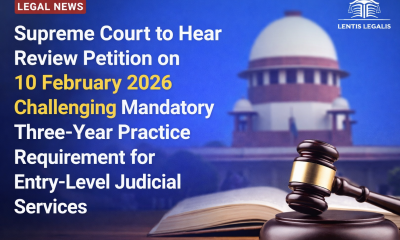
Supreme Court to Hear Review Petition on 10 February 2026 Challenging Mandatory Three-Year Practice Requirement for Entry-Level Judicial Services
New Delhi | Lentis Legalis
The Supreme Court of India is set to consider a Review Petition filed by Advocate Chandrasen Yadav, through Advocate-on-Record Kunal Yadav, challenging the mandatory requirement of three years’ legal practice for entry into judicial services, as introduced in All India Judges Association v. Union of India (2024 SCC OnLine SC 1553).
As per the Supreme Court’s case status portal, the Review Petition titled Chandrasen Yadav v. Union of India (Diary No. 33086/2025) has been listed for motion hearing (fresh for admission) on 10 February 2026.
Bench Composition
The matter is listed before a Bench comprising:
- Hon’ble the Chief Justice of India,
- Hon’ble Mr. Justice Augustine George Masih, and
- Hon’ble Mr. Justice K. Vinod Chandran.
The petition will be taken up at the threshold stage to determine whether it merits admission.
Background of the Case
In its 2024 Constitution Bench judgment, the Supreme Court mandated a minimum of three years’ advocacy practice as an eligibility condition for appointment to the post of Civil Judge (Junior Division). The ruling marked a significant departure from the earlier position that permitted fresh law graduates to compete in judicial service examinations.
The decision has had wide-ranging implications for thousands of law graduates across the country who were preparing for judicial service examinations under the previous eligibility framework.
Key Grounds Raised in the Review Petition
The Review Petition contends that:
- The mandatory three-year practice requirement causes manifest injustice to law graduates who had a legitimate expectation based on earlier recruitment rules.
- The condition operates retrospectively, adversely affecting candidates already in the pipeline.
- The judgment overlooks federal variations in State judicial service rules.
- The requirement lacks sufficient empirical data demonstrating its necessity for judicial competence.
Interlocutory Applications Filed
Along with the Review Petition, multiple applications have been filed, including:
- Application seeking permission to file the review petition,
- Application requesting oral hearing,
- Stay application, and
- Application to place additional documents and materials on record.
At the motion hearing stage, the Supreme Court will decide whether the Review Petition discloses an error apparent on the face of the record or presents exceptional circumstances warranting reconsideration of the Constitution Bench verdict. Review petitions are ordinarily decided by circulation, and oral hearing is granted only in rare cases.
The outcome of the proceedings is expected to have a significant bearing on the future of judicial service aspirants across India.


Major Relief for Law Students as Supreme Court Opens Review on Mandatory 3-Year Practice Rule

Allahabad High Court Sets Aside Charges for Ignoring Subsequent Closure Report Filed After Cognizance

Allahabad High Court Quashes Chargesheet and other Proceedings, Holds Relationship Prima Facie Consensual

Supreme Court to Hear Review Petition on 10 February 2026 Challenging Mandatory Three-Year Practice Requirement for Entry-Level Judicial Services

Supreme Court Mandates Free Sanitary Pads, Functional Toilets and Menstrual Hygiene Infrastructure in All Schools
Major Relief for Law Students as Supreme Court Opens Review on Mandatory 3-Year Practice Rule
-
 Supreme Court Highlights3 weeks ago
Supreme Court to Hear Review Petition on 10 February 2026 Challenging Mandatory Three-Year Practice Requirement for Entry-Level Judicial Services
-
 Landmark judgements4 weeks ago
Supreme Court Mandates Free Sanitary Pads, Functional Toilets and Menstrual Hygiene Infrastructure in All Schools
-
 Landmark judgements1 week ago
Major Relief for Law Students as Supreme Court Opens Review on Mandatory 3-Year Practice Rule
-
 High Court Updates1 month ago
Accessing Wife’s Private Photos Without Consent and Humiliating Her Before Family Amounts to Mental Cruelty
-

 High Court Updates3 weeks ago
Surge in Police Encounters in UP: Allahabad High Court Seeks Compliance with PUCL Guidelines
-

 Crime And Justice3 weeks ago
Pre-Trial Detention, Human Rights, and the rejection of Bail of Umar Khalid and Sharjeel Imam.
-
 Supreme Court Highlights4 weeks ago
Supreme Court Keeps UGC Equity Regulations, 2026 in Abeyance; Raises Concerns Over Ambiguity and Possible Misuse
-
 High Court Updates1 month ago
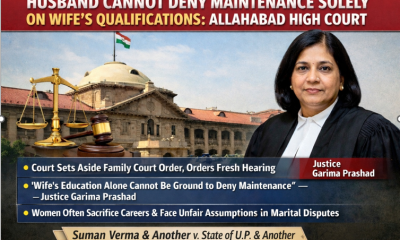
Husband Cannot Deny Maintenance Solely on Wife’s Educational Qualifications