
Law Students
Supreme Court Review Petition Challenges 3-Year Mandatory Practice for Judicial Services: What Law Students Must Know

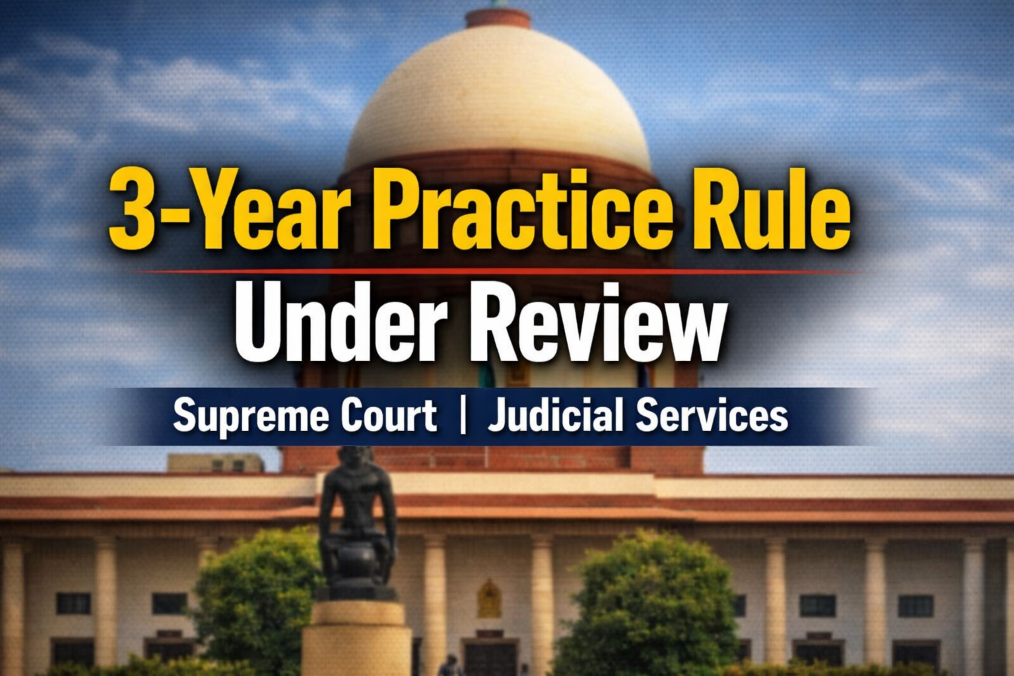
Public debate continues to grip the nation’s attention among newly admitted lawyers and law students regarding the Hon’ble Supreme Court’s decision of May 20, 2025, in I.A. No. 93974/2019, along with I.A. Nos. 72900/2021, 73015/2021, 40695/2021, I.A. No. 50269/2022, and I.A. No. 201893/2022. By this decision, the Hon’ble Supreme Court made a minimum of three years’ experience as a practicing lawyer a mandatory eligibility condition for appointment to the entry-level Judicial Service (Civil Judge Junior Division).
This decision has caused great concern among those preparing for the judicial service, especially fresh law graduates and newly registered lawyers, who now face a long and uncertain path to reach the judiciary.
The requirement of three years’ prior practice places aspiring candidates in an exceptionally difficult position, particularly when viewed against the ground realities of the Indian legal profession. Meaningful courtroom exposure is often hard to obtain, a challenge that is disproportionately severe for women students, persons with disabilities, and first-generation lawyers who lack familial backing, professional networks, or institutional guidance. For many first-generation aspirants, even securing a basic internship proves arduous in the absence of personal connections, making the acquisition of practical skills and professional confidence an uphill task.
The situation is further compounded by entrenched hierarchies within legal education itself. Graduates from National Law Universities are frequently perceived as belonging to an elite category, while students from other universities, despite comparable merit are often overlooked, resulting in unequal access to quality internships and chambers offering substantive work. This systemic disparity deepens existing inequalities within the profession. Moreover, the financial realities of legal training remain stark: stipends during internships or traineeships are either negligible or entirely absent, and earnings in the initial years of practice are generally insufficient to sustain a dignified livelihood.
As a result, a significant number of young aspirants are forced into a prolonged period of professional and economic uncertainty. This raises serious concerns regarding equal access to judicial service, social inclusiveness, and the future composition of the subordinate judiciary, which risks becoming less representative of India’s diverse social realities. The mandate, though aimed at enhancing judicial competence, thus calls for a deeper examination of whether it inadvertently erects structural barriers incompatible with the constitutional promise of equality and fairness in public employment.
Review Petition filed by a young advocate, Chandrasen Yadav, who himself had been preparing for the judicial services, titled Chandrasen Yadav v. Union of India & Others, challenges the judgment dated 20 May 2025 of the Hon’ble Supreme Court which mandates a minimum of three years’ prior practice as an advocate for appointment to the lower judiciary. The Review Petition was instituted on 16 June 2025 and was listed on 10 February 2026. The decision on the petition is presently awaited. In the absence of any immediate public update, a sense of anxiety and uncertainty has emerged among law students and newly enrolled advocates who are closely following the outcome of the matter.
It is important to note that a Review Petition is procedurally distinct from a writ petition or a Special Leave Petition. Review matters are ordinarily decided by circulation in the chambers of the Hon’ble Judges, without oral hearings, and the process often takes time. The absence of an instant order on the listing date does not indicate delay or adverse inference; rather, it reflects the established judicial practice governing review jurisdiction. The final order is issued only after due consideration by the Bench, following which it is uploaded on the official website of the Supreme Court.
A Review Petition serves as an important constitutional and procedural safeguard, enabling the Supreme Court of India to reconsider its own judgments in exceptional circumstances. While the finality of judgments remains a fundamental principle of judicial discipline and legal certainty, the power of review exists to prevent a miscarriage of justice arising from errors apparent on the face of the record. At the same time, the Court’s review jurisdiction is deliberately narrow, exercised with great caution, and invoked only in the rarest of cases, so as to strike a careful balance between correcting palpable errors and preserving the stability of judicial decisions.
The power of review exercised by the Supreme Court of India emanates from distinct constitutional and procedural sources. Article 137 of the Constitution of India expressly empowers the Supreme Court to review any judgment or order passed by it, subject to the provisions of Article 145, which authorises the Court to frame rules regulating its practice and procedure, as well as any law enacted by Parliament.
In furtherance of this constitutional mandate, Order XLVII of the Supreme Court Rules, 2013 governs the procedure for the institution and consideration of review petitions. The review jurisdiction is clearly distinguishable from the Court’s appellate jurisdiction and cannot be invoked as a substitute for an appeal or a rehearing of the case on merits.
Under Order XLVII Rule 2 of the Supreme Court Rules, 2013, a review petition is ordinarily required to be filed within thirty days from the date of the judgment or order sought to be reviewed. Such a petition is placed, as far as practicable, before the same Bench of Hon’ble Judges that delivered the original decision. This procedural framework underscores the limited and exceptional nature of the review power, which is designed not to reopen concluded issues, but to correct manifest errors in the interest of justice.
Review petitions before the Supreme Court are ordinarily considered in chambers by the same Bench of Hon’ble Judges that delivered the original judgment. At this stage, no oral hearing is granted, and the matter is decided solely on the basis of the pleadings and the record. This in-chamber circulation mechanism is intended to uphold judicial efficiency, discipline, and the finality of judgments, while allowing limited scope for correction of manifest errors.
In a review petition, the Supreme Court typically decides the case by reading the papers in chambers, and in most cases, the petition is dismissed by a short order without detailed reasons. Only in rare and exceptional circumstances, when there is a clear and serious error or potential for injustice—does the Court grant review, issue notice, or list the matter for hearing in open court. There is no fixed time limit for deciding a review petition; sometimes it is decided the same day it is listed, and sometimes it can take weeks, and the order is uploaded with some delay. For law students and young lawyers, it is important to remain calm and patient, as a delay in uploading the order does not mean that the review has been accepted or that something unusual has occurred, it is simply part of the normal process followed by the Supreme Court.
Landmark judgements
Major Relief for Law Students as Supreme Court Opens Review on Mandatory 3-Year Practice Rule
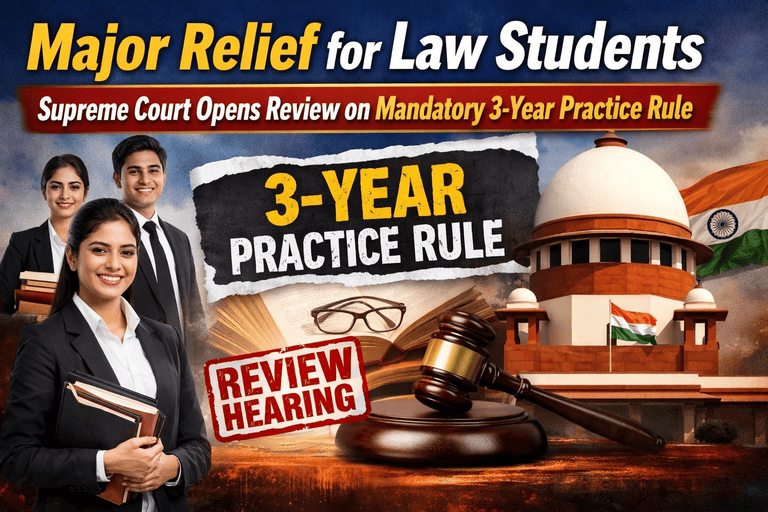
New Delhi | February 18, 2026
LENTIS LEGALIS BREAKING
The Supreme Court of India has allowed applications seeking permission to file Review Petition(s) in a long-pending matter arising out of Writ Petition (C) No. 1022 of 1989. Importantly, applications requesting that the Review Petition be listed in open court with oral hearing have also been allowed, recognizing the significance of the issues involved. The review petition has been filed by Advocate Chandrasen Yadav, through Advocate-on-Record Kunal Yadav.
The order was passed by a Bench comprising The Chief Justice of India, Justice Augustine George Masih, and Justice K. Vinod Chandran.
The Court has issued notice to the respondents, returnable on 26 February 2026, directing them to respond to the Review Petition. The Review Petition has also been tagged with Writ Petition (C) No. 1110 of 2025 (Diary No. 52914 of 2025 – Bhumika Trust) to ensure comprehensive and consistent adjudication of connected issues.
In the Writ Petition (C) No. 1110 of 2025 (Diary No. 52914 of 2025 – Bhumika Trust vs. Union of India), the Supreme Court of India has already invited suggestions from law universities across the country on the issue of mandatory three-year legal practice as a prerequisite for entry into judicial service. With the Review Petitions now permitted and ordered to be heard in open court, the forthcoming hearing will address the wider constitutional, institutional, and practical issues raised both in the Review Petitions and in the writ petition filed by Bhumika Trust, enabling a comprehensive reconsideration of the policy’s impact on law students, judicial recruitment, and access to justice.
The Review Petition assails the Supreme Court’s judgment dated 20 May 2025 in Writ Petition (C) No. 1022 of 1989, challenging the direction mandating three years’ minimum practice at the Bar for entry into the Civil Judge (Junior Division) cadre. The petitioner, Chandrasen Yadav argues that the decision is unsupported by empirical data, impact studies, or objective evaluation, and rests largely on subjective opinions of certain High Courts while ignoring dissenting views of several States and High Courts. It is contended that no credible evidence establishes that fresh law graduates perform poorly as judges or that prior advocacy experience necessarily enhances judicial competence, particularly when rigorous competitive examinations and structured judicial training exist. The petition further highlights that the judgment selectively overlooks key recommendations of the Justice Shetty Commission, earlier binding precedent in All India Judges Association (1993), and the role of institutional training as an alternative to mandatory practice. The uniform, nationwide imposition of the rule is alleged to be arbitrary, exclusionary, and disproportionate, adversely impacting economically weaker sections, SC/ST/OBC candidates, recent graduates, and those working in law firms, PSUs, or corporate roles. It is also argued that the absence of a transitional mechanism, the impractical certificate requirement, and the coercive nature of forcing graduates into litigation practice infringe Articles 14 and 19(1)(g) of the Constitution. The petitioner asserts that by effectively prescribing eligibility norms without legislative backing or inclusive consultation, the ruling raises serious constitutional concerns regarding arbitrariness, equal opportunity, and access to judicial service, warranting reconsideration by the Supreme Court of India.
The matter is now scheduled for further proceedings upon return of notice on 26.02.2026.
Crime And Justice
Pre-Trial Detention, Human Rights, and the rejection of Bail of Umar Khalid and Sharjeel Imam.
The continued imprisonment of activists Umar Khalid and Sharjeel Imam both detained for more than five years without the completion of trial has become a stark illustration of the human rights challenges surrounding pre-trial detention in India today
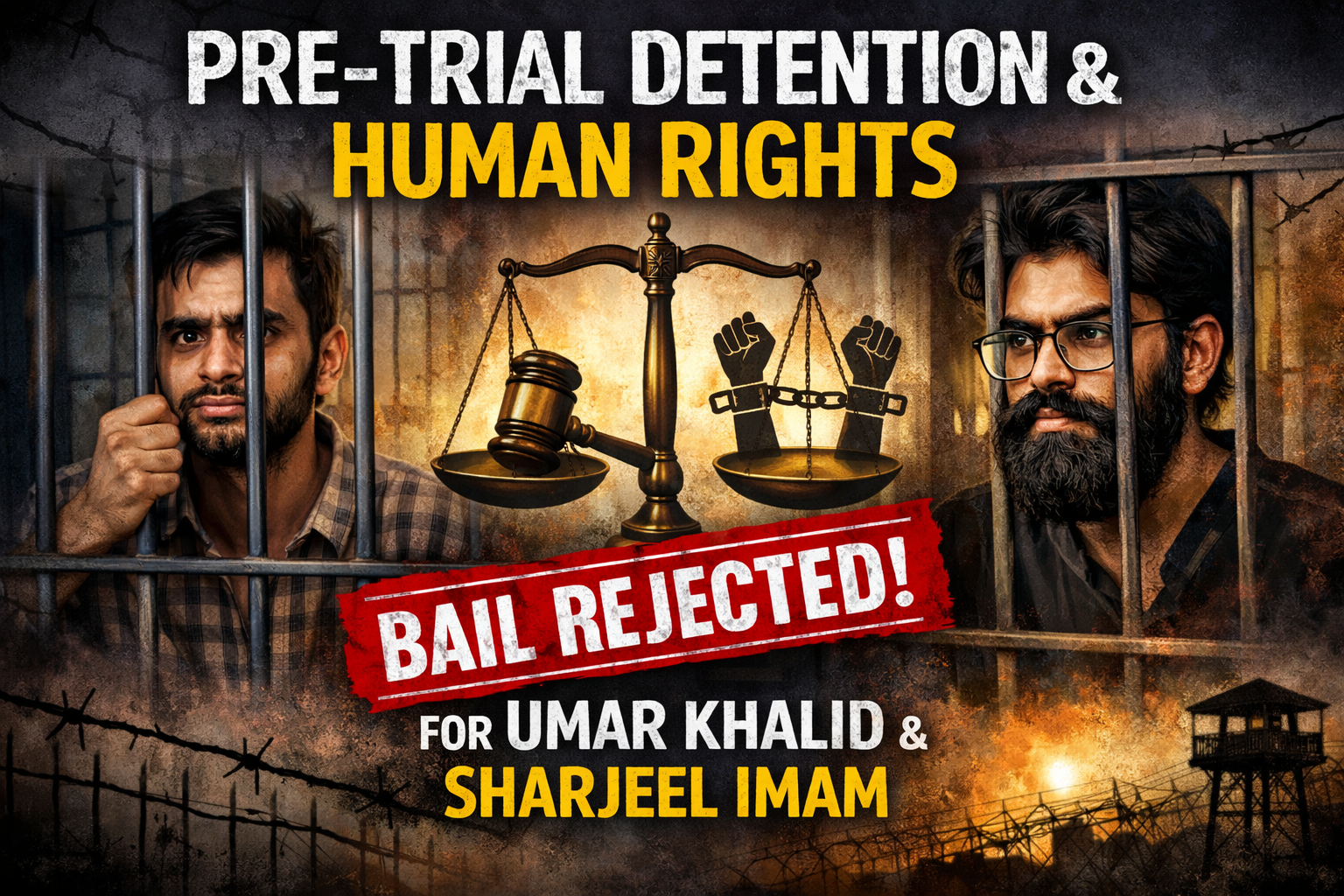
The continued imprisonment of activists Umar Khalid and Sharjeel Imam both detained for more than five years without the completion of trial has become a stark illustration of the human rights challenges surrounding pre-trial detention in India today.
Arrested in connection with the alleged conspiracy behind the 2020 Delhi riots and charged under the Unlawful Activities (Prevention) Act, 1967 (UAPA), their cases raise serious questions about the erosion of personal liberty, procedural fairness, and the right to due process as guaranteed under the Indian Constitution and international human rights instruments. Central to this debate is the foundational legal principle that detention prior to conviction should be exceptional rather than routine. In criminal jurisprudence, bail is intended to secure the accused’s appearance before the court, not to function as a form of punishment before guilt is established. However, in the cases of Khalid and Imam, extended incarceration has effectively assumed a punitive character, notwithstanding the absence of a concluded trial or a final determination of culpability.
In 5th January 2026, the Supreme Court of India declined to grant bail to both individuals, even as bail was extended to several co-accused in the same matter. The Court’s decision rested on the restrictive bail standard contained in Section 43D(5) of the UAPA, concluding that the prosecution had succeeded in establishing a prima facie case. While this approach may be defensible within the narrow confines of statutory interpretation, it exposes deeper constitutional and human rights dilemmas particularly the permissibility of prolonged detention without timely adjudication.
India, as a signatory to the International Covenant on Civil and Political Rights (ICCPR), is bound by international norms that prohibit arbitrary deprivation of liberty. Article 9 of the ICCPR emphasises that pre-trial detention should not be the default position, while Article 14 affirms the right to a fair and expeditious trial. The UN Human Rights Committee has consistently observed that excessively long pre-trial detention, especially when caused by systemic delays rather than the conduct of the accused, may amount to arbitrariness even if sanctioned by domestic legislation.
Global human rights bodies, including Amnesty International, have repeatedly expressed concern over India’s invocation of the UAPA in cases involving political dissent and human rights advocacy. The prosecutions of Khalid and Imam demonstrate how counterterrorism laws can be applied in ways that dilute the presumption of innocence and weaken meaningful judicial oversight, thereby departing from international human rights standards.
Judicial reluctance to intervene robustly in such cases often stems from deference to claims of national security. In matters involving alleged terrorism or conspiracy, courts frequently adopt a cautious stance at the bail stage, according substantial weight to prosecutorial narratives. When combined with the UAPA’s stringent bail regime and chronic delays within India’s criminal justice system, this deference results in prolonged incarceration with minimal prospects for timely relief.
The implications extend beyond the personal liberty of the accused. Such cases generate a broader chilling effect on free expression and peaceful dissent, discouraging civic engagement and eroding democratic accountability. From a global standpoint, the routine use of prolonged pre-trial detention risks weakening India’s standing as a constitutional democracy committed to the rule of law and human rights.
Meaningful reform is therefore imperative. Revisiting the bail provisions of the UAPA, strengthening judicial enforcement of the right to a speedy trial, and addressing systemic causes of trial delays are essential steps toward aligning domestic practice with constitutional principles and international obligations.
Ultimately, the incarceration of Umar Khalid and Sharjeel Imam transcends the fate of two individuals. It reflects a deeper crisis concerning liberty, due process, and judicial responsibility. Despite so much criticism regarding the rejection of Bail of both the accused, neither court nor the government nor the government is taking it as a serious matter which demean The human rights perspective and image of India in Global scenario. The true measure of a democracy lies not in its treatment of the compliant or popular, but in its willingness to protect the rights of the accused, the dissenting voice, and those who challenge prevailing power structures in India.
The opinions and views reflected in this article are exclusively those of the author.
Adv. Parvez Ahmad
Delhi High Court
B.com(H), LL.B ,LL.M


Major Relief for Law Students as Supreme Court Opens Review on Mandatory 3-Year Practice Rule

Allahabad High Court Sets Aside Charges for Ignoring Subsequent Closure Report Filed After Cognizance

Allahabad High Court Quashes Chargesheet and other Proceedings, Holds Relationship Prima Facie Consensual

Supreme Court to Hear Review Petition on 10 February 2026 Challenging Mandatory Three-Year Practice Requirement for Entry-Level Judicial Services

Supreme Court Mandates Free Sanitary Pads, Functional Toilets and Menstrual Hygiene Infrastructure in All Schools
Major Relief for Law Students as Supreme Court Opens Review on Mandatory 3-Year Practice Rule
-
 Supreme Court Highlights3 weeks ago
Supreme Court to Hear Review Petition on 10 February 2026 Challenging Mandatory Three-Year Practice Requirement for Entry-Level Judicial Services
-
 Landmark judgements4 weeks ago
Supreme Court Mandates Free Sanitary Pads, Functional Toilets and Menstrual Hygiene Infrastructure in All Schools
-
 Landmark judgements1 week ago
Major Relief for Law Students as Supreme Court Opens Review on Mandatory 3-Year Practice Rule
-
 High Court Updates1 month ago
Accessing Wife’s Private Photos Without Consent and Humiliating Her Before Family Amounts to Mental Cruelty
-

 High Court Updates3 weeks ago
Surge in Police Encounters in UP: Allahabad High Court Seeks Compliance with PUCL Guidelines
-
 Crime And Justice3 weeks ago
Pre-Trial Detention, Human Rights, and the rejection of Bail of Umar Khalid and Sharjeel Imam.
-
 Supreme Court Highlights4 weeks ago
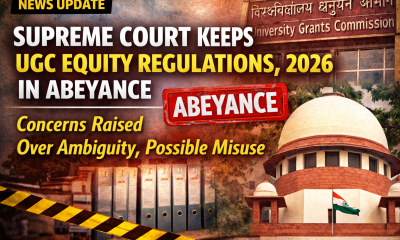
Supreme Court Keeps UGC Equity Regulations, 2026 in Abeyance; Raises Concerns Over Ambiguity and Possible Misuse
-
 High Court Updates1 month ago
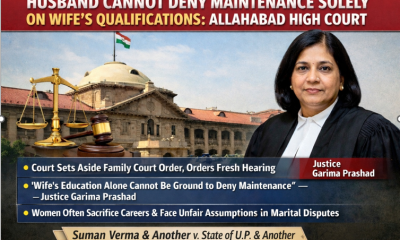
Husband Cannot Deny Maintenance Solely on Wife’s Educational Qualifications