
Explainers
Explainer | PUCL Guidelines on Police Encounters: Supreme Court Judgment Declared Law Under Article 141
PUCL Guidelines on Police Encounters: Supreme Court Judgment Declared Law Under Article 141

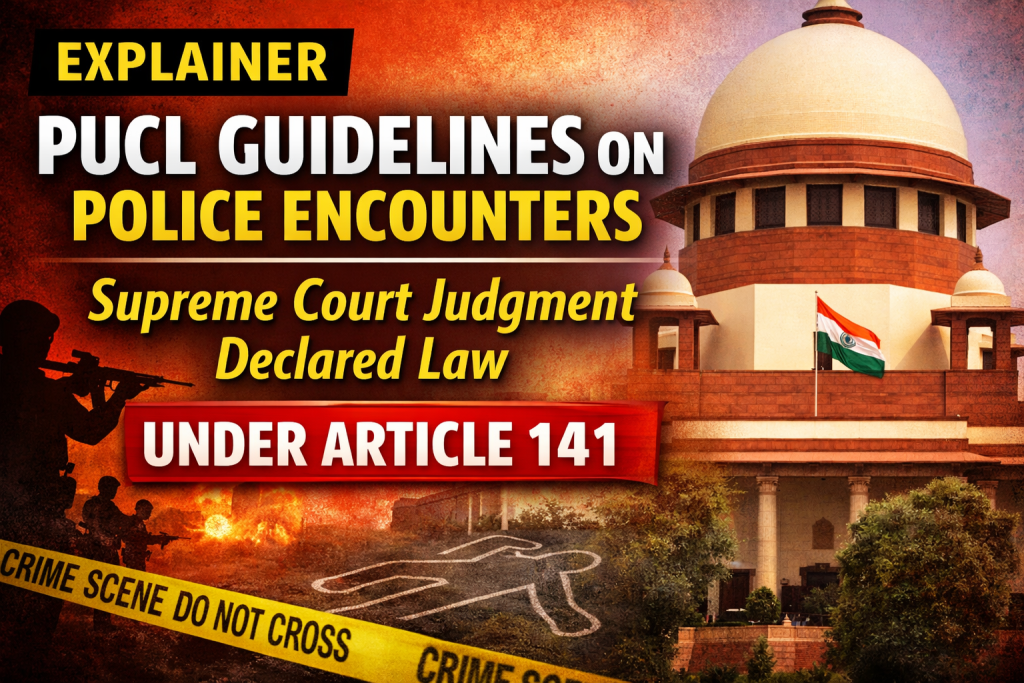
The Hon’ble Supreme Court of India, in People’s Union for Civil Liberties (PUCL) & Anr. v. State of Maharashtra, (2014) 10 SCC 635, has authoritatively laid down mandatory procedural safeguards to be followed in cases of alleged police encounters. The Court categorically held that whenever death or grievous injury is caused to the accused in a police encounter, it is imperative that an F.I.R. be registered forthwith and that an independent, impartial, and effective investigation be conducted.
The Apex Court further directed that such investigation must not be carried out by the police personnel involved in the encounter, but should instead be entrusted to the CBCID or a police team of another police station, and in any event, the investigation must be conducted by a police officer of a rank senior to the head of the police party involved in the encounter, so as to ensure transparency, accountability, and public confidence in the rule of law.
These directions, which are binding in terms of Article 141 of the Constitution of India, are expressly contained in Paragraph 31 of the judgment and are extracted hereinbelow-
31. In the light of the above discussion and having regard to the directions issued by the Bombay High Court, guidelines issued by NHRC, suggestions of the appellant PUCL, amicus curiae and the affidavits filed by the Union of India, the State Governments and the Union Territories, we think it appropriate to issue the following requirements to be followed in the matters of investigating police encounters in the cases of death as the standard procedure for thorough, effective and independent investigation:
31.1. Whenever the police is in receipt of any intelligence or tip-off regarding criminal movements or activities pertaining to the commission of grave criminal offence, it shall be reduced into writing in some form (preferably into case diary) or in some electronic form. Such recording need not reveal details of the suspect or the location to which the party is headed. If such intelligence or tip-off is received by a higher authority, the same may be noted in some form without revealing details of the suspect or the location.
31.2. If pursuant to the tip-off or receipt of any intelligence, as above, encounter takes place and firearm is used by the police party and as a result of that, death occurs, an FIR to that effect shall be registered and the same shall be forwarded to the court under Section 157 of CRPC (Now Section – 176 BNSS) without any delay. While forwarding the report under Section 176 BNSS, the procedure prescribed under 176 of the BNSS shall be followed.
31.3. An independent investigation into the incident/encounter shall be conducted by the CID or police team of another police station under the supervision of a senior officer (at least a level above the head of the police party engaged in the encounter). The team conducting inquiry/investigation shall, at a minimum, seek:
(a) To identify the victim; colour photographs of the victim should be taken;
(b) To recover and preserve evidentiary material, including bloodstained earth, hair, fibres and threads, etc. related to the death;
(c) To identify scene witnesses with complete names, addresses and telephone numbers and obtain their statements (including the statements of police personnel involved) concerning the death;
(d) To determine the cause, manner, location (including preparation of rough sketch of topography of the scene and, if possible, photo/video of the scene and any physical evidence) and time of death as well as any pattern or practice that may have brought about the death;
(e) It must be ensured that intact fingerprints of deceased are sent for chemical analysis. Any other fingerprints should be located, developed, lifted and sent for chemical analysis;
(f) Post-mortem must be conducted by two doctors in the district hospital, one of them, as far as possible, should be incharge/head of the district hospital. Post-mortem shall be videographed and preserved;
(g) Any evidence of weapons, such as guns, projectiles, bullets and cartridge cases, should be taken and preserved. Wherever applicable, tests for gunshot residue and trace metal detection should be performed.
(h) The cause of death should be found out, whether it was natural death, accidental death, suicide or homicide.
31.4. A magisterial inquiry under Section 176 of the CRPC (Now 196 BNSS) must invariably be held in all cases of death which occur in the course of police firing and a report thereof must be sent to the Judicial Magistrate having jurisdiction under Section 190 of the CRPC (Now Section 210).
31.5. The involvement of NHRC is not necessary unless there is serious doubt about independent and impartial investigation. However, the information of the incident without any delay must be sent to NHRC or the State Human Rights Commission, as the case may be.
31.6. The injured criminal/victim should be provided medical aid and his/her statement recorded by the Magistrate or Medical Officer with certificate of fitness.
31.7. It should be ensured that there is no delay in sending FIR, diary entries, panchnamas, sketch, etc. to the court concerned.
31.8. After full investigation into the incident, the report should be sent to the competent court under Section 173 of CRPC (Now Section 193 BNSS). The trial, pursuant to the charge-sheet submitted by the investigating officer, must be concluded expeditiously.
31.9. In the event of death, the next of kin of the alleged criminal/victim must be informed at the earliest.
31.10. Six-monthly statements of all cases where deaths have occurred in police firing must be sent to NHRC by DGPs. It must be ensured that the six-monthly statements reach to NHRC by 15th day of January and July, respectively. The statements may be sent in the following format along with postmortem, inquest and, wherever available, the inquiry reports:
(i) Date and place of occurrence.
(ii) Police station, district.
(iii) Circumstances leading to deaths: (a) Self-defence in encounter. (b) In the course of dispersal of unlawful assembly. (c) In the course of affecting arrest.
(iv) Brief facts of the incident.
(v) Criminal case no.
(vi) Investigating agency.
(vii) Findings of the magisterial inquiry/inquiry by senior officers: (a) disclosing, in particular, names and designation of police officials, if found responsible for the death; and (b) whether use of force was justified and action taken was lawful.
31.11. If on the conclusion of investigation, the materials/evidence having come on record show that death had occurred by use of firearm amounting to offence under IPC (Now BNS), disciplinary action against such officer must be promptly initiated and he be placed under suspension.
31.12. As regards compensation to be granted to the dependants of the victim who suffered death in a police encounter, the scheme provided under Section 357-A of the CRPC (Now Section 396 of the BNSS dealing with Victim Compensation Scheme) must be applied.
31.13. The police officer(s) concerned must surrender his/her weapons for forensic and ballistic analysis, including any other material, as required by the investigating team, subject to the rights under Article 20 of the Constitution.
31.14. An intimation about the incident must also be sent to the police officer’s family and should the family need services of a lawyer/counselling, same must be offered.
31.15. No out-of-turn promotion or instant gallantry rewards shall be bestowed on the officers concerned soon after the occurrence. It must be ensured at all cost that such rewards are given/recommended only when the gallantry of the officers concerned is established beyond doubt.
31.16. If the family of the victim finds that the above procedure has not been followed or there exists a pattern of abuse or lack of independent investigation or impartiality by any of the functionaries as abovementioned, it may make a complaint to the Sessions Judge having territorial jurisdiction over the place of incident. Upon such complaint being made, the Sessions Judge concerned shall look into the merits of the complaint and address the grievances raised therein.
These guidelines were framed to strike a constitutional balance between the legitimate powers of the police and the fundamental right to life guaranteed under Article 21, and continue to operate as mandatory law unless modified by the Supreme Court itself.





Lentis Legalis | 08 April 2026
Reviewed by Adv. Chandrasen Yadav
On 13 March 2026, the Transgender Persons (Protection of Rights) Amendment Bill, 2026 was introduced in the Lok Sabha, proposing significant changes to the Transgender Persons (Protection of Rights) Act, 2019. The Statement of Objects and Reasons accompanying the Bill underscores a distinct legislative policy: to recognise and protect a specific class of transgender (TG) persons who suffer from acute social exclusion.
The Bill asserts that the original legislative intent was, and continues to be, the protection of individuals who face severe social discrimination owing to biological factors beyond their control and without any element of choice. It emphasises that the Act was designed to safeguard a narrowly defined class of persons—those historically and socially recognised as transgender—who endure extreme and systemic marginalisation. According to the proposed amendment, the statute was never intended to extend protection to all categories of gender identities, including self-perceived identities or gender fluid expressions.
A central concern highlighted by the Bill is the alleged vagueness in the existing definition of “transgender person.” It contends that such ambiguity hampers the identification of genuinely oppressed individuals and renders the implementation of various provisions—across penal, civil, and personal laws—ineffective and unworkable. Consequently, the Amendment Bill seeks to introduce a more precise and restrictive definition to ensure that the benefits of the Act reach its intended beneficiaries through clearer identification mechanisms.
The foundation of transgender jurisprudence in India can be traced to the landmark decision in National Legal Services Authority v. Union of India (2014), popularly known as the NALSA case. In this seminal judgment, the Supreme Court recognised transgender persons as a “third gender” and affirmed their entitlement to fundamental rights under the Constitution. The Court unequivocally held that gender identity lies at the core of an individual’s personal autonomy and must be determined by self-identification rather than biological or medical criteria. It observed:
“Gender identity is integral to the dignity of an individual and is based on self-identification, not on surgical or medical procedures. No person can be discriminated against on the ground of gender identity.”
Justice K.S. Radhakrishnan, drawing upon a catena of judicial precedents and international human rights instruments, elaborated that gender identity is among the most fundamental aspects of life. It reflects a person’s deeply felt internal and individual experience of gender, which may or may not correspond with the sex assigned at birth. This understanding firmly situates gender identity within the domain of personal liberty and dignity.
The jurisprudential evolution continued with Navtej Singh Johar v. Union of India (2018), where the Supreme Court decriminalised consensual same-sex relations by reading down Section 377 of the Indian Penal Code. The Court, in doing so, foregrounded the primacy of constitutional morality over societal or majoritarian morality. It also recognised rights relating to sexual orientation, autonomy, and choice of partner as intrinsic to Article 21.
Further strengthening this framework, the nine-judge bench decision in K.S. Puttaswamy v. Union of India (2017) affirmed that the right to privacy encompasses sexual orientation and gender identity as essential attributes of individual dignity and liberty, immune from majoritarian disapproval.
More recently, in Supriyo v. Union of India (the “Marriage Equality Case”), the Supreme Court acknowledged that transgender persons in heterosexual relationships possess the right to marry under existing legal frameworks, thereby reinforcing their legal recognition and dignity.
In light of this established jurisprudence, the 2026 Amendment Bill appears, prima facie, to depart from the constitutional principles articulated by the Supreme Court. While judicial precedents have consistently upheld self-perceived gender identity as central to personal autonomy, the proposed amendments introduce a certification regime requiring recognition by a district magistrate based on the recommendation of a designated medical board headed by a chief medical officer.
This shift from self-identification to medical verification raises critical constitutional questions. It potentially reintroduces elements of external validation and bureaucratic control over identity, which the Supreme Court had expressly sought to eliminate. Whether such a framework can withstand constitutional scrutiny—particularly in light of the principles of dignity, autonomy, and privacy—remains an open and significant question.
Read the full judgment of NALSA case. – Click Here
Read the Full Judgement of Navtej Singh Johar vs. Union of India. – Click Here
Read the Full Judgement of Justice K.S. Puttaswamy vs. Union of India. – Click Here
Author
Adv. Chandrasen Yadav
B.Sc., LL.B. & LL.M.


Lentis Legalis | 06 April 2026
Reviewed by Adv. Chandrasen Yadav
The doctrine of casus omissus, a Latin expression meaning “a case omitted,” refers to a situation where the legislature has failed to provide for a particular contingency within a statutory framework.
The settled principle governing this doctrine is that courts cannot supply omissions in a statute; they are bound to interpret the law as it exists, and not as it ought to be. Any attempt to fill legislative gaps would amount to judicial legislation, which is impermissible.
The law on this aspect is well crystallized. In State of Jharkhand v. Govind Singh,(2005) 10 SCC 437, the Supreme Court authoritatively held that a casus omissus cannot be supplied by the Court except in cases of clear necessity, and even then, only when such necessity is evident from the four corners of the statute itself. The Court cautioned that an omission should not be readily inferred, nor can the judiciary, under the guise of interpretation, create or fill gaps in the statutory scheme.
It was further emphasized that statutory provisions must be construed as a whole, harmoniously, so as to give effect to the legislative intent. Unless the plain language of the statute leads to manifest absurdity or defeats the object of the enactment, it is not open to the Court to read into the statute words which are not expressly provided.
The Court succinctly summarized the position by holding that two principles of construction are well settled: first, that a casus omissus cannot be supplied except in cases of clear necessity discernible from the statute itself; and second, that every part of a statute must be read in context, so as to ensure a consistent and coherent interpretation of the entire enactment. A construction that leads to absurd or anomalous results may be avoided, but only within the permissible limits of interpretation—not by rewriting the statute.
Thus, the doctrine underscores a fundamental restraint on judicial power: where the legislature has consciously or inadvertently omitted a provision, the defect must be remedied by legislative action and not by judicial innovation.
Author
Adv. Chandrasen Yadav
B.Sc., LL.B. & LL.M.
Bharatiya Nyaya Sanhita (BNS)
Section 102 of the Bharatiya Nyaya Sanhita, 2023: Culpable homicide by causing death of person other than person whose death was intended.

Lentis Legalis | 23 March 2026
Reviewed by Adv. Chandrasen Yadav
Section – 102 BNS: Culpable homicide by causing death of person other than person whose death was intended.—
If a person, by doing anything which he intends or knows to be likely to cause death, commits culpable homicide by causing the death of any person, whose death he neither intends nor knows himself to be likely to cause, the culpable homicide committed by the offender is of the description of which it would have been if he had caused the death of the person whose death he intended or knew himself to be likely to cause.
Section 102 of the Bharatiya Nyaya Sanhita, 2023 statutorily recognizes the principle of transfer of malice/transmigration of malice. This doctrine permits the prosecution of an offender where the harm is caused to a person other than the one originally intended, by transferring the malicious intent from the intended target to the actual victim.
Relevant Cases –
R Vs Mitchell (1983)
Emperor Vs Mushnooru Suryanarayana Murthy (1912)
Author
Adv. Chandrasen Yadav
B.Sc., LL.B. & LL.M.

From Self-Identification to State Certification: A Step Back for Transgender Rights?

No More ‘Bona Fide Need’: Allahabad High Court Redefines Eviction Standards Under the UP Tenancy Act, 2021

Doctrine of Casus Omissus: Limits of Judicial Interpretation.

Supreme Court to Hear Review Petition on 10 February 2026 Challenging Mandatory Three-Year Practice Requirement for Entry-Level Judicial Services

Major Relief for Law Students as Supreme Court Opens Review on Mandatory 3-Year Practice Rule

Supreme Court Mandates Free Sanitary Pads, Functional Toilets and Menstrual Hygiene Infrastructure in All Schools
-
 Supreme Court Highlights2 months ago
Supreme Court to Hear Review Petition on 10 February 2026 Challenging Mandatory Three-Year Practice Requirement for Entry-Level Judicial Services
-
 Landmark judgements2 months ago
Major Relief for Law Students as Supreme Court Opens Review on Mandatory 3-Year Practice Rule
-
 Landmark judgements3 months ago
Supreme Court Mandates Free Sanitary Pads, Functional Toilets and Menstrual Hygiene Infrastructure in All Schools
-
 High Court Updates3 months ago
Accessing Wife’s Private Photos Without Consent and Humiliating Her Before Family Amounts to Mental Cruelty
-
 High Court Updates2 months ago
Surge in Police Encounters in UP: Allahabad High Court Seeks Compliance with PUCL Guidelines
-

 Crime And Justice2 months ago
Pre-Trial Detention, Human Rights, and the rejection of Bail of Umar Khalid and Sharjeel Imam.
-
 Supreme Court Highlights2 months ago
Supreme Court Keeps UGC Equity Regulations, 2026 in Abeyance; Raises Concerns Over Ambiguity and Possible Misuse
-
 Opinions & Columns9 months ago
School Merger in Uttar Pradesh: A Stark Reflection of State Abdication of Educational Duty Undermining the Constitutional Mandate of Article 21-A and the RTE Act, 2009.