
Crime And Justice
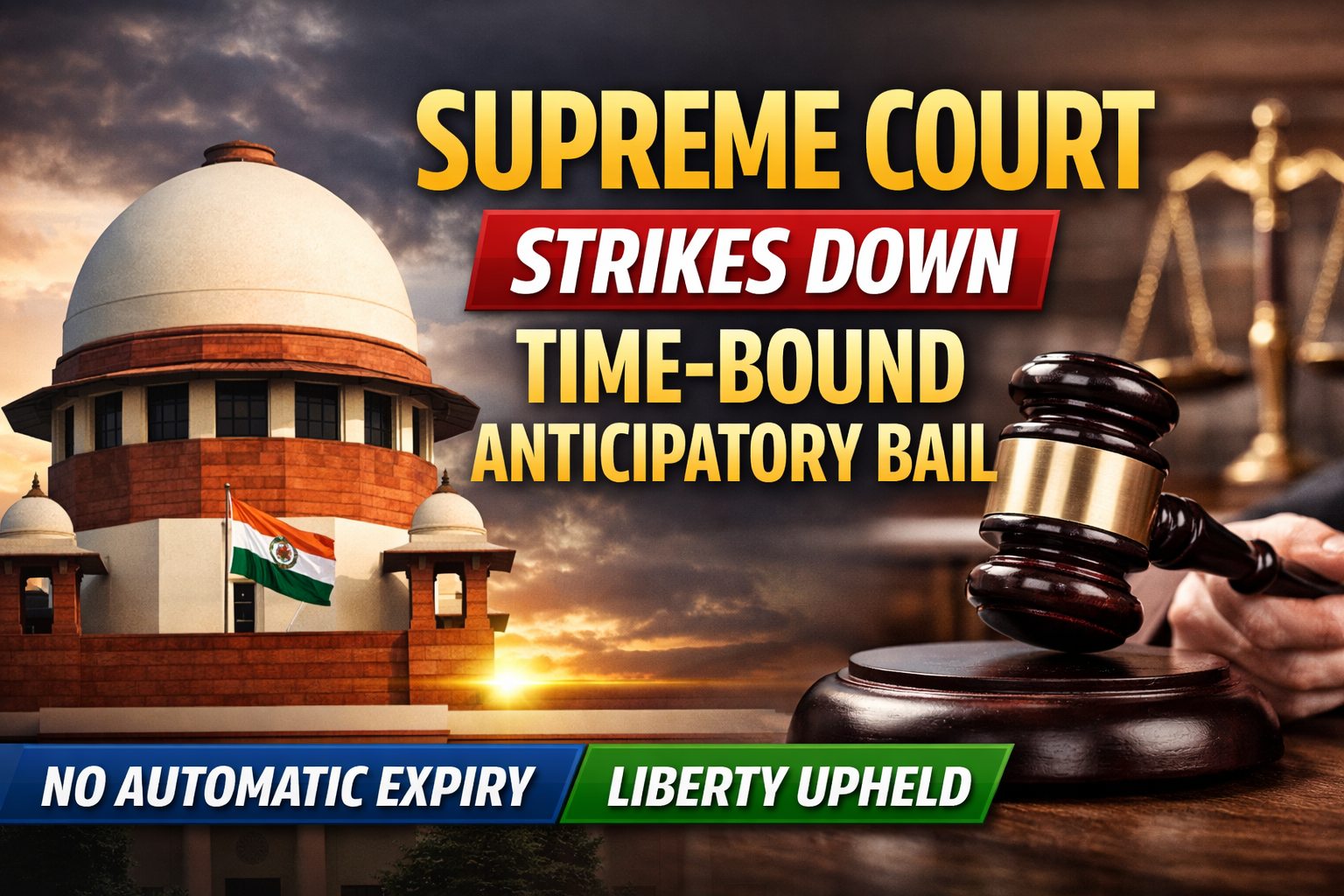
Supreme Court Sets Aside Time-Bound Anticipatory Bail: Reaffirms That Protection Cannot Expire Automatically on Filing of Charge Sheet

Lentis Legalis
New Delhi | 9 February 2026
In a significant ruling clarifying the law on anticipatory bail, the Supreme Court of India held that once anticipatory bail is granted, it ordinarily cannot be restricted till the filing of the charge sheet, unless exceptional circumstances are recorded. The Court set aside an order of the High Court of Allahabad which had denied continued protection to an accused after completion of investigation.
The judgment was delivered by a Division Bench comprising Justice J.B. Pardiwala and Justice K.V. Viswanathan in Criminal Appeal arising out of SLP (Crl.) No. 1536 of 2026, titled Sumit v. State of Uttar Pradesh & Anr.
The appellant, Sumit, is the brother-in-law (devar) of a deceased woman who had been married to the appellant’s brother for about seven months prior to her death.
- The deceased died under mysterious circumstances at her matrimonial home.
- An FIR bearing No. 560/2024 was registered at Akbarpur Police Station, Kanpur Dehat, under:
- Sections 80(2) / 85 of the Bharatiya Nyaya Sanhita (BNS)
- Sections 3 & 4 of the Dowry Prohibition Act, 1961
- The FIR was lodged by the mother of the deceased, alleging dowry-related harassment and death.
Apprehending arrest, the appellant initially approached the Allahabad High Court seeking anticipatory bail.
Proceedings Before the High Court
First Anticipatory Bail Order
In Criminal Misc. Anticipatory Bail Application No. 3992/2025, the High Court granted anticipatory bail to the appellant. However, the relief was restricted only till the filing of the police charge sheet.
The High Court:
- Accepted that there were no specific allegations against the appellant.
- Noted that he was implicated largely due to his relationship as a brother-in-law.
- Observed that he had no criminal antecedents.
- Still imposed a time-bound limitation, terminating protection once the investigation concluded.
Second Anticipatory Bail Application
After the charge sheet was filed, the appellant again sought anticipatory bail. This time, the High Court rejected the application without identifying any new aggravating circumstance or change in the factual matrix.
This rejection led to the present appeal before the Supreme Court.
Issues Before the Supreme Court
- Whether anticipatory bail can be restricted till the filing of the charge sheet as a matter of routine?
- Whether filing of a charge sheet automatically extinguishes the protection of anticipatory bail?
- Whether the High Court was justified in rejecting the second anticipatory bail application without recording special reasons?
Supreme Court’s Analysis and Discussion
The Supreme Court expressed strong disapproval of the practice of granting time-bound anticipatory bail orders.
No Rationale for Automatic Expiry
The Bench observed:
- Once a court, after considering the nature of allegations, role of the accused, and overall facts, exercises discretion in favour of the accused, there must be strong and special reasons to subsequently deny protection.
- Merely because the charge sheet is filed, the anticipatory bail does not automatically lapse.
The Court questioned the logic behind such restrictions, noting:
“Either the Court grants anticipatory bail or declines it. Having granted it after due consideration, there was no justification to limit it till the filing of the charge sheet.”
Reliance on Constitution Bench Precedent
The Bench reaffirmed the law laid down in Sushila Aggarwal v. State (NCT of Delhi), holding that:
- Anticipatory bail need not have a fixed expiry period.
- Duration of bail is a matter of judicial discretion, not procedural milestones.
- Arbitrary timelines undermine personal liberty.
The Court also relied upon Siddharam Satlingappa Mhetre v. State of Maharashtra (2011) 1 SCC 694, reiterating that:
- Anticipatory bail should not hinge upon investigation stages like filing of charge sheet or taking cognizance.
Conditions, Not Time Limits, Are the Safeguard
Addressing concerns of misuse, the Court clarified that:
- Risks can be mitigated through conditions of cooperation, attendance, and non-tampering of evidence.
- If circumstances change, the prosecution is always at liberty to seek cancellation or modification of bail under law.
- However, expiry clauses at inception are legally unsustainable.
Clarification on Addition of Graver Offences
Before concluding, the Court addressed an important legal scenario:
What happens if new, serious non-bailable offences are added after bail is granted?
Relying on Pradeep Ram v. State of Jharkhand (2019) and Prahlad Singh Bhati v. NCT of Delhi (2001), the Court held:
- Addition of graver cognizable and non-bailable offences may disentitle the accused from earlier bail.
- In such cases:
- Courts must apply their mind afresh.
- Investigating agencies may seek custody through appropriate judicial orders.
- Arrest cannot be mechanical and must follow judicial authorization.
Allowing the appeal, the Supreme Court:
- Set aside the impugned order of the Allahabad High Court rejecting anticipatory bail.
- Directed that In the event of arrest, the appellant shall be released on anticipatory bail, subject to conditions imposed by the Investigating Officer. The appellant shall thereafter appear before the Trial Court and furnish fresh bail bonds. Directed the Registry to forward a copy of the judgment to the Registrar General of the Allahabad High Court for placement before the Hon’ble Chief Justice.
Click Below to read the Judgment
https://api.sci.gov.in/supremecourt/2026/3119/3119_2026_5_32_68496_Judgement_09-Feb-2026.pdf





Crime And Justice
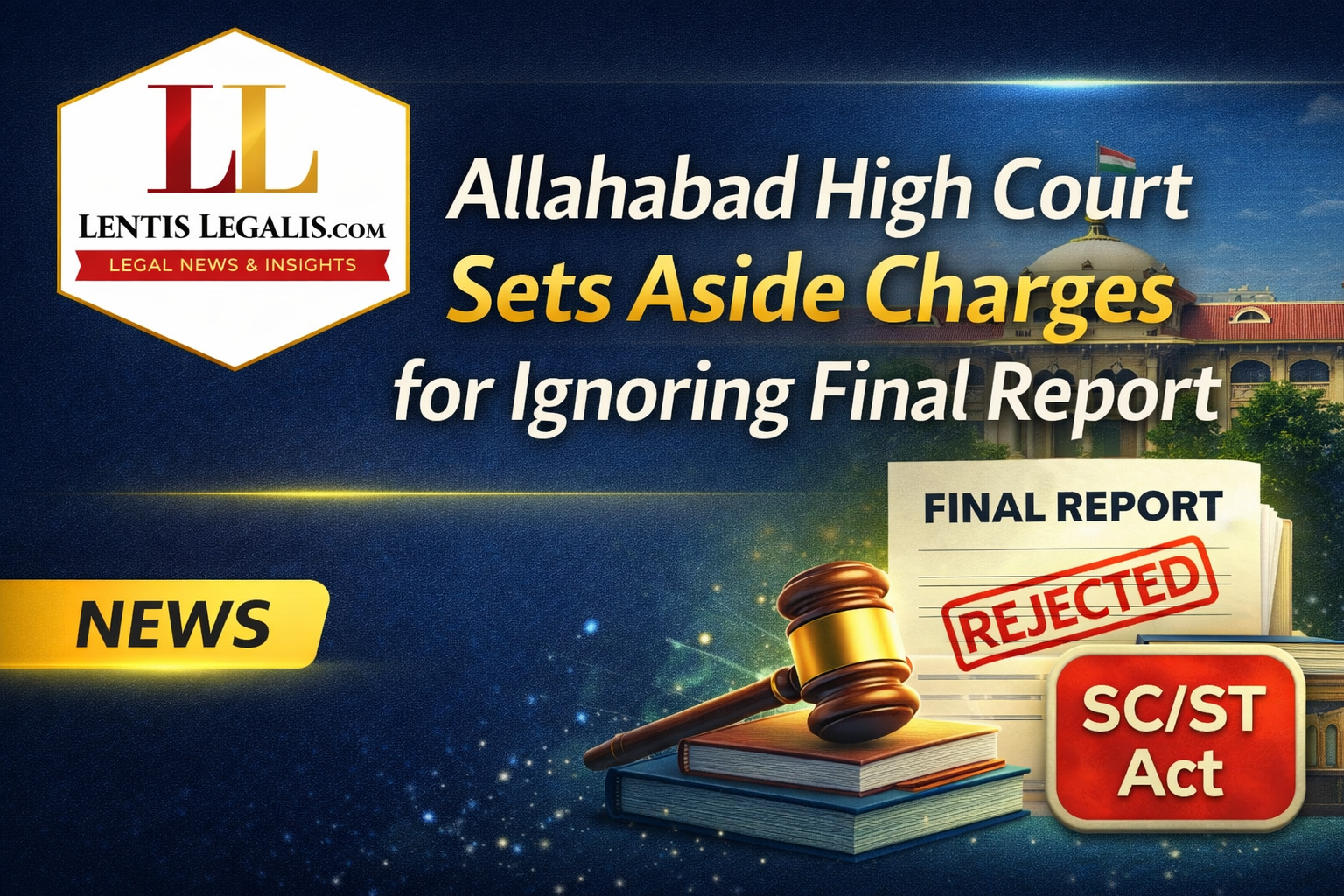
Allahabad High Court Sets Aside Charges for Ignoring Subsequent Closure Report Filed After Cognizance
LENTIS LEGALIS
ALLAHABAD| 14.02.2026
The Allahabad High Court has allowed a criminal appeal and set aside multiple orders passed by the Special Judge (SC/ST Act), Kannauj, holding that a trial court cannot ignore a Final Report (closure report) filed after further investigation merely because cognizance had already been taken on an earlier charge sheet.
The present criminal appeal under Section 14-A(1) Scheduled Castes & Scheduled Tribes (Prevention of Atrocities) Act has been preferred to allow this present appeal and set aside the impugned order dated 21.08.2024, 27.06.2024 and 10.05.2024 and all other consequential orders also passed by Special Judge SC/ST Act, District-Kannauj in S.C. No.1374/2023 (State Vs. Sonu @ Bhagwan Bhakt and others) arising out of Case Crime No.627/2023 U/s 147, 452, 323, 504, 506 I.P.C. and 3 (1)(d) SC/St Act, Police Station Kotwali Kannauj District-Kannauj. The Investigating Officer initially filed a charge sheet on 15.09.2023, on which cognizance was taken on 21.12.2023.
As the investigation was still under progress, supplementary report under Section 173(2) Cr.P.C. was submitted by I.O. on 31.3.2024 by concluding that allegations against the appellants were found false. It can be said that a final report was submitted by I.O. subsequent to the order of taking cognizance upon the charge sheet on 21.12.2023
During further investigation under Section 173(8) Cr.P.C., the I.O. submitted a Final Report/Closure Report on 31.03.2024, concluding that the allegations were false. Despite this, the trial court proceeded to frame charges on 07.08.2025 without passing any order on the Final Report.
The central question before the High Court was:
What is the duty of a Magistrate when, after taking cognizance on a charge sheet, a subsequent Final Report (negative report) is filed following further investigation?
The High Court held that A supplementary report, including a Final Report, is an integral part of the primary police report under Section 173 Cr.P.C. A Magistrate is duty-bound to consider every subsequent report filed during investigation, even after cognizance has been taken. Ignoring a Final Report and proceeding to frame charges amounts to a procedural illegality. Passing a fresh order on a Final Report does not amount to a review barred under Section 362 Cr.P.C., as cognizance does not finally dispose of the case.
The Court relied on landmark judgments including:
- Vinay Tyagi v. Irshad Ali (2013) – holding that primary and supplementary reports must be read conjointly.
- Ram Lal Narang v. State (Delhi Administration) – recognising the necessity of further investigation even after cognizance.
- Dharmatma Singh v. Harminder Singh – reiterating the Magistrate’s duty to independently assess conflicting police reports.
- Mariam Fasihuddin v. State (2024) – emphasising that courts must apply judicial mind to every valid supplementary report.
The impugned orders dated 21.08.2024, 27.06.2024 and 10.05.2024, including the order framing charges on 07.08.2025, were set aside. The trial court has been directed to first decide the Final Report after considering it along with the initial charge sheet. Charges may be framed only if a conjoint reading of both reports discloses a prima facie case.
See Here to read full Judgement
Crime And Justice
Pre-Trial Detention, Human Rights, and the rejection of Bail of Umar Khalid and Sharjeel Imam.
The continued imprisonment of activists Umar Khalid and Sharjeel Imam both detained for more than five years without the completion of trial has become a stark illustration of the human rights challenges surrounding pre-trial detention in India today

The continued imprisonment of activists Umar Khalid and Sharjeel Imam both detained for more than five years without the completion of trial has become a stark illustration of the human rights challenges surrounding pre-trial detention in India today.
Arrested in connection with the alleged conspiracy behind the 2020 Delhi riots and charged under the Unlawful Activities (Prevention) Act, 1967 (UAPA), their cases raise serious questions about the erosion of personal liberty, procedural fairness, and the right to due process as guaranteed under the Indian Constitution and international human rights instruments. Central to this debate is the foundational legal principle that detention prior to conviction should be exceptional rather than routine. In criminal jurisprudence, bail is intended to secure the accused’s appearance before the court, not to function as a form of punishment before guilt is established. However, in the cases of Khalid and Imam, extended incarceration has effectively assumed a punitive character, notwithstanding the absence of a concluded trial or a final determination of culpability.
In 5th January 2026, the Supreme Court of India declined to grant bail to both individuals, even as bail was extended to several co-accused in the same matter. The Court’s decision rested on the restrictive bail standard contained in Section 43D(5) of the UAPA, concluding that the prosecution had succeeded in establishing a prima facie case. While this approach may be defensible within the narrow confines of statutory interpretation, it exposes deeper constitutional and human rights dilemmas particularly the permissibility of prolonged detention without timely adjudication.
India, as a signatory to the International Covenant on Civil and Political Rights (ICCPR), is bound by international norms that prohibit arbitrary deprivation of liberty. Article 9 of the ICCPR emphasises that pre-trial detention should not be the default position, while Article 14 affirms the right to a fair and expeditious trial. The UN Human Rights Committee has consistently observed that excessively long pre-trial detention, especially when caused by systemic delays rather than the conduct of the accused, may amount to arbitrariness even if sanctioned by domestic legislation.
Global human rights bodies, including Amnesty International, have repeatedly expressed concern over India’s invocation of the UAPA in cases involving political dissent and human rights advocacy. The prosecutions of Khalid and Imam demonstrate how counterterrorism laws can be applied in ways that dilute the presumption of innocence and weaken meaningful judicial oversight, thereby departing from international human rights standards.
Judicial reluctance to intervene robustly in such cases often stems from deference to claims of national security. In matters involving alleged terrorism or conspiracy, courts frequently adopt a cautious stance at the bail stage, according substantial weight to prosecutorial narratives. When combined with the UAPA’s stringent bail regime and chronic delays within India’s criminal justice system, this deference results in prolonged incarceration with minimal prospects for timely relief.
The implications extend beyond the personal liberty of the accused. Such cases generate a broader chilling effect on free expression and peaceful dissent, discouraging civic engagement and eroding democratic accountability. From a global standpoint, the routine use of prolonged pre-trial detention risks weakening India’s standing as a constitutional democracy committed to the rule of law and human rights.
Meaningful reform is therefore imperative. Revisiting the bail provisions of the UAPA, strengthening judicial enforcement of the right to a speedy trial, and addressing systemic causes of trial delays are essential steps toward aligning domestic practice with constitutional principles and international obligations.
Ultimately, the incarceration of Umar Khalid and Sharjeel Imam transcends the fate of two individuals. It reflects a deeper crisis concerning liberty, due process, and judicial responsibility. Despite so much criticism regarding the rejection of Bail of both the accused, neither court nor the government nor the government is taking it as a serious matter which demean The human rights perspective and image of India in Global scenario. The true measure of a democracy lies not in its treatment of the compliant or popular, but in its willingness to protect the rights of the accused, the dissenting voice, and those who challenge prevailing power structures in India.
The opinions and views reflected in this article are exclusively those of the author.
Adv. Parvez Ahmad
Delhi High Court
B.com(H), LL.B ,LL.M

The Protection of Children from Sexual Offences Act, 2012 (POCSO) was enacted in India as a stringent legal measure in response to the widespread and deeply troubling problem of child sexual abuse. Its objective was clear and uncompromising – to protect children from sexual exploitation through a zero-tolerance legal framework. Yet, more than a decade after its implementation, a disturbing paradox has emerged: a law designed to safeguard minors is being used to criminalize consensual relationships between adolescents.
This concern has now received official judicial recognition. In the case of State of Uttar Pradesh v. Anirudh and Others, while hearing a bail application, the Supreme Court urged the central government to examine the possibility of incorporating a “Romeo-Juliet” clause into the POCSO framework. The Court’s observation reflects a ground reality that has long been apparent to trial courts and High Courts – that POCSO is often invoked not in cases of predatory abuse, but in consensual relationships between adolescents with minor age differences.
POCSO is a strict liability law. The consent of a person under the age of eighteen is legally deemed irrelevant, regardless of the nature of the relationship or the proximity in age between the parties. While such stringency is justifiable – and indeed necessary – in cases involving coercion, seduction, or sexual exploitation, its mechanical application to adolescent romantic relationships has resulted in outcomes that are patently incongruous.
Young boys are routinely charged with serious sexual offenses, subjected to prolonged incarceration, social ostracism, and the lifelong stigma of a criminal record. Girls, even when they explicitly consent, are relegated to the legal status of “victims.” Families get entangled in protracted criminal trials, and scarce judicial resources are diverted to cases that reflect social anxieties, parental disagreements, or caste-based animosities rather than actual sexual violence.
Significantly, the Supreme Court’s subsequent observation goes further by explicitly acknowledging that POCSO is often misused as a tool to settle personal scores, enforce parental authority, or uphold social norms. Such an admission from the Supreme Court carries considerable institutional and policy significance.
A “Romeo-Juliet” clause—recognized in several countries worldwide—creates a limited exception in statutory rape laws where the relationship is consensual and the age difference between the individuals is minimal. Rather than weakening child protection laws, such a provision introduces proportionality, context, and legal realism into their application. By distinguishing exploitative behavior from age-appropriate intimacy, the law can preserve POCSO’s true deterrent force against genuine abuse, while simultaneously preventing adolescence itself from becoming criminalized. The purpose of criminal law is to punish harm—not young love.
Equally important is the Supreme Court’s reaffirmation of procedural safeguards. By setting aside the Allahabad High Court’s sweeping directions on determining age through medical examinations, the Court reinforced the statutory scheme under Section 94 of the Juvenile Justice (Care and Protection of Children) Act, 2015. The Court clarified that documentary evidence should be given primacy in age determination, and medical tests should be resorted to only as a last resort.
This emphasis on due process is crucial. In sensitive and punitive laws like POCSO, procedural shortcuts can inflict irreversible harm on young lives.
The Supreme Court has now placed this responsibility squarely on the legislature. A carefully crafted Romeo-Juliet clause—limited to consensual relationships between teenagers of similar age—could restore balance within the POCSO framework. Simultaneously, as the court has clearly stated, effective mechanisms must be developed to prevent and punish the deliberate misuse of the Act.
Child protection laws must evolve with social realities. Justice is not served when protection becomes punishment. The judiciary has signaled the need for reform; it is now the legislature’s responsibility to respond with sensitivity, nuance, and constitutional understanding.
Chandrasen Yadav
B.Sc & L.L.B from Allahabad University
LL.M from Central University of Punjab
Lucknow


Major Relief for Law Students as Supreme Court Opens Review on Mandatory 3-Year Practice Rule

Allahabad High Court Sets Aside Charges for Ignoring Subsequent Closure Report Filed After Cognizance

Allahabad High Court Quashes Chargesheet and other Proceedings, Holds Relationship Prima Facie Consensual

Supreme Court to Hear Review Petition on 10 February 2026 Challenging Mandatory Three-Year Practice Requirement for Entry-Level Judicial Services

Supreme Court Mandates Free Sanitary Pads, Functional Toilets and Menstrual Hygiene Infrastructure in All Schools
Major Relief for Law Students as Supreme Court Opens Review on Mandatory 3-Year Practice Rule
-
 Supreme Court Highlights3 weeks ago
Supreme Court to Hear Review Petition on 10 February 2026 Challenging Mandatory Three-Year Practice Requirement for Entry-Level Judicial Services
-
 Landmark judgements4 weeks ago
Supreme Court Mandates Free Sanitary Pads, Functional Toilets and Menstrual Hygiene Infrastructure in All Schools
-
 Landmark judgements1 week ago
Major Relief for Law Students as Supreme Court Opens Review on Mandatory 3-Year Practice Rule
-
 High Court Updates1 month ago
Accessing Wife’s Private Photos Without Consent and Humiliating Her Before Family Amounts to Mental Cruelty
-

 High Court Updates3 weeks ago
Surge in Police Encounters in UP: Allahabad High Court Seeks Compliance with PUCL Guidelines
-

 Crime And Justice3 weeks ago
Pre-Trial Detention, Human Rights, and the rejection of Bail of Umar Khalid and Sharjeel Imam.
-
 Supreme Court Highlights4 weeks ago
Supreme Court Keeps UGC Equity Regulations, 2026 in Abeyance; Raises Concerns Over Ambiguity and Possible Misuse
-
 High Court Updates1 month ago
Husband Cannot Deny Maintenance Solely on Wife’s Educational Qualifications