Latest Judgments
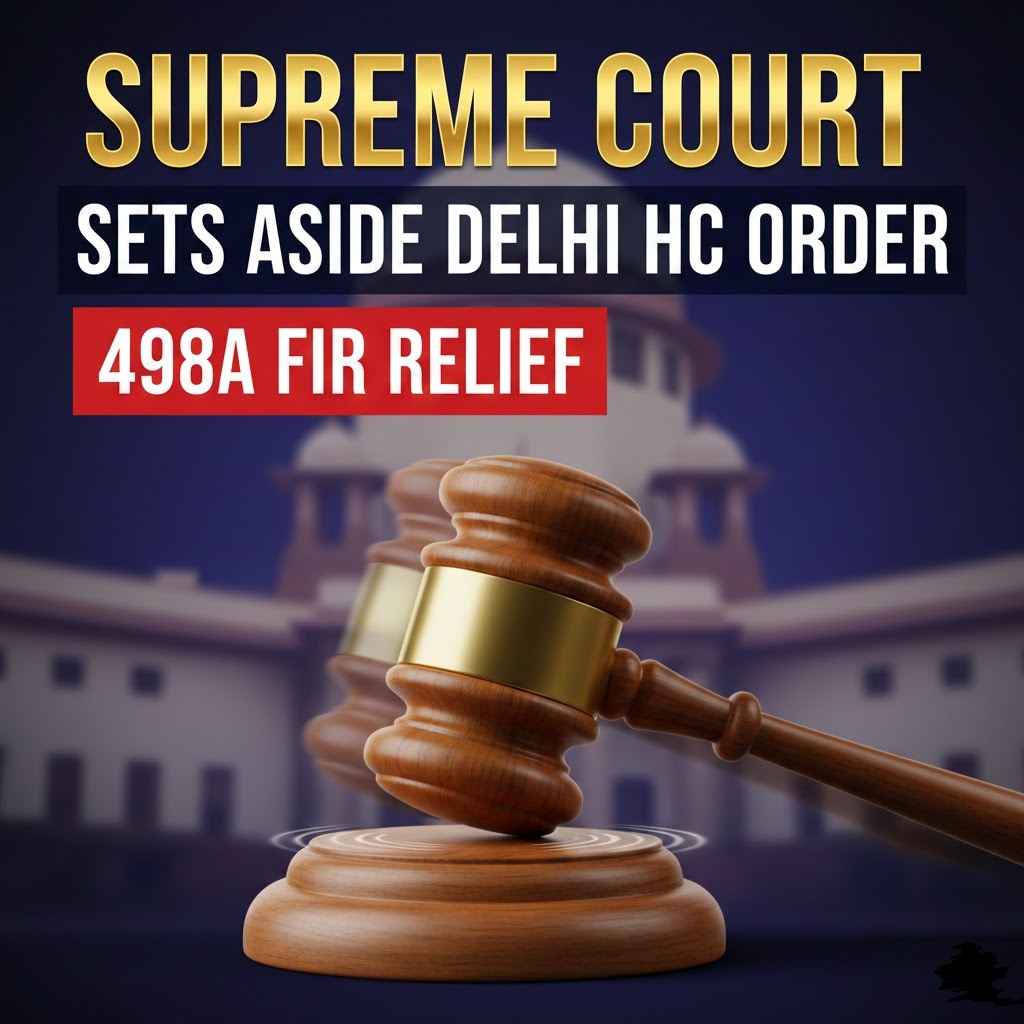
Supreme Court Sets Aside Delhi High Court Order in 498A FIR Case; Restores Plea for Quashing
The Supreme Court has set aside an order of the Delhi High Court which had dismissed a writ petition seeking quashing of an FIR lodged under Sections 498A and 406 read with Section 34 of the Indian Penal Code, holding that the High Court committed a gross and patent error by refusing to examine the merits of the challenge.

New Delhi:
The Supreme Court has set aside an order of the Delhi High Court which had dismissed a writ petition seeking quashing of an FIR lodged under Sections 498A and 406 read with Section 34 of the Indian Penal Code, holding that the High Court committed a gross and patent error by refusing to examine the merits of the challenge.
The ruling came in Rajnish Kumar Biswakarma v. State of NCT of Delhi & Anr., arising out of SLP (Criminal) No. 5290 of 2024, wherein the appellant-husband was accused pursuant to an FIR registered on 8 May 2019 at the instance of his wife.
Before registration of the FIR, the appellant had approached the Family Court under Section 12 of the Hindu Marriage Act, 1955, seeking a declaration of nullity of marriage. Although an earlier writ petition for quashing the FIR was withdrawn in November 2020, the Family Court subsequently passed a decree of nullity on 23 June 2021.
Thereafter, the appellant again approached the Delhi High Court seeking quashing of the FIR, contending inter alia that the criminal proceedings were an abuse of the process of law, having been initiated after the matrimonial proceedings were set in motion.
However, by its order dated 7 November 2023, the High Court dismissed the writ petition without examining its merits and directed the Trial Court to consider the decree of nullity and the appeal filed against it at the stage of framing of charge.
Disapproving the High Court’s approach, the Supreme Court observed that directing the Trial Court to consider documents not forming part of the charge-sheet at the stage of framing of charge was contrary to settled law.
Relying on State of Orissa v. Debendra Nath Padhi (2005) 1 SCC 568, the Court reiterated that at the stage of framing of charge or considering discharge, the Trial Court cannot look into documents beyond the charge-sheet.
The Court further noted that the High Court failed to examine the challenge to the FIR on merits under Section 482 CrPC, rendering its order legally unsustainable.
Rejecting the submission of the Additional Solicitor General that a challenge to an FIR must be raised at the inception itself, the Supreme Court clarified that:
An accused can seek quashing of an FIR or criminal proceedings at any stage of the proceedings under Section 482 CrPC or Article 226 of the Constitution, subject to the discretion of the High Court.
The Court categorically held that a quashing petition cannot be dismissed solely on the ground of delay or earlier withdrawal.
Relief Granted
Accordingly, the Supreme Court has Set aside the Delhi High Court’s order dated 7 November 2023; Restored Writ Petition (Criminal) No. 696 of 2022 to the file of the Delhi High Court; Directed that the petition be listed before the Roster Bench on 17 December 2024; Ordered continuation of the interim protection granted on 10 April 2024 till disposal of the writ petition and the Court clarified that all issues are left open to be decided by the High Court.
The judgment reinforces two crucial principles that High Courts must examine FIR-quashing petitions on merits, especially when abuse of process is alleged; and Quashing jurisdiction is not confined to the inception stage of criminal proceedings.




Landmark judgements
Major Relief for Law Students as Supreme Court Opens Review on Mandatory 3-Year Practice Rule
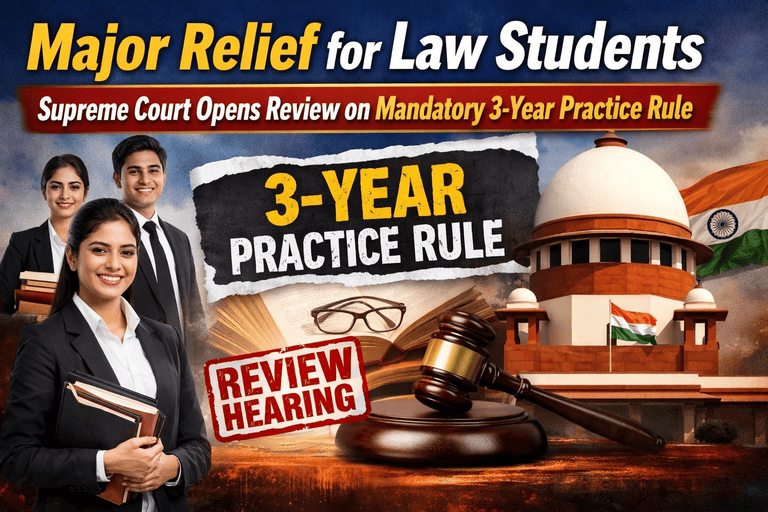
New Delhi | February 18, 2026
LENTIS LEGALIS BREAKING
The Supreme Court of India has allowed applications seeking permission to file Review Petition(s) in a long-pending matter arising out of Writ Petition (C) No. 1022 of 1989. Importantly, applications requesting that the Review Petition be listed in open court with oral hearing have also been allowed, recognizing the significance of the issues involved. The review petition has been filed by Advocate Chandrasen Yadav, through Advocate-on-Record Kunal Yadav.
The order was passed by a Bench comprising The Chief Justice of India, Justice Augustine George Masih, and Justice K. Vinod Chandran.
The Court has issued notice to the respondents, returnable on 26 February 2026, directing them to respond to the Review Petition. The Review Petition has also been tagged with Writ Petition (C) No. 1110 of 2025 (Diary No. 52914 of 2025 – Bhumika Trust) to ensure comprehensive and consistent adjudication of connected issues.
In the Writ Petition (C) No. 1110 of 2025 (Diary No. 52914 of 2025 – Bhumika Trust vs. Union of India), the Supreme Court of India has already invited suggestions from law universities across the country on the issue of mandatory three-year legal practice as a prerequisite for entry into judicial service. With the Review Petitions now permitted and ordered to be heard in open court, the forthcoming hearing will address the wider constitutional, institutional, and practical issues raised both in the Review Petitions and in the writ petition filed by Bhumika Trust, enabling a comprehensive reconsideration of the policy’s impact on law students, judicial recruitment, and access to justice.
The Review Petition assails the Supreme Court’s judgment dated 20 May 2025 in Writ Petition (C) No. 1022 of 1989, challenging the direction mandating three years’ minimum practice at the Bar for entry into the Civil Judge (Junior Division) cadre. The petitioner, Chandrasen Yadav argues that the decision is unsupported by empirical data, impact studies, or objective evaluation, and rests largely on subjective opinions of certain High Courts while ignoring dissenting views of several States and High Courts. It is contended that no credible evidence establishes that fresh law graduates perform poorly as judges or that prior advocacy experience necessarily enhances judicial competence, particularly when rigorous competitive examinations and structured judicial training exist. The petition further highlights that the judgment selectively overlooks key recommendations of the Justice Shetty Commission, earlier binding precedent in All India Judges Association (1993), and the role of institutional training as an alternative to mandatory practice. The uniform, nationwide imposition of the rule is alleged to be arbitrary, exclusionary, and disproportionate, adversely impacting economically weaker sections, SC/ST/OBC candidates, recent graduates, and those working in law firms, PSUs, or corporate roles. It is also argued that the absence of a transitional mechanism, the impractical certificate requirement, and the coercive nature of forcing graduates into litigation practice infringe Articles 14 and 19(1)(g) of the Constitution. The petitioner asserts that by effectively prescribing eligibility norms without legislative backing or inclusive consultation, the ruling raises serious constitutional concerns regarding arbitrariness, equal opportunity, and access to judicial service, warranting reconsideration by the Supreme Court of India.
The matter is now scheduled for further proceedings upon return of notice on 26.02.2026.
Crime And Justice
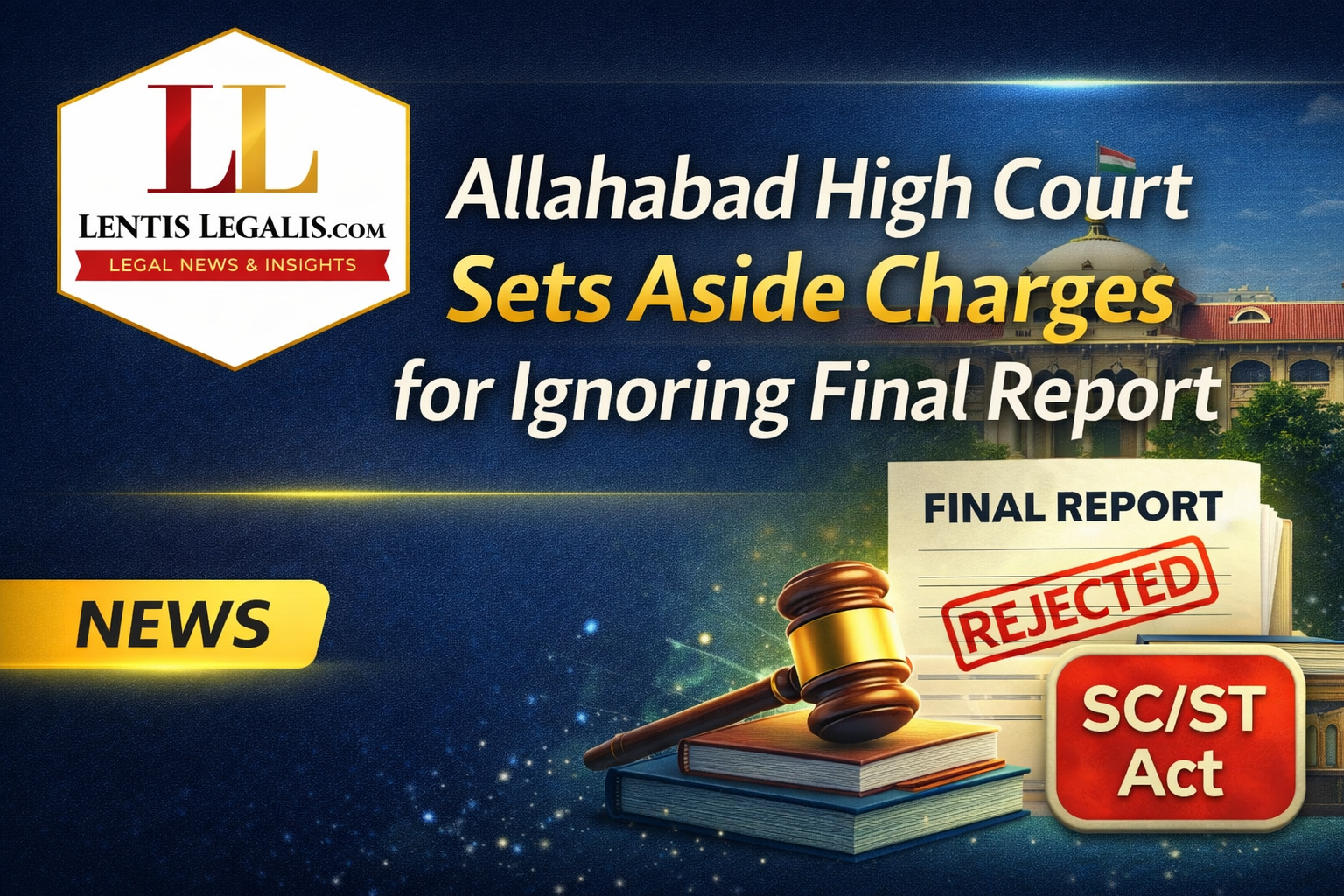
Allahabad High Court Sets Aside Charges for Ignoring Subsequent Closure Report Filed After Cognizance
LENTIS LEGALIS
ALLAHABAD| 14.02.2026
The Allahabad High Court has allowed a criminal appeal and set aside multiple orders passed by the Special Judge (SC/ST Act), Kannauj, holding that a trial court cannot ignore a Final Report (closure report) filed after further investigation merely because cognizance had already been taken on an earlier charge sheet.
The present criminal appeal under Section 14-A(1) Scheduled Castes & Scheduled Tribes (Prevention of Atrocities) Act has been preferred to allow this present appeal and set aside the impugned order dated 21.08.2024, 27.06.2024 and 10.05.2024 and all other consequential orders also passed by Special Judge SC/ST Act, District-Kannauj in S.C. No.1374/2023 (State Vs. Sonu @ Bhagwan Bhakt and others) arising out of Case Crime No.627/2023 U/s 147, 452, 323, 504, 506 I.P.C. and 3 (1)(d) SC/St Act, Police Station Kotwali Kannauj District-Kannauj. The Investigating Officer initially filed a charge sheet on 15.09.2023, on which cognizance was taken on 21.12.2023.
As the investigation was still under progress, supplementary report under Section 173(2) Cr.P.C. was submitted by I.O. on 31.3.2024 by concluding that allegations against the appellants were found false. It can be said that a final report was submitted by I.O. subsequent to the order of taking cognizance upon the charge sheet on 21.12.2023
During further investigation under Section 173(8) Cr.P.C., the I.O. submitted a Final Report/Closure Report on 31.03.2024, concluding that the allegations were false. Despite this, the trial court proceeded to frame charges on 07.08.2025 without passing any order on the Final Report.
The central question before the High Court was:
What is the duty of a Magistrate when, after taking cognizance on a charge sheet, a subsequent Final Report (negative report) is filed following further investigation?
The High Court held that A supplementary report, including a Final Report, is an integral part of the primary police report under Section 173 Cr.P.C. A Magistrate is duty-bound to consider every subsequent report filed during investigation, even after cognizance has been taken. Ignoring a Final Report and proceeding to frame charges amounts to a procedural illegality. Passing a fresh order on a Final Report does not amount to a review barred under Section 362 Cr.P.C., as cognizance does not finally dispose of the case.
The Court relied on landmark judgments including:
- Vinay Tyagi v. Irshad Ali (2013) – holding that primary and supplementary reports must be read conjointly.
- Ram Lal Narang v. State (Delhi Administration) – recognising the necessity of further investigation even after cognizance.
- Dharmatma Singh v. Harminder Singh – reiterating the Magistrate’s duty to independently assess conflicting police reports.
- Mariam Fasihuddin v. State (2024) – emphasising that courts must apply judicial mind to every valid supplementary report.
The impugned orders dated 21.08.2024, 27.06.2024 and 10.05.2024, including the order framing charges on 07.08.2025, were set aside. The trial court has been directed to first decide the Final Report after considering it along with the initial charge sheet. Charges may be framed only if a conjoint reading of both reports discloses a prima facie case.
See Here to read full Judgement
High Court Updates
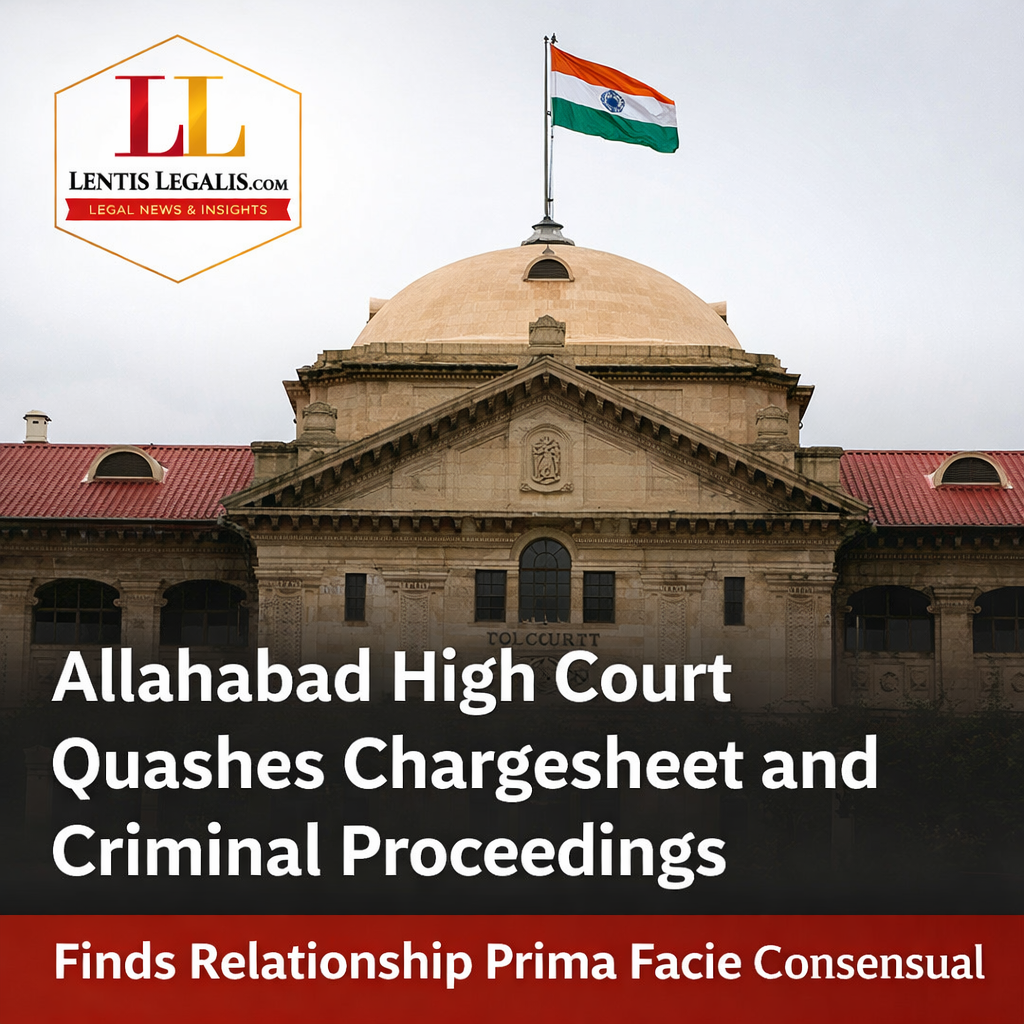
Allahabad High Court Quashes Chargesheet and other Proceedings, Holds Relationship Prima Facie Consensual
LENTIS LEGALIS
Prayagraj | 16 February 2026
The Allahabad High Court has quashed the criminal proceedings, including charges under Section 376(2)(n) IPC and Section 67 of the Information Technology Act, in a case alleging repeated sexual assault and blackmail, holding that the material on record did not disclose a prima facie case warranting trial.
Justice Avnish Saxena allowed an application under Section 528 of the Bharatiya Nagarik Suraksha Sanhita (BNSS) filed by the accused persons, setting aside the charge-sheet dated 12.02.2025, the cognizance order dated 28.02.2025, and all consequential proceedings arising out of Case Crime No. 883 of 2024, Police Station Izzatnagar, District Bareilly.
The FIR, lodged on 01.12.2024 by the complainant, a married woman, alleged that she was repeatedly raped by the first accused between August 2022 and November 2023 on the pretext of guidance for the Provincial Civil Services examination. It was further alleged that obscene videos were recorded and later used for blackmail, with the second accused allegedly circulating the videos to the complainant’s family members.
Applicants submit that the FIR is grossly delayed. The informant is a married lady having two children, who has some oblique motive to fulfil. The record shows that the victim herself has sent friend request to the sister of accused through facebook, came closer to her and thereafter made distance and came closer to accused applicant.
After examining the FIR, statements under Sections 180 and 183 BNSS, and material collected during investigation, the Court noted multiple inconsistencies and improbabilities in the prosecution story. The Court observed that:
- The complainant was a married, educated woman with children and allegedly maintained prolonged physical relations over several years without reporting the matter.
- The alleged blackmail was based on videos which the complainant admitted she had never seen.
- There was no recoverable electronic evidence to substantiate claims of circulation of obscene material.
- Statements of the complainant’s husband and father did not conclusively support the allegation of transmission of videos.
- WhatsApp chats placed on record indicated intimate communication beyond mere academic guidance.
Relying on recent Supreme Court precedents, the Court held that prolonged and repeated physical relations, in the absence of compelling evidence of coercion or threat, cannot be presumed to be non-consensual.
The Court concluded that continuation of the criminal proceedings would amount to an abuse of the process of law. Consequently, all proceedings against both accused persons were quashed.
read judgement below


Major Relief for Law Students as Supreme Court Opens Review on Mandatory 3-Year Practice Rule

Allahabad High Court Sets Aside Charges for Ignoring Subsequent Closure Report Filed After Cognizance

Allahabad High Court Quashes Chargesheet and other Proceedings, Holds Relationship Prima Facie Consensual

Supreme Court to Hear Review Petition on 10 February 2026 Challenging Mandatory Three-Year Practice Requirement for Entry-Level Judicial Services

Supreme Court Mandates Free Sanitary Pads, Functional Toilets and Menstrual Hygiene Infrastructure in All Schools
Major Relief for Law Students as Supreme Court Opens Review on Mandatory 3-Year Practice Rule
-
 Supreme Court Highlights3 weeks ago
Supreme Court to Hear Review Petition on 10 February 2026 Challenging Mandatory Three-Year Practice Requirement for Entry-Level Judicial Services
-
 Landmark judgements4 weeks ago
Supreme Court Mandates Free Sanitary Pads, Functional Toilets and Menstrual Hygiene Infrastructure in All Schools
-
 Landmark judgements1 week ago
Major Relief for Law Students as Supreme Court Opens Review on Mandatory 3-Year Practice Rule
-
 High Court Updates1 month ago
Accessing Wife’s Private Photos Without Consent and Humiliating Her Before Family Amounts to Mental Cruelty
-

 High Court Updates3 weeks ago
Surge in Police Encounters in UP: Allahabad High Court Seeks Compliance with PUCL Guidelines
-

 Crime And Justice3 weeks ago
Pre-Trial Detention, Human Rights, and the rejection of Bail of Umar Khalid and Sharjeel Imam.
-
 Supreme Court Highlights4 weeks ago
Supreme Court Keeps UGC Equity Regulations, 2026 in Abeyance; Raises Concerns Over Ambiguity and Possible Misuse
-
 High Court Updates1 month ago
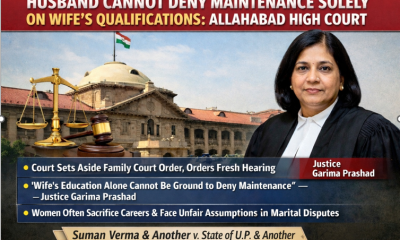
Husband Cannot Deny Maintenance Solely on Wife’s Educational Qualifications