
Crime And Justice
Case Review of the Landmark Judgement : Imran Pratapgadhi v. State of Gujarat 2025 INSC 410


Lentis Legalis| 04.03.2026
Chandrasen Yadav
The appellant in the present matter, Imran Pratapgadhi who was a Member of the Rajya Sabha. The 2nd respondent Kishan Bhai Dipak Bhai Nanda was the first informant at whose instance a First Information Report (for short, ‘FIR’) was registered with Jamnagar Police Station for the offences punishable under Sections 196, 197(1), 302, 299, 57 and 3(5) of the Bharatiya Nyaya Sanhita, 2023 (for short, ‘the BNS’).
| Offence | Section No. of BNS |
| Promoting enmity between different groups on ground of religion, race, place of birth, residence, language, etc , and doing acts prejudicial to maintenance of harmony. | 196 |
| Imputations, assertions prejudicial to national integration | 197(1) |
| Uttering words, etc., with deliberate intent to wound religious feelings of any person. | 302 |
| Deliberate and malicious acts, intended to outrage religious feelings of any class by insulting its religion or religious beliefs. | 299 |
| Abetting commission of offence by the public or by more than ten persons. | 57 |
| Rule of evidence for Constructive liability in case of act done in furtherance of any Common intention | 3(5) |
In the complaint of the 2nd respondent, he stated that on 29th December 2024, on the occasion of the birthday of one Altaf Ghafarbhai Khafi, a member of the Municipal Corporation of Jamnagar, a mass wedding program was held at Sanjari Education and Charitable Trust. The said Municipal Councillor invited the present appellant to the function. A video of the event was made. The appellant posted the video on the social media platform ‘X’ from his verified account. The video has the recitation of a poem reproduced hereinbelow-
“ए खून (blood) के प्यासो (thirsty) बात सुनो ग ़र हक्क़ (truth) की लडाई जुल्म (excesses/injustice) सही
हम जुल्म (excesses/injustice) से इश्क़ (love) ननभा देंगे गर शम- ए- नगररया (melting of a candle which resembles tears) आनतश (flame) है
हर राह वो शम्मा (light) जला देंगे गर लाश हमारे अपनोोंकी खतरा है तुम्हारी मसनद (throne) का
उस रब (god) की ़सम हस्ते हस्ते नकतनी लाशे दफ़ना देंगे ए खूनके प्यासोों बात सुनो”
The allegation in the complaint is that the spoken words of the poem incite people of one community against another, and it hurts a community’s religious and social sentiments. It is alleged that the song had lyrics that incited people of other communities to fight for the community’s rights. It is alleged that the video posted by the appellant created enmity between two communities at the national level and hatred towards each other. It was further alleged that it had a detrimental effect on national unity.
The appellant before coming to the Supreme Court had filed a petition under Section 528 of the Bharatiya Nagarik Suraksha Sanhita (for short, ‘the BNSS’) read with Article 226 of the Constitution of India, praying for quashing the said FIR in the High Court. While issuing notice on the said petition, the learned Judge had directed the appellant to file an affidavit disclosing the poem’s source. Accordingly, an affidavit was filed by the appellant but could not disclose the specific origin of the source.
The learned Single Judge of the High Court by impugned judgment and order, rejected the petition by holding that as the investigation is at a very nascent stage, interference cannot be made in view of the judgement of the Hon’ble Supreme Court in the case of Neeharika Infrastructure Pvt. Ltd. v State of Maharashtra 2021 SCC Online SC 315.
Appellant in support of the appeal had taken following grounds-
- That none of the ingredients of the offences alleged against the appellant are made out on the plain reading of the complaint and the poem.
- It cannot be said that the poem caused social disharmony amongst the people.
- the poem does not promote disharmony or feelings of enmity, hatred or ill-will between the various religious, racial, language or regional groups and castes or communities.
- The plain reading of the poem indicated that it was all about sacrificing oneself to fight for rights and truth.
- That registration of the FIR based on the said poem violates the appellant’s fundamental right guaranteed under Article 19(1)(a) of the Constitution.
Supreme Court highlighting the role of dissent mentioned that Free expression of thoughts and views by individuals or groups of individuals is an integral part of a healthy, civilised society. Without freedom of expression of thoughts and views, it is impossible to lead a dignified life guaranteed by Article 21 of the Constitution. In a healthy democracy, the views, opinions or thoughts expressed by an individual or group of individuals must be countered by expressing another point of view. Even if a large number of persons dislike the views expressed by another, the right of the person to express the views must be respected and protected.
Supreme Court in the Judgement mounted a standard that The Courts are duty-bound to uphold and enforce fundamental rights guaranteed under the Constitution of India. Sometimes, we, the Judges, may not like spoken or written words. But, still, it is our duty to uphold the fundamental right under Article 19 (1)(a). We Judges are also under an obligation to uphold the Constitution and respect its ideals. If the police or executive fail to honour and protect the fundamental rights guaranteed under Article 19 (1)(a) of the Constitution, it is the duty of the Courts to step in and protect the fundamental rights. There is no other institution which can uphold the fundamental rights of the citizens.
Supreme court not only set aside the impugned order of the High Court but also quashed the FIR which was registered against the Imran Pratapgaradhi.
Read full Judgement:
https://api.sci.gov.in/supremecourt/2025/3511/3511_2025_4_1501_60508_Judgement_28-Mar-2025.pdf





This appeal was at the instance of the State of Madhya Pradesh and was directed against the judgment and order dated 29.06.2010 passed by the High Court of Madhya Pradesh of judicature at Gwalior in Criminal Appeal No. 524 of 2004 whereby the High Court allowed the appeal filed by the respondent herein and acquitted him of the offence under Section(s) 302, 201 and 34 respectively of the Indian Penal Code, 1860 (for short, the ‘IPC’).
The deceased, namely, Birendra Kumari was married to the respondent accused. In the wedlock, two sons and a daughter named Rani were born. Rani at the time of the incident in 2003, was seven years of age.
On 15.07.2003 sometime during the midnight, Bhoora Singh @ Yashpal i.e., the complainant along with his father Bharat Singh; reported an incident of unnatural death to the Indar Police Station at around 9:00 AM . In the said report, the Complainants stated that on the fateful night of the incident, at around 12:00 AM, they heard the cries and screams of the deceased which eventually ceased. Shortly, thereafter they saw the accused along with his family members cremating the deceased in their field. It was further stated that when they went to the house of the accused to inquire about the incident, the daughter of the deceased (Rani) informed that her mother had died.
Upon enquiry done by ASI Mahendra Singh Chauhan an FIR was lodged bearing no. 142 of 2003 dated 20.07.2003 came to be registered against the respondent and her sister, Jatan Bai for the offence punishable under Section(s) 302, 201 read with 34 respectively of the IPC.
Trial Court vide its final judgment and order dated 09.08.2004 passed in Sessions Trial No. 197 of 2003 held the respondent accused guilty of the said offences of IPC.
The accused convict being dissatisfied with the judgment and order passed by the Trial Court, went in appeal before the High Court by way of Criminal Appeal No. 524 of 2004. The High Court vide its final judgment and order dated 29.06.2010 allowed the appeal and acquitted the respondent accused.
The High Court holding the oral evidence of the daughter, who was just 7 years old at the time of incidence being unreliable and some other reasons to extended the benefit of doubt to the accused.
The Supreme Court of India, in the present matter, examined the law relating to the evidentiary value of a child witness and the tests for identifying tutored testimony. The Court held that the evidence of a child witness stands on the same footing as that of any other witness, subject to certain well-recognised safeguards and caution. Accordingly, the appeal was allowed, the impugned judgment and order of acquittal passed by the High Court were set aside, and the judgment and order of conviction passed by the Trial Court in S.T. No. 197 of 2003 were restored.
Author
Chandrasen Yadav
B.Sc, LL.B& LL.M
Crime And Justice
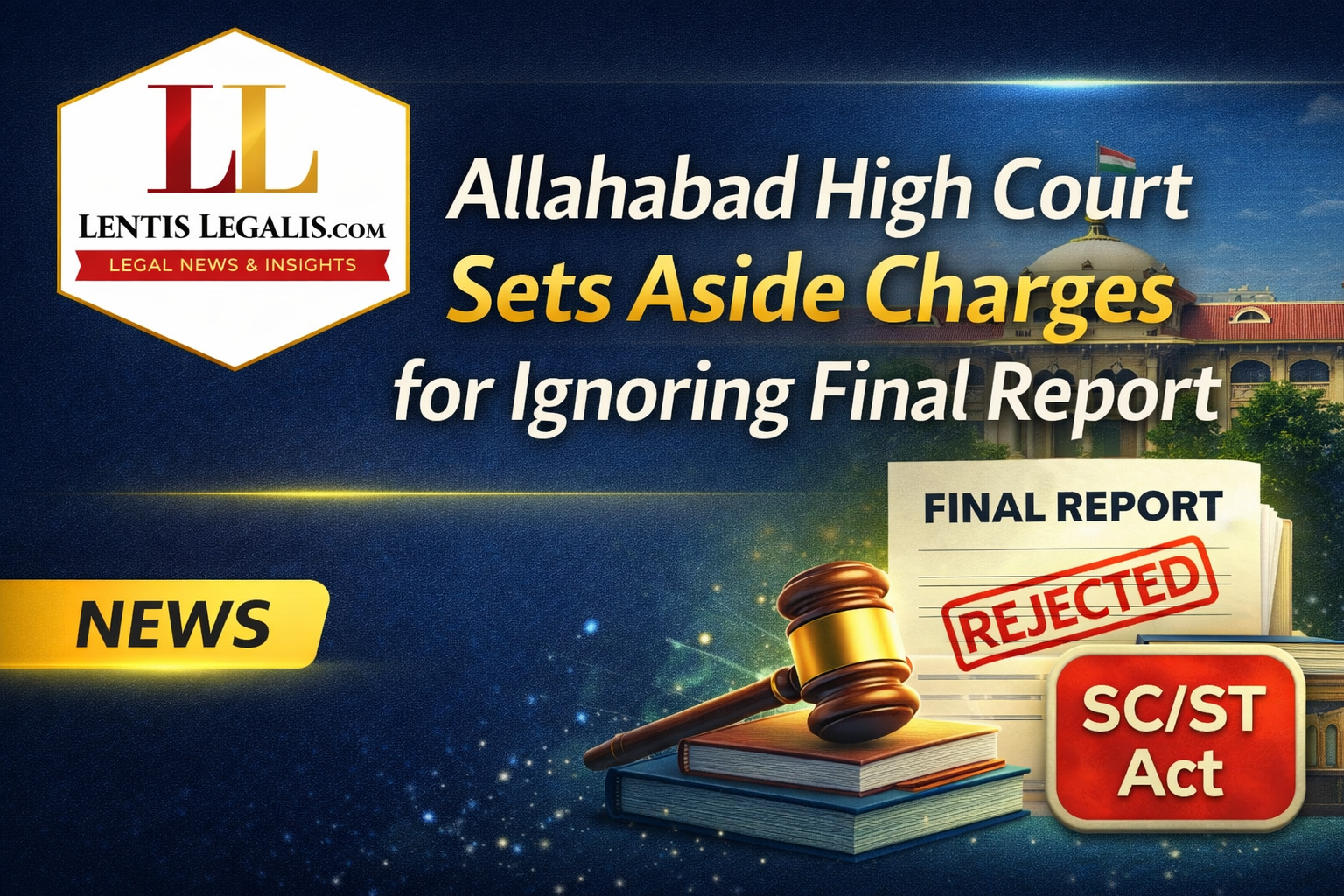
Allahabad High Court Sets Aside Charges for Ignoring Subsequent Closure Report Filed After Cognizance
LENTIS LEGALIS
ALLAHABAD| 14.02.2026
The Allahabad High Court has allowed a criminal appeal and set aside multiple orders passed by the Special Judge (SC/ST Act), Kannauj, holding that a trial court cannot ignore a Final Report (closure report) filed after further investigation merely because cognizance had already been taken on an earlier charge sheet.
The present criminal appeal under Section 14-A(1) Scheduled Castes & Scheduled Tribes (Prevention of Atrocities) Act has been preferred to allow this present appeal and set aside the impugned order dated 21.08.2024, 27.06.2024 and 10.05.2024 and all other consequential orders also passed by Special Judge SC/ST Act, District-Kannauj in S.C. No.1374/2023 (State Vs. Sonu @ Bhagwan Bhakt and others) arising out of Case Crime No.627/2023 U/s 147, 452, 323, 504, 506 I.P.C. and 3 (1)(d) SC/St Act, Police Station Kotwali Kannauj District-Kannauj. The Investigating Officer initially filed a charge sheet on 15.09.2023, on which cognizance was taken on 21.12.2023.
As the investigation was still under progress, supplementary report under Section 173(2) Cr.P.C. was submitted by I.O. on 31.3.2024 by concluding that allegations against the appellants were found false. It can be said that a final report was submitted by I.O. subsequent to the order of taking cognizance upon the charge sheet on 21.12.2023
During further investigation under Section 173(8) Cr.P.C., the I.O. submitted a Final Report/Closure Report on 31.03.2024, concluding that the allegations were false. Despite this, the trial court proceeded to frame charges on 07.08.2025 without passing any order on the Final Report.
The central question before the High Court was:
What is the duty of a Magistrate when, after taking cognizance on a charge sheet, a subsequent Final Report (negative report) is filed following further investigation?
The High Court held that A supplementary report, including a Final Report, is an integral part of the primary police report under Section 173 Cr.P.C. A Magistrate is duty-bound to consider every subsequent report filed during investigation, even after cognizance has been taken. Ignoring a Final Report and proceeding to frame charges amounts to a procedural illegality. Passing a fresh order on a Final Report does not amount to a review barred under Section 362 Cr.P.C., as cognizance does not finally dispose of the case.
The Court relied on landmark judgments including:
- Vinay Tyagi v. Irshad Ali (2013) – holding that primary and supplementary reports must be read conjointly.
- Ram Lal Narang v. State (Delhi Administration) – recognising the necessity of further investigation even after cognizance.
- Dharmatma Singh v. Harminder Singh – reiterating the Magistrate’s duty to independently assess conflicting police reports.
- Mariam Fasihuddin v. State (2024) – emphasising that courts must apply judicial mind to every valid supplementary report.
The impugned orders dated 21.08.2024, 27.06.2024 and 10.05.2024, including the order framing charges on 07.08.2025, were set aside. The trial court has been directed to first decide the Final Report after considering it along with the initial charge sheet. Charges may be framed only if a conjoint reading of both reports discloses a prima facie case.
See Here to read full Judgement
Crime And Justice
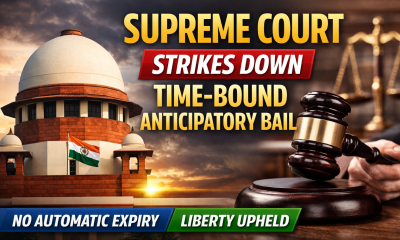
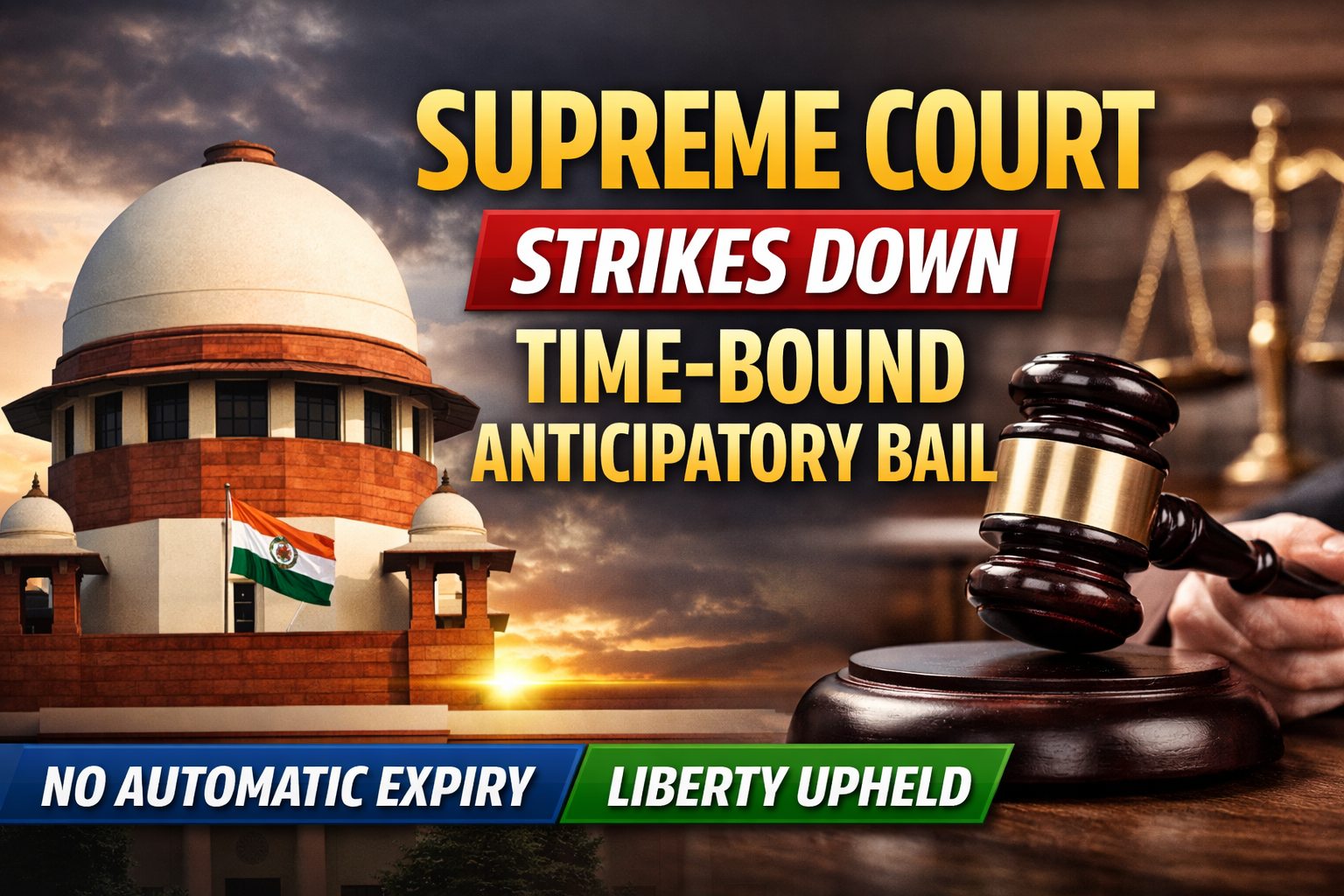
Supreme Court Sets Aside Time-Bound Anticipatory Bail: Reaffirms That Protection Cannot Expire Automatically on Filing of Charge Sheet
Lentis Legalis
New Delhi | 9 February 2026
In a significant ruling clarifying the law on anticipatory bail, the Supreme Court of India held that once anticipatory bail is granted, it ordinarily cannot be restricted till the filing of the charge sheet, unless exceptional circumstances are recorded. The Court set aside an order of the High Court of Allahabad which had denied continued protection to an accused after completion of investigation.
The judgment was delivered by a Division Bench comprising Justice J.B. Pardiwala and Justice K.V. Viswanathan in Criminal Appeal arising out of SLP (Crl.) No. 1536 of 2026, titled Sumit v. State of Uttar Pradesh & Anr.
The appellant, Sumit, is the brother-in-law (devar) of a deceased woman who had been married to the appellant’s brother for about seven months prior to her death.
- The deceased died under mysterious circumstances at her matrimonial home.
- An FIR bearing No. 560/2024 was registered at Akbarpur Police Station, Kanpur Dehat, under:
- Sections 80(2) / 85 of the Bharatiya Nyaya Sanhita (BNS)
- Sections 3 & 4 of the Dowry Prohibition Act, 1961
- The FIR was lodged by the mother of the deceased, alleging dowry-related harassment and death.
Apprehending arrest, the appellant initially approached the Allahabad High Court seeking anticipatory bail.
Proceedings Before the High Court
First Anticipatory Bail Order
In Criminal Misc. Anticipatory Bail Application No. 3992/2025, the High Court granted anticipatory bail to the appellant. However, the relief was restricted only till the filing of the police charge sheet.
The High Court:
- Accepted that there were no specific allegations against the appellant.
- Noted that he was implicated largely due to his relationship as a brother-in-law.
- Observed that he had no criminal antecedents.
- Still imposed a time-bound limitation, terminating protection once the investigation concluded.
Second Anticipatory Bail Application
After the charge sheet was filed, the appellant again sought anticipatory bail. This time, the High Court rejected the application without identifying any new aggravating circumstance or change in the factual matrix.
This rejection led to the present appeal before the Supreme Court.
Issues Before the Supreme Court
- Whether anticipatory bail can be restricted till the filing of the charge sheet as a matter of routine?
- Whether filing of a charge sheet automatically extinguishes the protection of anticipatory bail?
- Whether the High Court was justified in rejecting the second anticipatory bail application without recording special reasons?
Supreme Court’s Analysis and Discussion
The Supreme Court expressed strong disapproval of the practice of granting time-bound anticipatory bail orders.
No Rationale for Automatic Expiry
The Bench observed:
- Once a court, after considering the nature of allegations, role of the accused, and overall facts, exercises discretion in favour of the accused, there must be strong and special reasons to subsequently deny protection.
- Merely because the charge sheet is filed, the anticipatory bail does not automatically lapse.
The Court questioned the logic behind such restrictions, noting:
“Either the Court grants anticipatory bail or declines it. Having granted it after due consideration, there was no justification to limit it till the filing of the charge sheet.”
Reliance on Constitution Bench Precedent
The Bench reaffirmed the law laid down in Sushila Aggarwal v. State (NCT of Delhi), holding that:
- Anticipatory bail need not have a fixed expiry period.
- Duration of bail is a matter of judicial discretion, not procedural milestones.
- Arbitrary timelines undermine personal liberty.
The Court also relied upon Siddharam Satlingappa Mhetre v. State of Maharashtra (2011) 1 SCC 694, reiterating that:
- Anticipatory bail should not hinge upon investigation stages like filing of charge sheet or taking cognizance.
Conditions, Not Time Limits, Are the Safeguard
Addressing concerns of misuse, the Court clarified that:
- Risks can be mitigated through conditions of cooperation, attendance, and non-tampering of evidence.
- If circumstances change, the prosecution is always at liberty to seek cancellation or modification of bail under law.
- However, expiry clauses at inception are legally unsustainable.
Clarification on Addition of Graver Offences
Before concluding, the Court addressed an important legal scenario:
What happens if new, serious non-bailable offences are added after bail is granted?
Relying on Pradeep Ram v. State of Jharkhand (2019) and Prahlad Singh Bhati v. NCT of Delhi (2001), the Court held:
- Addition of graver cognizable and non-bailable offences may disentitle the accused from earlier bail.
- In such cases:
- Courts must apply their mind afresh.
- Investigating agencies may seek custody through appropriate judicial orders.
- Arrest cannot be mechanical and must follow judicial authorization.
Allowing the appeal, the Supreme Court:
- Set aside the impugned order of the Allahabad High Court rejecting anticipatory bail.
- Directed that In the event of arrest, the appellant shall be released on anticipatory bail, subject to conditions imposed by the Investigating Officer. The appellant shall thereafter appear before the Trial Court and furnish fresh bail bonds. Directed the Registry to forward a copy of the judgment to the Registrar General of the Allahabad High Court for placement before the Hon’ble Chief Justice.
Click Below to read the Judgment
https://api.sci.gov.in/supremecourt/2026/3119/3119_2026_5_32_68496_Judgement_09-Feb-2026.pdf
Section 26 of the Bharatiya Nyaya Sanhita, 2023: Act not intended to cause death, done by consent in good faith for person’s benefit.
Section 25 of the Bharatiya Nyaya Sanhita, 2023: Act not intended and not known to be likely to cause death or grievous hurt, done by consent.
Section 24 of the Bharatiya Nyaya Sanhita, 2023: Offence requiring a particular intent or knowledge committed by one who is intoxicated.

Supreme Court to Hear Review Petition on 10 February 2026 Challenging Mandatory Three-Year Practice Requirement for Entry-Level Judicial Services

Supreme Court Mandates Free Sanitary Pads, Functional Toilets and Menstrual Hygiene Infrastructure in All Schools

Major Relief for Law Students as Supreme Court Opens Review on Mandatory 3-Year Practice Rule
-
 Supreme Court Highlights1 month ago
Supreme Court to Hear Review Petition on 10 February 2026 Challenging Mandatory Three-Year Practice Requirement for Entry-Level Judicial Services
-
 Landmark judgements1 month ago
Supreme Court Mandates Free Sanitary Pads, Functional Toilets and Menstrual Hygiene Infrastructure in All Schools
-
 Landmark judgements3 weeks ago
Major Relief for Law Students as Supreme Court Opens Review on Mandatory 3-Year Practice Rule
-
 High Court Updates1 month ago
Accessing Wife’s Private Photos Without Consent and Humiliating Her Before Family Amounts to Mental Cruelty
-

 High Court Updates1 month ago
Surge in Police Encounters in UP: Allahabad High Court Seeks Compliance with PUCL Guidelines
-

 Crime And Justice1 month ago
Pre-Trial Detention, Human Rights, and the rejection of Bail of Umar Khalid and Sharjeel Imam.
-
 Supreme Court Highlights1 month ago
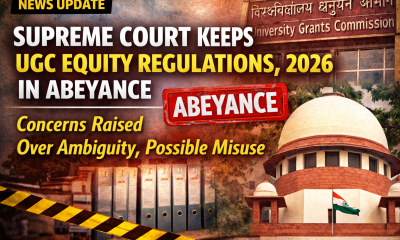
Supreme Court Keeps UGC Equity Regulations, 2026 in Abeyance; Raises Concerns Over Ambiguity and Possible Misuse
-
 High Court Updates2 months ago
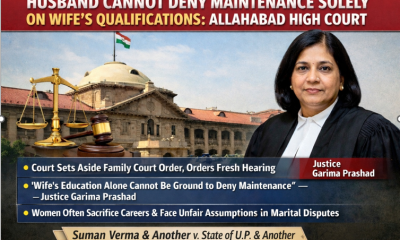
Husband Cannot Deny Maintenance Solely on Wife’s Educational Qualifications